View Charts

Why Do Silver Prices React to Industrial Production Data?
 0
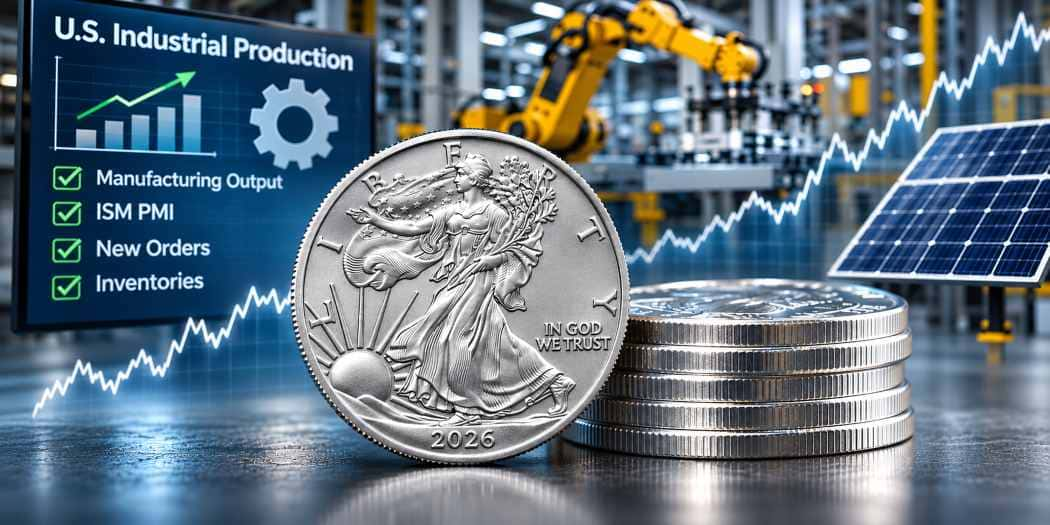
The Manufacturing Signal Behind Silver's Price Movements
A stronger manufacturing report should be encouraging for silver, a metal used extensively in electronics, solar technology, automobiles, and electrical infrastructure. Yet silver prices sometimes fall following positive industrial data, revealing a complicated relationship between factory output, physical demand, and financial-market expectations.
The latest figures illustrate the challenge. According to the Federal Reserve's September 2026 industrial production report, total U.S. industrial output increased 0.7%, while manufacturing production rose just 0.3%. Utilities increased 3.5%, contributing to a stronger headline despite more modest factory growth. Manufacturing influences expectations for physical silver consumption, but the same economic data can also change interest-rate forecasts, Treasury yields, and the dollar. Those forces do not always point in the same direction.
Why Industrial Production Matters to Silver Demand
Industrial production measures changes in output across manufacturing, mining, and utilities. Investors monitor the Federal Reserve's monthly figures for evidence that economic activity is accelerating or slowing, particularly in industries dependent on capital investment and consumer spending.
Silver's electrical conductivity supports applications in electronic components, photovoltaic cells, automotive systems, and industrial equipment. Expanding production in these sectors can increase demand for silver-containing materials, especially when manufacturers are building inventories or responding to stronger orders. However, industrial growth is uneven. A rise in electricity generation contributes to the headline production index without necessarily indicating increased fabrication of silver-containing components. Stronger food processing or textile output likewise carries different implications from expanding electronics manufacturing.
The composition of production therefore matters as much as the overall growth rate. Investors should examine manufacturing separately from mining and utilities, then identify which industries are driving changes. Market expectations add another complication: a modest increase can support silver if traders anticipated contraction, whereas seemingly strong production may disappoint when forecasts were higher. Prices often reflect the surprise relative to expectations rather than the reported number alone.
Solar Manufacturing Exposes a Weakness in the Relationship
Perhaps the clearest evidence that industrial expansion does not guarantee greater silver consumption comes from photovoltaic manufacturing. Solar cells use silver-containing conductive materials to collect and transfer electricity, making the industry an important source of demand. Yet manufacturers have increasingly focused on reducing silver consumption per cell.
The Silver Institute's World Silver Survey 2026 reported that global industrial silver demand declined 3% in 2025 to 657.4 million troy ounces. Electrical and electronics demand fell 2%, despite support from artificial intelligence infrastructure, automotive applications, and power-grid investment. Much of the weakness came from photovoltaics, where manufacturers accelerated efforts to reduce silver usage and substitute alternative materials.
This creates a distinction between production volume and metal intensity. A manufacturer increasing output by 10% while reducing silver consumption per unit by 15% would require less silver overall. The Silver Institute expects industrial demand to decline another 3% in 2026, with photovoltaic consumption remaining under pressure. Similar efficiency improvements in electronics and automotive manufacturing can weaken the relationship between expanding output and raw-material consumption. These changes are explored further in our analysis of how rising silver prices affect demand across major sectors.
Why Global Manufacturing Trends Matter
U.S. industrial production provides important economic signals, but silver demand is global. Manufacturing conditions in China and other major Asian economies are particularly relevant because of their extensive electronics, photovoltaic, and industrial supply chains.
Purchasing Managers' Index surveys offer another perspective by tracking production, new orders, inventories, employment, and supplier deliveries. A manufacturing PMI above 50 generally indicates expansion from the previous month, while a reading below 50 indicates contraction. New orders are especially useful because they help establish whether current production growth is likely to continue. A factory might increase output while completing an existing backlog even as incoming orders weaken, making that expansion potentially temporary.
In the United States, the ISM Manufacturing PMI provides timely information about factory conditions, including new orders and production. Unlike the Federal Reserve's industrial production index, which measures actual output, the ISM survey captures changes in business activity reported by purchasing managers. Comparing the two helps investors distinguish survey-based indications of improving conditions from measurable production growth.
Inventories further complicate the picture. Manufacturers can meet increased orders using previously purchased materials, delaying additional silver demand. Conversely, businesses anticipating stronger sales may rebuild inventories before production accelerates. Manufacturing PMIs and industrial production reports should therefore be interpreted alongside sector-specific activity and physical consumption estimates rather than treated as direct measurements of silver purchases.
Why Strong Factory Data Can Push Silver Prices Lower
Industrial demand explains only part of silver's response to economic releases. The metal also trades as a financial asset, making it sensitive to monetary policy, currency movements, and investor positioning.
Stronger manufacturing figures can encourage expectations that the Federal Reserve will maintain higher interest rates for longer. If those expectations lift Treasury yields and strengthen the dollar, precious metals may face selling pressure. Higher yields increase the relative appeal of interest-bearing assets, while a stronger dollar can make silver more expensive for international buyers. The market may therefore interpret positive manufacturing data as encouraging for industrial consumption but unfavorable for precious-metal investment demand.
This dual exposure helps explain why silver sometimes reacts differently from gold. Gold demand is more heavily influenced by investment, central-bank purchases, and monetary conditions, while silver has a larger industrial component. Strong manufacturing data may therefore support silver relative to gold, even when rising Treasury yields create pressure across precious metals. Our guide to silver's industrial demand versus monetary demand examines how these competing influences shape the market.
Weak manufacturing data can produce the opposite combination. Concerns about industrial consumption may intensify, but expectations for monetary easing could lower yields and weaken the dollar, supporting silver prices. Futures positioning can amplify either reaction. Unexpected economic releases may trigger short covering or rapid liquidation without an immediate corresponding change in physical silver purchases.
Comparing live silver spot prices with movements in gold, Treasury yields, and the dollar can help clarify which forces are dominating. Silver moving alongside gold may indicate a broader precious-metals reaction, whereas unusual silver outperformance could warrant closer examination of industrial expectations or speculative positioning.
What the Next Industrial Production Report Could Reveal
The Federal Reserve's next industrial production report is scheduled for November 17, 2026, according to its official release calendar. It will provide another assessment of U.S. factory activity and an opportunity to evaluate whether September's manufacturing improvement has continued. Changes in electronics, electrical equipment, and transportation-related production may offer more useful context for silver than fluctuations in utilities or mining, particularly when considered alongside manufacturing surveys and new orders.
Beyond industrial production and PMI releases, investors should monitor employment reports, inflation data, and Federal Reserve decisions. These indicators can influence silver indirectly by changing expectations for interest rates and the dollar. The strongest industrial-demand signal comes when improving manufacturing activity is accompanied by sustained orders and higher consumption in silver-intensive industries.
Investors should also distinguish immediate market reactions from longer-term consumption trends. Futures prices can adjust within minutes of an unexpected release, while industrial purchasing follows production schedules, supply contracts, and inventory decisions. The broader supply-demand picture matters: the Silver Institute forecasts another annual silver market deficit in 2026 despite declining industrial fabrication.
Manufacturing reports will remain valuable indicators, but their meaning is changing as producers reduce the silver content of finished products. The critical question is whether industrial growth translates into greater physical silver requirements—and whether that influence outweighs the financial-market response to the same economic news.