View Charts

What Happens to Silver Demand When Prices Rise Sharply?
 0
Higher Prices Can Attract Buyers and Drive Others Away
A rising silver price sends different messages to different participants in the market. To a manufacturer, it represents a more expensive production input. To a jewelry customer, it may make a purchase less affordable. To a bullion investor, however, the same increase can strengthen the belief that silver is becoming more desirable.
These conflicting responses help explain why silver demand does not move uniformly with price. Higher prices can discourage consumption in one sector while attracting investment in another. The distinction has become particularly important as silver's industrial applications expand and manufacturers face pressure to control material costs.
The deeper question is how quickly each group can respond. Some buyers can reduce purchases almost immediately, while others must redesign products or fulfill existing contracts before using less metal. Understanding those differences reveals why a silver rally can continue even as certain categories of physical demand weaken.
Industrial Buyers Have More Than One Way to Respond
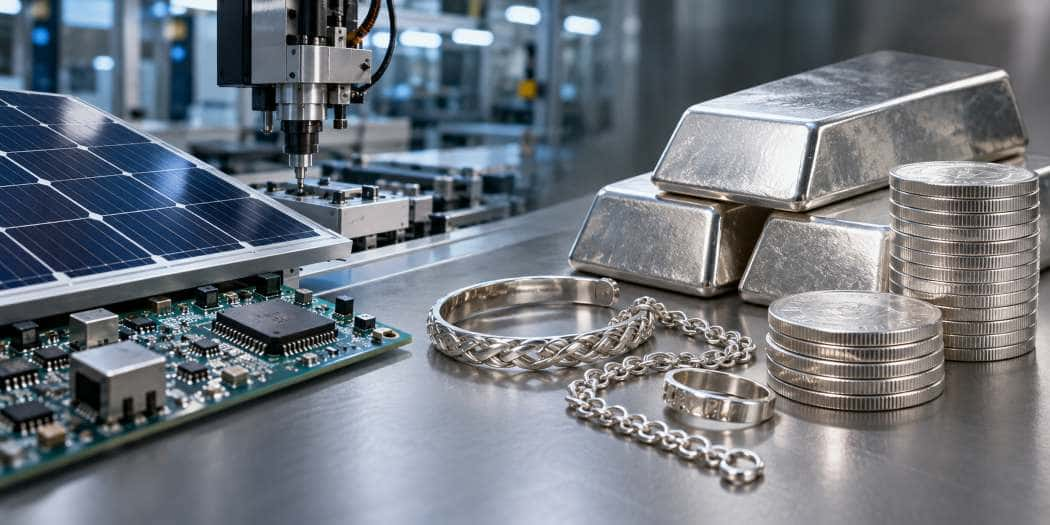
Manufacturers generally purchase silver because it performs a specific function, particularly in electrical contacts, conductive pastes, electronics and specialized industrial equipment. Its exceptional conductivity makes it valuable in applications where reliability and efficiency matter. A higher price increases costs, but replacing silver is not always technically straightforward.
Companies have several possible responses. They can absorb the increase, negotiate supply arrangements, pass costs to customers or reduce the quantity of silver used in each product. The last approach, known as thrifting, can lower silver consumption without reducing production volumes. A manufacturer producing more units may consequently purchase fewer ounces if each new unit contains substantially less silver.
Solar manufacturing illustrates this distinction. According to the World Silver Survey 2026, global industrial silver demand declined 3% to 657.4 million ounces in 2025. Reduced silver loadings and substitution in photovoltaic cells were important contributors, even as electrical infrastructure, automotive applications and advanced electronics provided support elsewhere.
This creates an important limitation when interpreting industrial growth forecasts. More solar installations, electric vehicles or electronic devices do not necessarily translate into proportionally higher silver consumption. Analysts must consider both the number of products manufactured and the quantity of silver required per product.
Substitution is more complicated than thrifting. Replacing silver with another material can require engineering changes, testing, new equipment and adjustments to manufacturing processes. Even when a substitute appears cheaper, performance requirements and conversion costs may delay adoption. Price pressure can accelerate that work, but the resulting reduction in silver demand may take years to become visible.
Jewelry and Silverware Buyers React More Directly
Silver jewelry and decorative silverware face a different calculation. Although craftsmanship, design and brand reputation contribute to their retail prices, the underlying metal cost remains significant. When silver becomes more expensive, consumers may postpone purchases, select lighter products or choose less costly alternatives.
Manufacturers can respond by reducing product weights, modifying designs or introducing different materials. Retailers may also accept smaller margins temporarily to preserve sales. These adjustments are particularly relevant in markets where silver jewelry and silverware are purchased for weddings, festivals, gifts or household use, because consumers often have considerable discretion over timing and expenditure.
The Silver Institute's 2026 market outlook projected jewelry demand to decline by more than 9% and silverware demand by approximately 17%. Elevated prices were expected to weigh especially heavily on price-sensitive purchasing. These forecasts illustrate how discretionary demand can weaken even when silver remains attractive to financial investors.
Price sensitivity also differs within each category. A buyer purchasing an inexpensive silver gift may reconsider quickly, whereas someone commissioning a distinctive piece of jewelry may place greater importance on design or occasion. Demand figures combine these behaviors, making it important to distinguish a broad decline in ounces consumed from a uniform loss of consumer interest.
Why Bullion Investment Can Move in the Opposite Direction
Investment demand introduces an apparent contradiction. Economic theory generally suggests that consumers purchase less of a product as its price increases, assuming other factors remain unchanged. Precious metals can behave differently because buyers also respond to expectations about future value.
A sharp silver rally may attract investors who anticipate further gains, seek diversification or become concerned about monetary conditions. Rising prices can generate additional attention, increasing demand for coins and bars even as manufacturers work to reduce their silver requirements. Momentum can therefore support investment purchases during periods when higher costs are already weakening some industrial and consumer demand.
The Silver Institute projected a 20% increase in physical silver investment during 2026, contrasting with expected declines in several fabrication categories. Such differences demonstrate why an aggregate demand forecast can conceal substantial shifts in who is buying silver and for what purpose.
Investment demand is not uniformly price-insensitive, however. Some buyers reduce purchases when silver becomes expensive, rebalance existing holdings or wait for a correction. Others sell into strength to realize gains. Buyers comparing physical products must also account for premiums above the underlying metal value, which can change independently of the silver spot price.
A further distinction concerns purchases of newly fabricated bullion versus trading in existing holdings. When one investor sells a previously owned silver bar to another, ownership changes, but the transaction does not necessarily create equivalent new fabrication demand. This matters when interpreting trading activity, retail sales and broader physical investment statistics.
Higher Prices Also Encourage Existing Silver to Return
The response to expensive silver extends beyond purchasing decisions. Households may sell unwanted jewelry, businesses may liquidate silverware and industrial operators may find additional scrap worth recovering. These transactions can release metal into refining channels and eventually increase available supply.
Yet higher prices do not make every source of silver immediately recoverable. Scrap must be collected, sorted and processed, while some metal remains embedded in products that will not reach the end of their useful lives for years. The U.S. Geological Survey's 2026 silver assessment also shows how silver production depends heavily on mining operations primarily focused on other metals, limiting the speed of the overall supply response.
The distinction between selling existing metal and reducing new consumption is essential. A household selling silverware contributes potential secondary supply; a manufacturer redesigning a product reduces future fabrication demand. Both may ease pressure on the market, but they operate through different channels and on different schedules.
Readers interested in the supply side can explore the separate analysis of silver recycling and its impact on market supply. The relevant point here is that rising prices change the incentives of people who already own silver as well as those considering new purchases.
What Changes First When Silver Becomes Expensive?
The earliest responses often come from participants with the greatest flexibility. A household can postpone buying silverware, and an investor can change an order almost immediately. Industrial users operating established production lines generally have less freedom, particularly when silver is essential to a component's performance.
Over longer periods, the balance changes. Manufacturers can invest in redesigned products, alternative materials and more efficient processes. These improvements may permanently reduce silver use per unit, even if prices subsequently decline. A temporary period of elevated prices can therefore produce lasting changes in industrial demand.
That possibility makes demand analysis more useful when it separates price sensitivity from technological change. Investors following the relationship between silver's industrial and monetary demand should examine which sectors are expanding, which are using less metal per product and whether investment buying is offsetting declines elsewhere.
Higher prices do not guarantee either stronger or weaker total silver demand. The outcome depends on which participants respond, how quickly they adjust and whether their decisions persist. As silver's applications evolve, the most revealing demand figures may be those showing changing consumption within individual industries rather than the headline total alone.