View Charts
Wangu Goldfield Find: What China’s “Supergiant” Discovery Could Mean
 0
0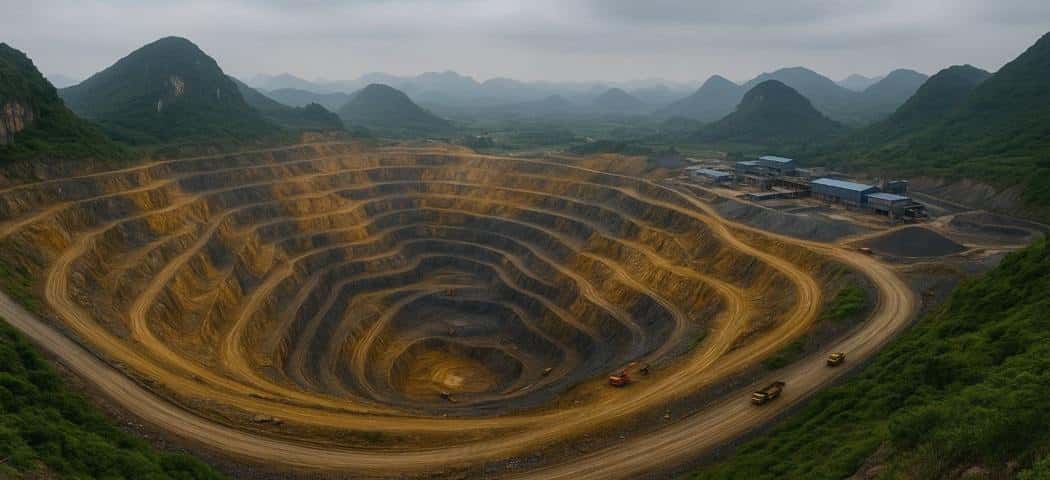
A Headline-Grabbing Find - What’s Actually Verified
In late 2024, provincial authorities in China announced a significant gold discovery at the Wangu goldfield in Pingjiang County, Hunan. Exploration results identified more than 40 gold-bearing veins containing an estimated 300 metric tons of gold at depths of around 2,000 meters. Officials indicated that geological modeling suggests the system could potentially hold over 1,000 metric tons in total, but stressed that these figures remain preliminary until further feasibility studies confirm commercially recoverable reserves.
State media coverage described the find as a “supergiant” deposit, with an estimated value of around 600 billion yuan (≈ US$80–83 billion) based on the larger modeled figure. However, the 300-ton figure is the most concrete, verifiable detail released so far.
High-Grade Ore
Notably, initial core samples from exploratory drilling revealed exceptionally rich concentrations - up to 138 grams of gold per metric ton. To put this in perspective, most high-grade gold deposits average closer to 8 g/t, making Wangu’s readings remarkable by global mining standards. Such grades could significantly enhance the economic viability of extraction, even at extreme depths.
Extractability Challenges: Depth, Cost, and Time
At depths of approximately 2,000 meters, Wangu would be among the world’s deepest gold mining prospects. Such depth introduces significant technical and economic challenges, including high ground pressure, heat load, ventilation needs, and water management. These factors can dramatically increase operating costs and extend development timelines. Even with promising initial estimates, the deposit’s commercial value hinges on years of resource definition, engineering, permitting, and financing.
Strategic Impact: China’s Gold Position
China is already the largest gold producer globally, accounting for roughly 10% of total annual mine output. A large-scale domestic deposit, if proven viable, could enhance supply security and align with Beijing’s ongoing strategy to diversify its reserves and reduce reliance on imports.
From a geopolitical perspective, a deposit of this magnitude could:
-
Strengthen China’s internal supply chains.
-
Bolster its position in regional refining and trading.
-
Support long-term reserve diversification, particularly as part of broader de-dollarization efforts.
Scale: Proven Tonnage vs. Potential Resource
Two different figures require careful interpretation:
-
~300 metric tons – currently identified, but not yet classified as proven reserves under international standards.
-
1,000+ metric tons – a modeled potential for the broader system, unverified by detailed drilling or feasibility data.
Until formal technical reports are released, investors and analysts should treat the larger number as speculative.
Market Reaction Outlook
Short term (months):
The discovery is unlikely to meaningfully impact global spot prices in the near term, as it will take years before any new supply reaches the market. Price action will remain dominated by macroeconomic drivers such as U.S. Federal Reserve policy, currency fluctuations, and central bank buying.
Medium term (1–3 years):
Equities linked to regional mining or exploration services could experience speculative volatility. Long-term valuations will depend on confirmed grades, metallurgical results, and cost profiles.
Long term (3–10 years):
If fully developed, Wangu could modestly increase China’s gold output and enhance domestic refining capacity, but it is unlikely to dramatically shift global supply-demand balances on its own.
Implications for Investors
-
Separate headlines from reserves: Treat the modeled “1,000+ ton” figure as potential, not guaranteed.
-
Macro factors still dominate: Global prices are more sensitive to monetary policy, geopolitical risk, and central bank activity than to a single deep deposit.
-
Portfolio positioning: Gold bullion retains its strategic role as a store of value regardless of new discoveries. For mining equities, focus on project economics, jurisdiction, and execution risk.
-
China’s long game: If developed, Wangu could reinforce China’s long-term resource independence, with possible ripple effects in regional gold market dynamics.
Bottom line:
The Wangu discovery is a credible and significant find that warrants attention, but investors should temper expectations with the realities of deep mining. Until technical studies confirm the mineable potential of the gold deposit, the market impact will be more about strategic positioning and geopolitical narratives than immediate supply changes.