View Charts
US Dollar and Trump Investigation
 4
4The big news across the currency markets this week was the significant drop in the US dollar. It fell over 2% against a basket of currencies representing the US dollar index. The decline came on the heels of the announcement that the US government will launch a special investigation. This investigation is about alleged Russian connections with President Trump during last November’s election. While the investigation may take years to complete the market has cast an initial vote. This is when sales of the US dollar go toward other currencies, most notably the euro and yen. Of course, the investigation could be a propaganda campaign by opposing political forces. Let's take a look at the US Dollar and Trump investigation.
Our focus here is not to dwell on the world political scene of the US Dollar and the Trump investigation
It is to illustrate the market reaction to these events. As well as to show how the currency cross-pairs may impact the precious metals prices. 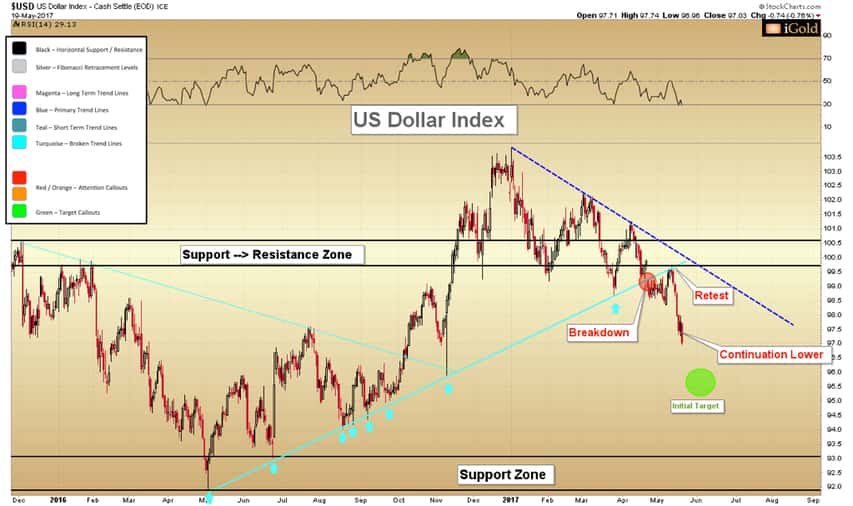 The dollar has now negated all of the post-Trump rallies, returning round-trip to the 97 levels on the dollar index. This is a process that has taken six months. It is important to note that in January our analysis gave hints that something negative was brewing for the dollar. This was strictly from interpretations of the chart. Lower lows forming in the dollar, and a failure to sustain a breakout to new highs in December, lead to this conclusion after a 9-year advance.
"False Breakout"
This failure of a market to move higher after an attempted breakout constitutes a “false breakout” in our technical model. When such a false move comes after a 9-year advance, it may signal exhaustion in a market. It may also signal a pending trend reversal in the opposite direction. It is not until now, four months later, that the news has finally synced with the technical hints. This is almost always the case in a technical-based market analysis. The move shows first on the charts, and the news arrives some weeks or months later to explain the reasons why.
Short-Term Technical Considerations
The rising trendline from May 2016 has now apparently broken to the downside. (turquoise color, above). The retest a week prior (callout), and a continuation lower are currently in process for the dollar. Our initial target for the dollar is 95.5 on the index, highlighted above in green. This target derives from measuring the amplitude of the failed move above the 99.5 former support level. Then to the 103.5 peaks (4.0). Further, we subtract this value below the breakdown point. The real-world interpretation of the target is that we expect an equal number of sellers to cut their losses below 99.5. Those who attempt to go along with the dollar above this level. As a confirming target, 96 on the index is also the 50% mid-point of the prior consolidation. This ranges from 92 to just above 100. When we have two targets within 0.5 points of one another, it increases the probability of the range hit.
Dollar Intermediate-Term
The 95.5 level is an initial downside target only. We have made the case in past issues that the false breakout is above 100. It consists of the entirety of the previous six months of post-Trump action. More importantly, it constitutes a long-term reversal after a 9-year advance in the USD. While some level of bounce comes after the initial 95.5 targets is hit, we anticipate further intermediate, and long-term downside remains.
Precious Metals Bull Market
Of course, this is a central component of the thesis for a precious metals bull market. The most substantial gains to come in years ahead should arrive from a growing worldwide recognition. This recognition is that the world’s present “reserve currency” is a depreciating store of value. After a bounce at 95.5, our secondary target will be 92 on the dollar index. This level is critically significant for the US currency. We can see from the 15-year chart below: 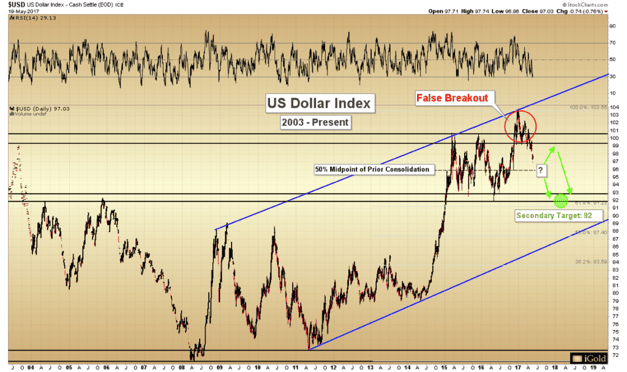 The 92 secondary target represents significant long-term horizontal support. (double black lines). You can observe them from the multiple spikes lower toward that level in 2015 – 2016. More significantly, you can see in the resistance zones which date back to 2004 – 2005. (far left). Further, just below this level, 91.2 represents the 38.2% Fibonacci retracement of the entire 2008 – 2017 advance. (light grey lines). Again, we have multiple technical targets in this 91-92 region. So the zone will take on an important consideration. The question that remains is: what sort of bounce will the market take between the initial target of 95.5 and the secondary target of 92? In an impulsive market decline, this sort of initial bounce may not last more than 1-3 months. That is before consistent selling re-emerges.
Regardless of when the exact length of the dollar bounces at 95.5. Any price action that remains below 100.5 on the index will keep the technical criteria for a long-term top valid in the US currency.
A test of the 92 secondary targets would thus anticipate for Q3 – Q4 2017. A break below 92 would be a strong confirming indicator of a new bear market materializing. Longer-term, we expect that the dollar will eventually make new all-time lows below 72. The timing for this likely will be into the mid-years of the forthcoming decade.
More articles:
US Dollar & Gold Technical Analysis
Trump Raises Historic $39 Million After Guilty Verdict
Christopher Aaron, Bullion Exchanges Market Analyst
Christopher Aaron has been trading in the commodity and financial markets since the early 2000s. He began his career as an intelligence analyst for the Central Intelligence Agency. The CIA is where he specialized in the creation and interpretation of the pattern of- life mapping in Afghanistan and Iraq. Technical analysis shares many similarities with mapping. They both base on the observations of repeating and embedded patterns in human nature. His strategy of blending behavioral and technical analysis has helped him and his clients. It has helped to identify both long-term market cycles and short-term opportunities for profit. This article is a third-party analysis. It does not necessarily match the views of Bullion Exchanges. Readers should not consider it as financial advice in any way.
4 Comments