View Charts
The U.S. $100 Bill: History, Security, and Hidden Value
 0
0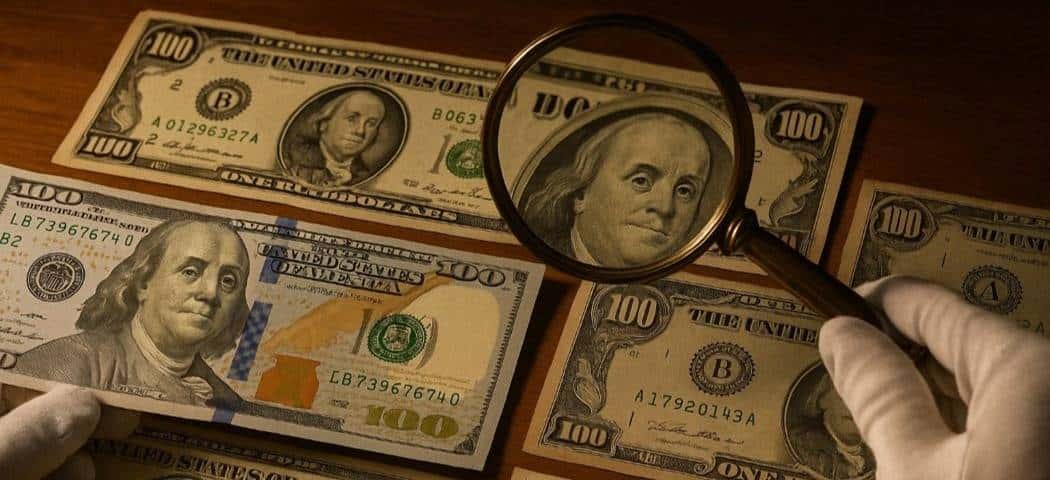
The Evolution of the U.S. $100 Bill
The U.S. $100 bill—often called a “Benjamin” in honor of Benjamin Franklin—has long symbolized wealth, trust, and global economic stability. Introduced in 1862 during the Civil War era, the denomination has undergone numerous redesigns to enhance security and preserve its integrity as one of the most circulated banknotes in the world.
Early $100 bills were large-size notes featuring allegorical figures before the adoption of Franklin’s portrait in 1914. His inclusion was deliberate: Franklin, a Founding Father, inventor, and diplomat, represented the spirit of American ingenuity and prudence—qualities the U.S. Treasury sought to embody in its highest commonly circulated note.
Benjamin Franklin: The Face of America’s $100 Bill
Unlike most U.S. currency featuring presidents, the $100 bill honors Benjamin Franklin, a statesman who never served as president but profoundly influenced America’s founding. Franklin’s image was chosen to emphasize intellect, invention, and civic virtue—values tied to financial wisdom and national prosperity. His legacy continues to elevate the bill’s symbolic and collector appeal.
A Brief History of Design Changes
The U.S. $100 bill has evolved through distinct design generations, each improving security and reflecting advances in printing technology.
-
1862–1929: Large “horse blanket” notes featured ornate designs and various allegorical and historical figures.
-
1929 Series: The modern small-size format was introduced with Franklin’s portrait standardized.
-
1996 Series: The first major modern redesign added a larger portrait, microprinting, and color-shifting ink.
-
2013 Series (Current): Introduced the 3D security ribbon, “Bell in the Inkwell” feature, and enhanced anti-counterfeiting technologies—making it one of the most advanced notes in circulation.
Understanding Security Features
Modern $100 bills integrate complex anti-counterfeiting features that showcase cutting-edge technology while maintaining classic design aesthetics. Key features include:
-
3D Security Ribbon: A blue ribbon woven into the paper, not printed, displaying shifting “100s” and Liberty Bells when tilted.
-
Color-Shifting Ink: The “100” in the lower right corner changes from copper to green depending on the angle.
-
Bell in the Inkwell: A subtle image of a bell appearing and disappearing within a copper inkwell when moved.
-
Watermark & Security Thread: A faint portrait watermark and embedded thread visible under UV light confirm authenticity.
-
Microprinting: Extremely fine lettering hidden around Franklin’s collar and quill line, readable only under magnification.
These features collectively protect the U.S. $100 bill from counterfeiting while providing an aesthetic blend of artistry and technology.
How to Identify a Real vs. Fake $100 Bill
While modern $100 bills include advanced security features, knowing how to quickly verify them in real-world situations is equally important. With the U.S. $100 bill being one of the most widely circulated banknotes globally, it is also among the most frequently targeted by counterfeiters. Fortunately, modern $100 bills incorporate advanced security features that make authentication accessible to anyone who knows what to look for. Verifying a bill’s authenticity involves both visual inspection and simple tactile checks.
When examining a $100 bill, focus on the following key indicators:
-
3D Security Ribbon Movement
Tilt the bill and observe the blue ribbon—authentic notes display moving “100s” and Liberty Bells that shift side-to-side and up-and-down depending on the angle. -
Color-Shifting Ink
The large “100” in the lower right corner should change color from copper to green when tilted, a feature difficult for counterfeiters to replicate. -
Raised Printing Texture
Genuine U.S. currency has a distinct feel due to intaglio printing. Run your fingers across Franklin’s shoulder or the text—real notes have a slightly raised texture. -
Watermark Verification
Hold the bill up to light to reveal a faint image of Benjamin Franklin embedded in the paper, not printed on the surface. -
Security Thread Under UV Light
Under ultraviolet light, the embedded security thread glows pink and displays “USA 100” in repeating text. -
Microprinting Details
Fine text around Franklin’s collar and the quill is crisp and readable under magnification—counterfeit bills often blur or omit these details.
In addition to these features, pay attention to overall print quality. Authentic notes have sharp lines, precise borders, and consistent spacing, while counterfeit bills may appear dull, misaligned, or overly smooth. If a bill feels suspicious or lacks multiple security features, it is best to consult a bank or financial institution for verification.
By becoming familiar with these authentication techniques, collectors and everyday users alike can confidently identify genuine $100 bills and protect themselves from counterfeit currency.
Seal Types and Their Significance
The Treasury Seal and Federal Reserve Seal on $100 bills help identify when and where a note was issued. Over the years, several seal types have appeared:
-
Red Seals: Issued on early United States Notes—now rare and collectible.
-
Blue Seals: Found on Silver Certificates, redeemable for silver until 1968.
-
Green Seals: Standard for Federal Reserve Notes, still in circulation today.
Collectors value certain combinations of seals, signatures, and serial numbers. For example, 1934 and 1950 series Blue Seal notes or Red Seal United States Notes can fetch significant premiums depending on condition and rarity.
Are Any $100 Bills Rare or Valuable?
While the majority of modern $100 bills remain worth only face value, there are notable exceptions where rare $100 bills have commanded substantial premiums in collector markets. Below are some key series to watch, followed by real-world auction results and guidance for further research.
Highly Collectible $100 Bills to Consider
-
1928 and 1934 Blue Seal Silver Certificates – These notes once promised silver redemption and are now prized by paper-money collectors.
-
1966 Red Seal United States Notes – Produced in smaller numbers, making them scarcer and more desirable.
-
Star Notes – Replacement notes identified by a star (*) in the serial number; limited print runs can boost value.
-
Low Serial Numbers (00000001–00000100) – Especially sought after for their scarcity and visual appeal.
-
Mismatched Serial Numbers or Printing Errors – Bills with misprints, offset seals, or other production anomalies can often command large premiums.
-
Uncirculated Modern Notes (e.g., 1996 & 2013 series) – Pristine condition, sequential serials or unique features may increase future collector value.
Real Auction Examples Demonstrating Potential Premiums
-
A 2009 Series $100 bill with a rare ink-error misalignment reportedly sold at a private auction for about $135,000.
-
A guide notes that a Gem-New graded early “Rainbow” style $100 realized $517,000 at a major auction (January 2014).
-
Value-guides emphasise that price depends heavily on condition, scarcity, and demand — average error notes may sell for far less.
How to Use This for Your Research
To understand how much a specific rare $100 bill might be worth:
-
Check recent auction results from reputable houses (e.g., Heritage Auctions, GreatCollections).
-
Compare the series, seal type, condition (grading), and error type with your note.
-
If it matches an example that sold for tens of thousands, it may warrant higher value. If not, premiums may be modest.
Preserving Value — Condition Matters
As with valuable coins, the premium placed on a rare $100 bill depends on condition, scarcity, and historical significance. Submit the note to a professional grading service such as PMG (Paper Money Guaranty) or PCGS Banknote for certification, store it in archival sleeves, and keep it away from light, heat, and moisture. Proper preservation maximises resale potential.
The Story Behind America’s Most Trusted Note
The U.S. $100 bill represents far more than its face value—it’s a tangible piece of American history and craftsmanship. From Franklin’s enduring portrait to sophisticated security features and scarce seal variations, each note embodies over 160 years of monetary evolution.
Whether you collect for profit, education, or passion, exploring the history and rarity of valuable $100 bills deepens appreciation for the artistry and trust that define U.S. coinage and currency.