View Charts
The Hidden Security Features Protecting Today's Bullion Coins
 0
0
Counterfeiters Forced the World's Mints to Think Smaller
There was a time when authenticating a gold or silver bullion coin was relatively straightforward. Investors checked the weight, measured the diameter, examined the design and, if questions remained, relied on a reputable dealer or an assay. For decades, that combination was enough.
It no longer is.
Advances in manufacturing have made counterfeit bullion increasingly sophisticated. High-quality dies, precision machining and inexpensive plating technologies have enabled fake coins to mimic genuine products with surprising accuracy, particularly in online marketplaces where buyers cannot inspect a coin before purchasing it. While experienced dealers still employ tools such as X-ray fluorescence analyzers, ultrasonic scanners and precise dimensional measurements, sovereign mints have responded by embedding security directly into the coins themselves.
The result is a quiet technological race that most investors never notice. Today's leading bullion coins contain microscopic details, engineered surfaces and laser-produced features that are exceptionally difficult to duplicate without the same specialized equipment used by the issuing mint. Those innovations do not eliminate counterfeiting, but they make convincing forgeries substantially more expensive and far easier to detect.
The Royal Canadian Mint Changed Expectations
Few institutions have influenced modern bullion security more than the Royal Canadian Mint.
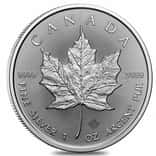
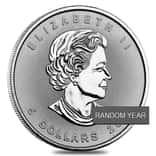
Its Gold and Silver Maple Leaf bullion coins have long been recognized for exceptional purity, but beginning in the last decade the Mint shifted its focus toward authentication technology. Rather than altering the familiar maple leaf design, engineers introduced features that strengthened security while preserving the coin's unmistakable appearance.
The most visible innovation is the field of precision-machined radial lines covering both sides of every bullion Maple Leaf. These finely spaced lines are produced using master dies created to extremely tight tolerances, giving the coin a distinctive visual texture while making accurate duplication extraordinarily difficult. Even slight inconsistencies become apparent under magnification.
In 2015, the Mint introduced another important safeguard: a laser-engraved micro maple leaf positioned near the bottom of the reverse. Inside that tiny security mark is the coin's year of issue, visible only with magnification and created using equipment unavailable to most counterfeiters. Because the mark is generated directly from the Mint's production process, reproducing it convincingly presents a significant technical challenge.
Beyond the coin itself, the Royal Canadian Mint developed Bullion DNA™, an authentication system used by participating bullion dealers. Each registered coin contains a unique digital signature created during production that can be verified against the Mint's secure database using specialized scanning equipment. Rather than relying solely on visual inspection, dealers can compare a coin's microscopic characteristics with its original production record, adding another layer of confidence for investors.
Britain's Britannia Became a Showcase for Modern Minting
For years, the Britannia was admired primarily for its symbolism. Then the Royal Mint transformed it into one of the world's most technically advanced bullion coins.
The redesign introduced in 2021 retained Britannia's iconic standing figure while incorporating multiple security elements directly into the artwork. Instead of relying on a single anti-counterfeiting device, the Mint layered several features together, each serving a different purpose.
Perhaps the best known is the latent image located near Britannia's trident. Depending on the viewing angle, the small circular device shifts between a padlock and a trident, an optical effect that is remarkably difficult to reproduce accurately. The background also incorporates finely engineered surface animation, producing changing light reflections as the coin is tilted.
Additional protection comes through microscopic text surrounding the design and carefully integrated tincture lines within Britannia's shield, borrowing concepts from traditional heraldry while adding another level of complexity for would-be counterfeiters. None of these elements dominates the artwork individually, but together they create a sophisticated security package that blends seamlessly into one of the bullion market's most recognizable designs.
Perth Mint Chose a Different Approach
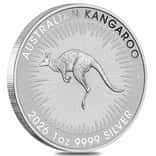
The Perth Mint's Australian Kangaroo is another example of how security can be added without overwhelming a coin's classic design.
Beginning with the 2020 bullion issue, every Gold Kangaroo has featured a tiny laser-engraved letter concealed within the reverse artwork. Visible only under magnification, the microscopic character changes annually, making it far more difficult for counterfeiters to produce convincing copies over multiple years. A forgery that overlooks this subtle detail—or repeats the wrong year's security mark—can often be identified immediately by an experienced dealer.
The feature is intentionally understated. Unlike holograms or overt security devices, it doesn't draw attention to itself during normal viewing. Instead, it functions as a discreet authentication tool while preserving the Kangaroo's clean aesthetic, a hallmark of Perth Mint bullion products.
That philosophy reflects a broader trend among leading sovereign mints. Security features are increasingly designed to become part of the artwork rather than additions layered on top of it. The more seamlessly they blend into the original design, the more difficult they are to imitate convincingly.
Precision Can Be a Security Feature in Its Own Right
Not every major mint has responded by adding hidden images or laser engraving.
The Austrian Mint's Vienna Philharmonic remains one of the world's best-selling gold bullion coins despite lacking the overt anti-counterfeiting technologies found on some competing products. Instead, the Mint continues to rely on exceptionally precise engraving, consistent strike quality and meticulous manufacturing standards that have defined the series since its introduction in 1989.
That decision isn't a technological shortcoming. Rather, it reflects a different philosophy. The Philharmonic's intricate arrangement of orchestral instruments, the richly detailed pipe organ and the coin's sharply executed lettering require manufacturing precision that is difficult to reproduce accurately. Counterfeit examples frequently reveal themselves through softer details, uneven fields or subtle inconsistencies in the relief long before laboratory testing becomes necessary.
The Austrian Mint complements those production standards with rigorous quality control throughout the manufacturing process. While investors won't find a latent image or micro-engraved security mark hidden within the design, they are purchasing a bullion coin produced by one of Europe's oldest and most respected minting institutions, where precision itself serves as an important layer of authentication.
Technology Helps, but It Doesn't Replace Due Diligence
As impressive as modern security features have become, no bullion coin should be considered counterfeit-proof.
Professional dealers rarely rely on a single authentication method. Visual inspection remains important, but it is typically supported by precise weight and dimension measurements, magnetic testing, ultrasonic analysis or X-ray fluorescence equipment capable of confirming a coin's metallic composition without causing damage. When those tools are used together with the security features built into today's sovereign bullion coins, identifying genuine products becomes considerably more reliable.
For individual investors, however, the simplest safeguard often comes long before any testing takes place: purchasing from established, reputable bullion dealers with proven sourcing practices. Authentic coins begin with trusted supply chains, and reputable dealers inspect, verify and stand behind the products they sell.
That combination of advanced mint technology and responsible distribution remains one of the strongest defenses against counterfeit bullion entering the marketplace.
Why Security Features Matter More Than Ever
Counterfeiters have become more sophisticated, but so have the world's leading mints. What once depended largely on recognizable designs and accurate specifications has evolved into a sophisticated combination of laser engraving, engineered surfaces, microscopic identifiers and digital authentication systems that would have been unimaginable a generation ago.
For investors, these innovations provide more than peace of mind. They help preserve confidence in the global bullion market by making authentic coins easier to verify and significantly more difficult to duplicate. At the same time, they demonstrate how modern minting has quietly become as much about advanced engineering as traditional craftsmanship.
The most effective security feature, however, isn't any single radial line, latent image or microscopic engraving. It's the combination of trusted sovereign mints, continuously improving production technology and reputable bullion dealers working together to ensure that investors receive exactly what they expect: genuine precious metals backed by generations of expertise.
Related reading you may find interesting:
2026 ANA World's Fair of Money: Where History Meets the Market
What Happens to Unsold Gold and Silver Bullion Coins?