View Charts
2026 ANA World's Fair of Money: Where History Meets the Market
 0
0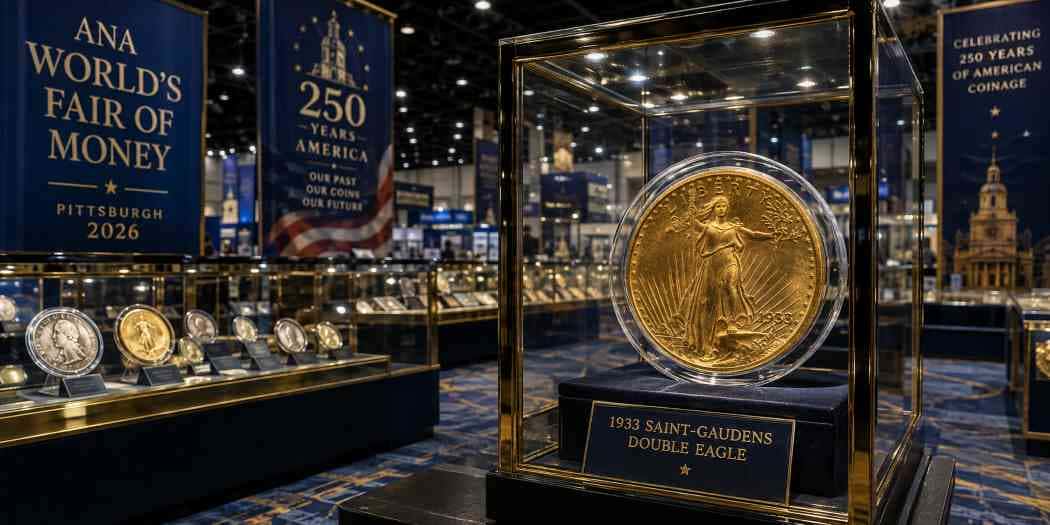
America's Biggest Coin Show Arrives at a Defining Moment
Every World's Fair of Money reflects the state of the numismatic hobby at a particular moment. The 2026 convention, however, arrives during one of the most significant years in American history. As the United States marks its 250th anniversary, collectors are rediscovering the stories told through the nation's coinage—from the earliest federal issues to the newest commemoratives leaving the U.S. Mint.
That convergence makes this year's American Numismatic Association World's Fair of Money®, held August 25–29 at Pittsburgh's David L. Lawrence Convention Center, more than the hobby's largest annual gathering. It will bring together landmark exhibits, major auction firms, hundreds of professional dealers, and some of the year's most anticipated U.S. Mint releases at a time when public interest in American history has expanded well beyond traditional collecting circles.
The convention has occupied that role before. Since the ANA began hosting national conventions in the late nineteenth century, the World's Fair of Money has evolved from a meeting of dedicated enthusiasts into North America's premier numismatic event, where important discoveries are unveiled, exceptional collections debut, and market trends often reveal themselves before they become apparent elsewhere. Few conventions, however, have entered the calendar with as much anticipation—or with a historical backdrop as fitting—as Pittsburgh in 2026.
A Historic Gathering of the 1933 Double Eagles
Every World's Fair of Money features exceptional exhibits, but one scheduled for Pittsburgh stands apart from anything previously assembled by the ANA.
For the first time, the eleven government-owned 1933 Saint-Gaudens Double Eagles are expected to be displayed together publicly—an unprecedented opportunity to see the coin that has become the defining rarity of American numismatics.
Its story begins in the Great Depression. Although more than 445,000 Double Eagles were struck in 1933, they were never released after President Franklin D. Roosevelt ended domestic gold circulation and restricted private gold ownership. Nearly the entire mintage was ordered melted before it could leave the Mint.
A handful of coins escaped destruction, setting off decades of investigations, legal battles, and ownership disputes that only deepened the Double Eagle's mystique. Most examples recovered outside government custody were eventually seized, leaving just one specimen legally available to private collectors. That coin sold for nearly $19 million in 2021, becoming one of the most valuable collectibles ever auctioned.
The Pittsburgh exhibit offers something money cannot buy: the chance to view the government's surviving examples together and appreciate the coin whose rarity, artistry, and extraordinary history have made it the undisputed icon of American numismatics.
A Semiquincentennial Celebration Seen Through Coinage
The timing of the convention gives that exhibit even greater resonance. Throughout 2026, the nation's Semiquincentennial has renewed attention on the people, events, and symbols that shaped the United States. Coins occupy a unique place in that story because they were created not simply to facilitate commerce, but also to express the country's ideals, commemorate its milestones, and reflect changing artistic and political priorities.
That broader narrative will be visible throughout the convention. Early American coppers, colonial issues, classic silver and gold coins, and modern commemoratives collectively illustrate nearly two and a half centuries of monetary history. Rather than presenting isolated eras, the World's Fair of Money allows visitors to follow a continuous timeline that connects the nation's earliest coinage with today's anniversary issues.
The renewed interest generated by the U.S. Mint's Semiquincentennial program has also encouraged many newer collectors to look beyond modern releases. Designs celebrating America's 250th anniversary naturally invite comparisons with the historic coins that established the country's visual identity, while longtime collectors have found fresh appreciation for classic series whose artistry continues to influence contemporary coinage.
That dialogue between past and present is one of the convention's defining strengths. A collector drawn to Pittsburgh by a newly released commemorative can stand only a few aisles away from the early federal coins that helped shape the nation's monetary heritage. Few events offer such an immediate connection between history and the modern marketplace.
Where the Numismatic Market Meets
The World's Fair of Money has always been a place where coins change hands. Its greater value, however, lies in what those transactions reveal. Every major convention offers an early reading of collector confidence, dealer sentiment, and the areas of the market attracting the strongest demand. With America's 250th anniversary fueling interest in U.S. coinage and precious metals remaining elevated, Pittsburgh may provide the clearest snapshot yet of the hobby's direction.
Demand for classic U.S. coins remains resilient despite a more selective marketplace. Collectors continue to pursue certified examples with exceptional eye appeal and proven scarcity, while many bullion buyers have expanded into historically significant issues. Saint-Gaudens Double Eagles, Liberty Head gold, key-date Morgan and Peace Dollars, and premium type coins remain especially sought after because they combine intrinsic value with established numismatic appeal.
That convergence of investing and collecting has become one of today's defining market trends. Gold may attract buyers, but rarity, originality, and provenance increasingly determine long-term premiums.
The U.S. Mint will add another focal point during the week. While no convention-exclusive releases have been announced, two major Semiquincentennial products are scheduled to debut during the show: the 2026 Enhanced Uncirculated Morgan and Peace Silver Dollars on August 25 and the Best of the Mint 1804 Silver Dollar Gold Coin and Silver Medal Set on August 27. Their release schedule underscores the convention's unique role, placing the Mint's anniversary program alongside the hobby's largest annual gathering.
History, Scholarship, and the Marketplace Under One Roof
The 1933 Double Eagles may dominate headlines, but they are only part of an exhibition program spanning centuries of monetary history.
Featured displays include treasures recovered from the S.S. Central America, whose gold ingots, Double Eagles, and artifacts remain among the most celebrated discoveries in American numismatics. Visitors can also view selections from the renowned Tyrant Collection, one of the world's premier private collections of ancient and medieval coinage, illustrating that the World's Fair of Money reaches far beyond American issues.
The marketplace surrounding those exhibits is equally important. Hundreds of professional dealers from across the United States and abroad are expected to fill the bourse floor, while leading auction houses—including Heritage Auctions, Stack's Bowers Galleries, GreatCollections, and others—will present important rarities that often establish new market benchmarks. Just as valuable are the conversations between collectors, dealers, grading specialists, and researchers that continue shaping the hobby long after the convention closes.
That combination of scholarship, commerce, and community is what distinguishes the World's Fair of Money. Collectors come not only to buy and sell, but also to study exceptional collections, exchange knowledge, and experience coins seldom seen outside museums or major auctions.
Why Pittsburgh May Define the Hobby's Biggest Year
Every World's Fair of Money reflects the numismatic landscape of its time. The 2026 convention does something more: it captures the hobby at the intersection of a historic national anniversary, one of the most celebrated rarities in American coinage, an ambitious U.S. Mint commemorative program, and a market that continues to attract both seasoned collectors and new participants.
Whether visitors travel to Pittsburgh to admire the unprecedented gathering of the government-owned 1933 Double Eagles, compete for an important rarity, explore world-class exhibits, or experience the excitement of North America's largest coin show, they will witness an event that extends well beyond five days on the calendar.
When the convention closes on August 29, its influence will not. Auction results will shape valuations, collector response to the Mint's Semiquincentennial releases will become clearer, and one of the most remarkable exhibits in ANA history will have added another chapter to the story of American numismatics. In that sense, the 2026 World's Fair of Money is more than the year's premier convention—it is a reflection of where the hobby has been, where it stands today, and where it may be heading next.