View Charts
The Evolution of Coin Minting Techniques
 0
0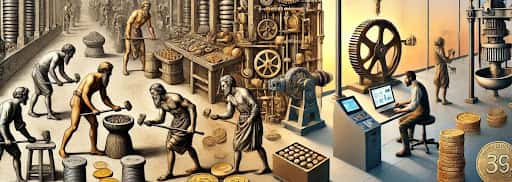
The history of coin minting is as rich and varied as the coins themselves. From the earliest rudimentary methods to today’s sophisticated technologies, the evolution of coin minting techniques reflects advancements in metallurgy, technology, and economics. This article explores the fascinating journey of how coin minting has evolved over millennia, highlighting key innovations and their impacts on society.
The Beginnings: Hammered Coinage
The earliest coins, dating back to around 600 BCE in Lydia (modern-day Turkey), were made using a simple but labor-intensive process called hammered coinage. These early coins were typically made of electrum, a natural alloy of gold and silver, and later of pure gold, silver, and bronze.
Hammered Coinage Process:
- Blank Preparation: Metal blanks, known as flans, were cut from a metal sheet or cast from a mold.
- Heating: The blanks were heated to make them malleable.
- Striking: A blank was placed between two engraved dies, and a hammer was used to strike the top die, imprinting the design onto the metal.
Hammered coins often had irregular shapes and varying thicknesses due to the manual nature of the process. Despite these imperfections, hammered coinage persisted for centuries due to its simplicity and the lack of better technology.
The Introduction of Milled Coinage
The Renaissance period brought significant advancements in many fields, including coin minting. In the 16th century, the introduction of the screw press marked a major shift from hammered to milled coinage, also known as machine-struck coins.
Milled Coinage Process:
- Blanks: Similar to hammered coinage, blanks were prepared but with greater precision.
- Edge Decoration: Blanks were often given reeded or patterned edges to prevent clipping (the shaving off of small amounts of precious metal).
- Screw Press: The blanks were placed in a screw press, which used a threaded screw mechanism to apply even pressure, producing coins with more uniform shapes and detailed designs.
The milled process allowed for greater consistency and security. The coins were harder to counterfeit and provided a more professional appearance, which enhanced public trust in the currency.
The Industrial Revolution: Steam-Powered Minting
The Industrial Revolution brought about another significant transformation in coin minting with the advent of steam-powered machinery. Matthew Boulton and James Watt pioneered this technology in the late 18th century, introducing steam-driven coin presses at the Soho Mint in Birmingham, England.
Steam-Powered Minting Process:
- Automated Blank Production: Steam engines powered machines that could cut blanks more precisely and in greater quantities.
- Efficient Striking: Steam-powered presses could strike coins with consistent force, producing high-quality and uniform coins at a much faster rate.
The efficiency and precision of steam-powered minting enabled the mass production of coins, which was crucial for the expanding economies of the industrialized world. This period also saw the introduction of new coin materials, including cupro-nickel alloys, which were more durable and economical than precious metals.
Modern Minting: Hydraulic and Electric Presses
The 20th century ushered in the era of hydraulic and electric presses, further enhancing the precision, speed, and security of coin minting.
Hydraulic Presses:
Hydraulic presses use fluid pressure to apply force, allowing for even greater control over the minting process. These presses can produce coins with intricate designs and high relief, enhancing their aesthetic appeal and collectibility.
Electric Presses:
Electric presses, introduced later in the century, use electric motors to drive the minting machinery. These presses offer unparalleled precision and automation, making the minting process more efficient and less labor-intensive.
The Role of Computer Technology
The integration of computer technology into coin minting represents the latest evolution in the field. Computer-aided design (CAD) and computer-aided manufacturing (CAM) have revolutionized the way coins are designed and produced.
Key Innovations:
- Precision Engraving: CAD allows for the creation of highly detailed and intricate coin designs, which can be precisely engraved using computer-controlled milling machines.
- Quality Control: Advanced sensors and imaging technology enable real-time quality control during the minting process, ensuring that each coin meets exacting standards.
- Security Features: Modern coins can incorporate sophisticated security features, such as microtext, holograms, and latent images, to combat counterfeiting.
The Future of Coin Minting
As technology continues to advance, the future of coin minting promises to bring even more innovations. Emerging technologies such as 3D printing and blockchain could further transform the way coins are designed, produced, and authenticated.
Potential Future Developments:
- 3D Printing: 3D printing technology could allow for the creation of complex coin molds and prototypes, streamlining the design and production process.
- Blockchain: Blockchain technology could be used to track the production and distribution of coins, providing a secure and transparent record of each coin’s provenance.
Conclusion
The evolution of coin minting techniques from the hammered coins of ancient Lydia to today’s sophisticated computer-aided processes reflects the broader technological and economic advancements of human society. Each innovation in minting technology has brought about greater precision, efficiency, and security, ensuring that coins remain a reliable and trusted medium of exchange. As we look to the future, continued advancements in technology will undoubtedly shape the next chapter in the fascinating history of coin minting.