View Charts
The British Britannia: History Behind Britain's Iconic Bullion Coin
 0
0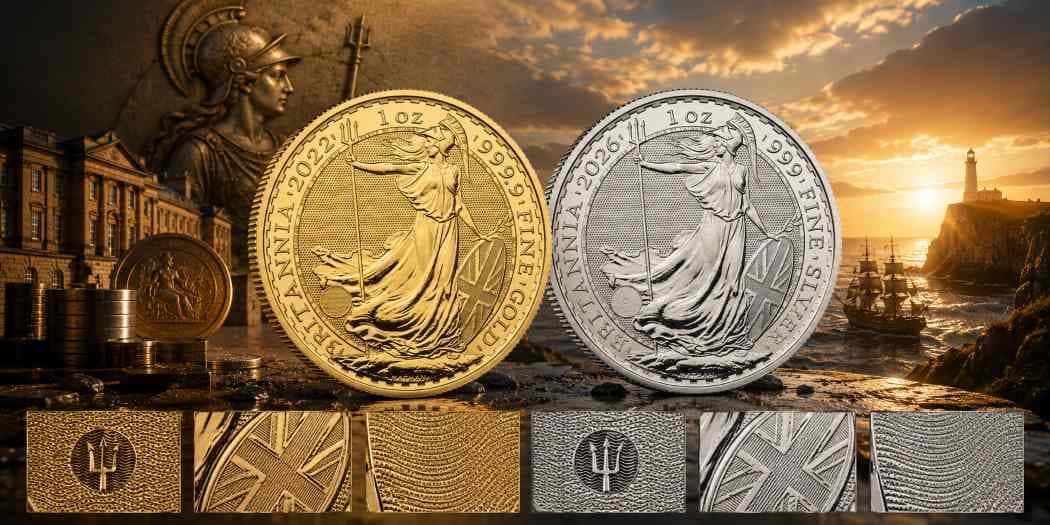
Britannia Is Older Than the Coin That Bears Her Name
Long before the Britannia became one of the world's most recognizable bullion coins, she was already one of Britain's most enduring national symbols. Her origins trace back nearly two thousand years to the Roman Empire, when Emperor Hadrian introduced the female figure of Britannia on coins commemorating the province of Britain. Depicted with a helmet, shield, and spear, she symbolized the strength and resilience of Rome's distant frontier.
Although Roman rule eventually ended, the image of Britannia endured. During the seventeenth century, King Charles II revived the allegorical figure on British coinage, where she came to represent national unity, maritime power, and stability. Over the centuries, Britannia evolved alongside Britain itself, appearing on countless circulating coins, official seals, and works of art while becoming an unmistakable emblem of the nation.
When The Royal Mint introduced the Britannia bullion series in the late twentieth century, it wasn't creating a new symbol—it was giving one of Britain's oldest icons a new role in the global precious metals market.
The Royal Mint Created a Modern Bullion Classic
The modern Britannia Gold Coin debuted in 1987, arriving at a time when investment bullion was becoming increasingly popular around the world. The Royal Mint sought to create a flagship bullion coin that combined internationally recognized gold content with a design rooted in British history and tradition.
Unlike many bullion programs that emphasize changing annual themes, the Britannia established a consistent identity centered on its iconic namesake. Investors could easily recognize the coin while collectors appreciated the artistic interpretation of one of Britain's best-known national figures.
The program expanded in 1997 with the introduction of the Britannia Silver Coin, giving investors access to the same celebrated design in silver. Platinum Britannias later joined the series, further broadening its appeal across the precious metals market.
The bullion program has also evolved technically. Early Gold Britannias were struck in 22-karat (.9167 fine) gold, an alloy that provided additional durability while still containing one full troy ounce of pure gold in the one-ounce denomination. Beginning in 2013, The Royal Mint transitioned the Gold Britannia to 24-karat (.9999 fine) gold, aligning it with many of the world's leading investment bullion coins. Silver Britannias likewise evolved, moving from .958 Britannia silver to the internationally recognized .999 fine silver standard.
These refinements reflected changing investor preferences while preserving the identity that had made the series successful.
A Design That Balances Tradition and Symbolism
The Britannia's enduring appeal owes much to its artwork. While the coin has featured several interpretations over the years, its central figure has remained remarkably consistent, reflecting values that have defined Britain for centuries.
The image most closely associated with the series was created by sculptor Philip Nathan, whose standing Britannia first appeared on the inaugural 1987 Gold Britannia. His design portrays Britannia facing the wind with flowing robes, holding a trident in one hand and a shield bearing the Union Flag in the other. Together, these elements symbolize Britain's maritime heritage, national defense, and resilience in the face of changing times.
Other details add further meaning. Britannia's Corinthian helmet recalls the classical origins of the figure while emphasizing courage and preparedness. An olive branch, featured in several modern interpretations, introduces a complementary message of peace and stability, reinforcing the idea that strength and diplomacy can coexist.
Although The Royal Mint occasionally commissions new artistic interpretations, each redesign preserves the figure's unmistakable identity. Some versions present Britannia overlooking the sea, while others adopt a more contemporary style, but the symbolism remains constant. This balance between continuity and artistic evolution has helped the series remain fresh without losing the heritage that distinguishes it from many other bullion programs.
Among the World's Most Secure Bullion Coins
While Britannia's history attracts collectors, its modern security features have become equally important for investors.
In 2021, The Royal Mint introduced one of the most significant redesigns in the coin's history by incorporating advanced anti-counterfeiting technology directly into the bullion series. These enhancements were developed to strengthen confidence in an increasingly global precious metals market where authenticity is paramount.
One of the most innovative additions is a latent security image that changes appearance as the coin is tilted, alternating between a padlock and a trident. This visual effect allows owners to verify authenticity without specialized equipment while remaining extremely difficult to reproduce accurately.
The redesign also introduced finely engraved surface animation, where intricate wave-like patterns create a dynamic visual effect as light moves across the coin. Beyond their aesthetic appeal, these precisely engineered textures provide another layer of protection against counterfeiting.
Additional safeguards include micro-text surrounding the design and carefully engraved tincture lines within Britannia's shield. Together, these features combine centuries-old minting craftsmanship with state-of-the-art engraving technology, making the Britannia one of the most technologically advanced bullion coins produced today.
Rather than changing the coin's classic appearance, these security elements enhance it, demonstrating how traditional artistry and modern manufacturing can work together in a single investment product.
Why Britannias Continue to Stand Out
The British Britannia has earned a respected place among the world's leading bullion coins by offering more than precious metal content alone. Its combination of historical symbolism, exceptional craftsmanship, and advanced security features has helped it appeal to investors and collectors across international markets.
The Royal Mint's centuries-long reputation for quality contributes to that confidence. As one of the world's oldest operating mints, it applies rigorous production standards that support the Britannia's global recognition and liquidity. Investors also appreciate the availability of the series in gold, silver, platinum, and multiple fractional sizes, making it accessible to a wide range of investment strategies.
For UK residents, Britannia bullion coins also carry a notable advantage because they are legal tender and may qualify for certain tax benefits, including exemption from Capital Gains Tax (CGT) under current UK regulations. While these provisions are specific to the United Kingdom and individual circumstances, they have contributed to the coin's enduring domestic popularity.
More broadly, the Britannia demonstrates how a bullion coin can successfully combine heritage with innovation. Nearly four decades after its introduction, it remains a flagship product of The Royal Mint and one of the most recognizable investment coins in the world. While buyers often focus on purity, weight, and market premiums, the Britannia reminds us that thoughtful design, national symbolism, and continued innovation can become just as lasting as the precious metal from which the coin is struck.