View Charts
Silver Breaks $115: What This Historic Rally Reveals
 0
0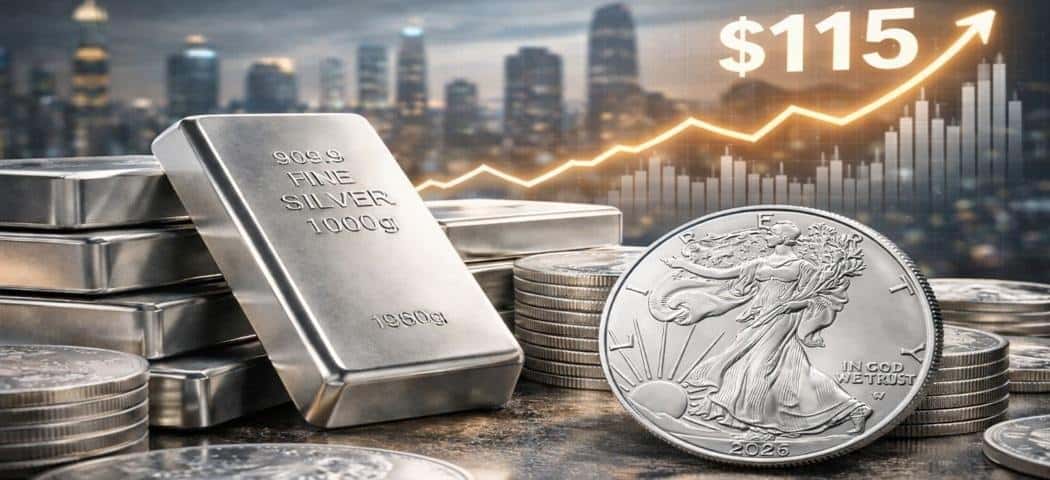
Silver Price Climbs to $115 Per Ounce: A New Market Era
Silver has surged beyond $115 per ounce, marking another decisive leg higher in what has become one of the most powerful rallies in modern precious metals history. After clearing the widely watched $110 psychological milestone, silver’s continued advance confirms that this move is not a fleeting spike but a sustained revaluation of the metal itself. As prices establish above $115, silver’s role within global markets, investment portfolios, and industrial supply chains is being fundamentally reassessed. Understanding what pushed silver through $110, why momentum carried it to $115, and what this shift means going forward is now essential for investors navigating today’s evolving financial landscape.
A Pivotal Turning Point for Silver
Reaching $115 per ounce represents a defining moment for silver. While the metal has experienced notable rallies in past cycles, this breakout signals a structural change rather than short-term enthusiasm. The silver spot price has entered a higher valuation band, compelling investors, institutions, and industrial users to reevaluate silver’s long-term function as both a monetary asset and a critical industrial input. This price level reflects deeper market forces at work, not speculative excess.
Why Silver Advanced to $115
Silver’s rise to $115 was driven by a convergence of powerful macroeconomic and supply-side factors. Persistent inflation, mounting sovereign debt, and eroding confidence in fiat currencies have fueled demand for tangible assets such as physical silver. At the same time, silver’s industrial importance has expanded significantly, intensifying pressure on already constrained supply.
Silver is indispensable in solar energy systems, electronics manufacturing, medical technologies, and electric vehicle production. Much of the silver used in these applications is permanently consumed, steadily reducing above-ground inventories. This combination of rising investment demand and irreversible industrial consumption compressed supply conditions, propelling prices decisively beyond the $115 level.
Historical Silver Highs Provide Valuable Context
Silver’s previous nominal high of $49.45 per ounce, reached in January 1980, is often cited as its historic peak. However, when adjusted for inflation, that price would exceed $200 per ounce in today’s dollars. Viewed through this historical lens, silver at $115 represents a partial normalization rather than an extreme valuation.
Decades of currency debasement, increasing mining costs, and chronic supply challenges are now being reflected in silver prices. The current rally suggests that the market is beginning to properly account for silver’s scarcity, utility, and long-term strategic value.
Gold-to-Silver Ratio Highlights a Structural Shift
The gold-to-silver ratio has played a critical role in validating silver’s breakout. Historically elevated ratios have often preceded major silver bull markets. As gold prices advanced first, capital eventually rotated into silver, compressing the ratio and accelerating silver’s price appreciation.
As the ratio moved toward more balanced levels, silver began outperforming gold on a percentage basis, reinforcing its reputation as the higher-volatility companion metal. This behavior confirms that silver’s surge past $115 is part of a broader realignment within the precious metals market rather than an isolated anomaly.
What Silver at $115 Signals for Other Precious Metals
Silver’s rally has unfolded alongside strength across the broader precious metals complex. Gold continues to serve as the primary monetary hedge, while silver’s breakout highlights growing investor appetite for leveraged exposure within hard assets. Platinum and palladium have also benefited from renewed interest, supported by supply constraints and ongoing industrial demand.
Collectively, these movements point toward a wider repricing of tangible assets rather than a single-metal event. The precious metals market appears to be transitioning into a new phase shaped by long-term structural pressures.
Could Silver Prices Continue Higher?
With silver now trading above $115, attention naturally turns to what comes next. While corrective pullbacks are always possible after major milestones, history suggests that breakouts of this magnitude often establish new long-term price regimes rather than marking immediate peaks.
If inflation remains elevated, industrial demand continues to expand, and investor interest persists, silver prices may remain structurally higher than in previous cycles. What once seemed like an aggressive forecast is increasingly viewed as a baseline scenario.
How Investors Can Approach a $115 Silver Market
Silver trading at $115 significantly reshapes portfolio considerations. Investors must account for heightened volatility, wider price swings, and rising premiums on physical silver products. Diversification across precious metals, disciplined position sizing, and a long-term strategy become increasingly important in this environment.
Physical silver remains appealing as a hedge against inflation and currency risk, while its expanding industrial relevance provides additional fundamental support. For many investors, silver continues to offer a compelling combination of monetary protection and growth potential.
Silver Above $115 Redefines the Market Landscape
Silver breaking above $115 per ounce is far more than a headline—it marks a transformation within the precious metals market. Driven by inflationary pressures, constrained supply, industrial demand, and shifting investor behavior, silver’s rally reflects deeper changes in the global financial system.
For investors, this moment underscores the importance of understanding not just price movements, but the underlying forces shaping them. Silver has crossed another historic threshold, and its role within portfolios may never look the same again.
Related reading you may find interesting:
Gold Above $5,100 and Silver Over $115: A Metals Market Reckoning
Is Junk Silver Still a Smart Investment in 2026?