View Charts
Silver outperforms gold
 0
0Silver Update
Silver outperforms gold on a relative basis over the past week. This is a positive sign for the sector over the short term. The gold to silver ratio declines slightly back toward 80. For the week in sum, Silver finishes lower by $0.02 (0.1%), to close at $16.47. As we discussed over the past weeks, silver is in the terminal stages of finishing a massive symmetrical triangle consolidation. (below, blue outline): 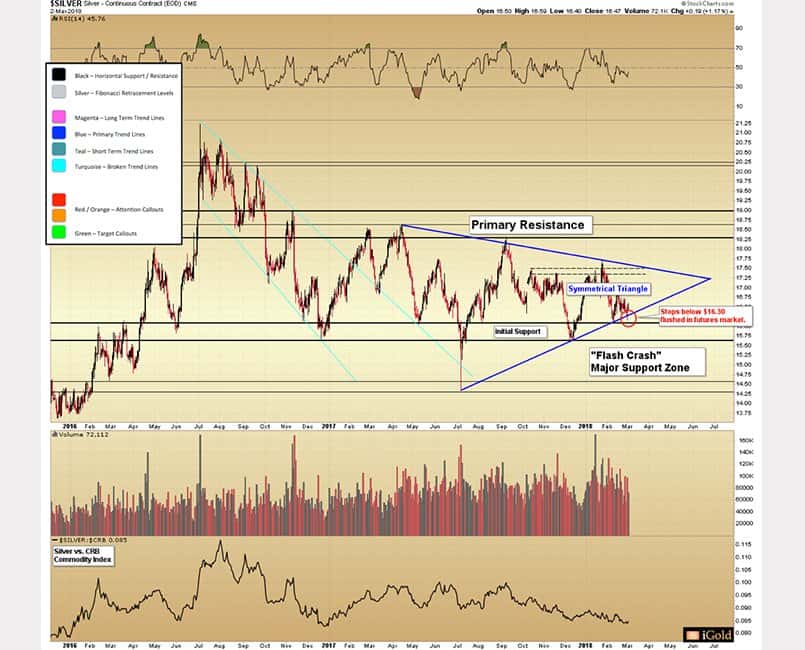 This week, silver has just barely held onto its lower triangle boundary. It is flushing future traders’ stops. These stops are immediately below the lower rising boundary at $16.30 shown above. (see red callout). This must be a positive sign over the short term. Yet, the more important point remains. Silver must perform positively during March and April to resolve this symmetrical triangle higher. A failure to do so will result in an adverse resolution to the consolidation. Additionally, it will be a significant warning sign for the entire sector moving forward. Silver must break $17.60 in the upper declining (blue) triangle boundary. This will be to show us that the resolution will remain positive.
Gold Update
For the week, gold closed lower by $7 (0.5%) to close at $1,323 as of the final trade on the New York COMEX futures market on Friday afternoon. The most critical point for gold investors is that the metal continues to carve out a clear ascending triangle pattern for its primary chart. This shows below in blue. Note the five distinct tests on the upper horizontal resistance since 2016. They have clear rising support. This is a bullish primary pattern unless proven otherwise. \ The breakout point for this pattern remains $1,378. (The 2016 peak). The invalidation point for this pattern would be the rising lower support line. Which, if it were to hit today, would come in at $1,215. We remind readers that the apex of this triangle would not come until the end of 2019. This shows on the chart. Yet in practicality, the majority of triangle formations will resolve between two-thirds (2/3) to three-quarters (3/4) of the way through the pattern timeline. In other words, this means that a break either higher or lower is due in 2018. Let's switch over to our more detailed regular annotations for gold. We consider the metal to be in the final consolidation before they exceed 2016 highs. This consolidation could still take either a more aggressive or a more drawn-out format. This indicates below by the red arrow scenarios. The primary point remains that gold is in a bullish ascending triangle. It is on the multi-year timeframe unless proven otherwise: 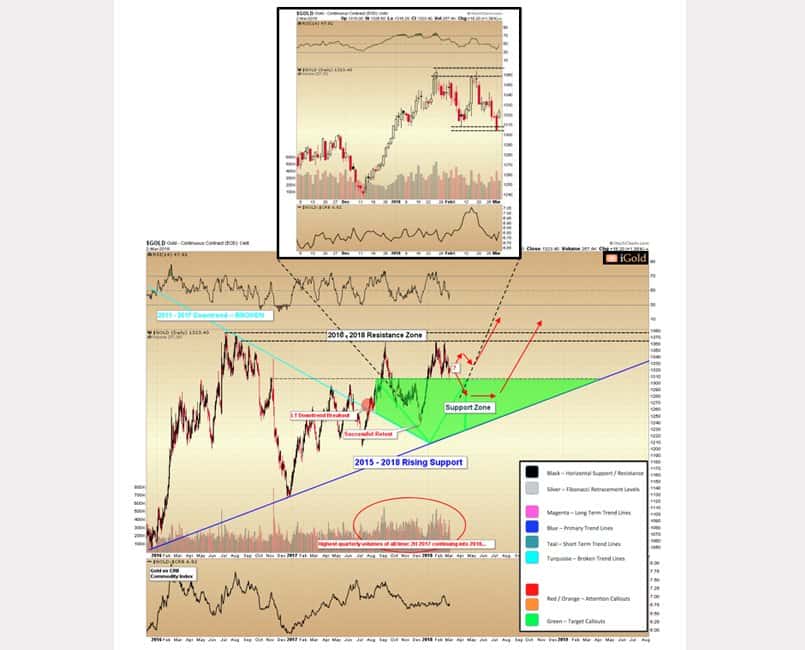
On the top zoomed-in cutout, we see that gold holds on a closing basis above the February low of $1,307.
We thus see an area of support defined by $1,303 - $1,307. There is an area of resistance defined between $1,359 - $1,366. (black dashed lines). We solidify this new support zone. However, if $1,303 were to fail on a closing daily basis, the calculated move lower would be equal to the amplitude of the consolidation. ($1,366 - $1,303 = $63) This would be subtracted from the breakdown point, revealing a target of $1,240. This measured target would be close enough to the December 2017 low of $1,236. This helps us to state that the $1,236 - $1,240 range is a level gold must hold for the bullish scenario to remain viable. We are not predicting a move this low yet. $1,303 may hold, and the consolidation would then resolve upward sooner. However, the downward target is significant enough that we must mention it in our evaluation this week.
Is it possible that gold could break the 2016 highs upward? Even as silver breaks lower from its symmetrical triangle?
What would such a diverging signal mean for the long-term precious metals thesis? We will examine these scenarios in the coming weeks. Until then, we observe the resolutions to the patterns begin to unfold.
Christopher Aaron Bullion Exchanges Market Analyst
Christopher Aaron has been trading in the commodity and financial markets since the early 2000s. He started his career as an intelligence analyst for the Central Intelligence Agency,. This is where he specialized in the creation and interpretation of pattern-of-life mapping in Afghanistan and Iraq. His strategy of blending behavioral and technical analysis has helped him and his clients. It helps to identify both long-term market cycles and short-term opportunities for profit. This article is a third-party analysis. It does not necessarily match the views of Bullion Exchanges. Readers should not consider it as financial advice in any way. Bullion Exchanges is located at 30 West 47th Street in New York City’s Diamond District. It is open Monday through Friday 9 A.M. to 5 P.M. Or views us online anytime at BullionExchanges.com.