View Charts
Sheldon Grading Scale Explained From PO1 to MS70
 0
0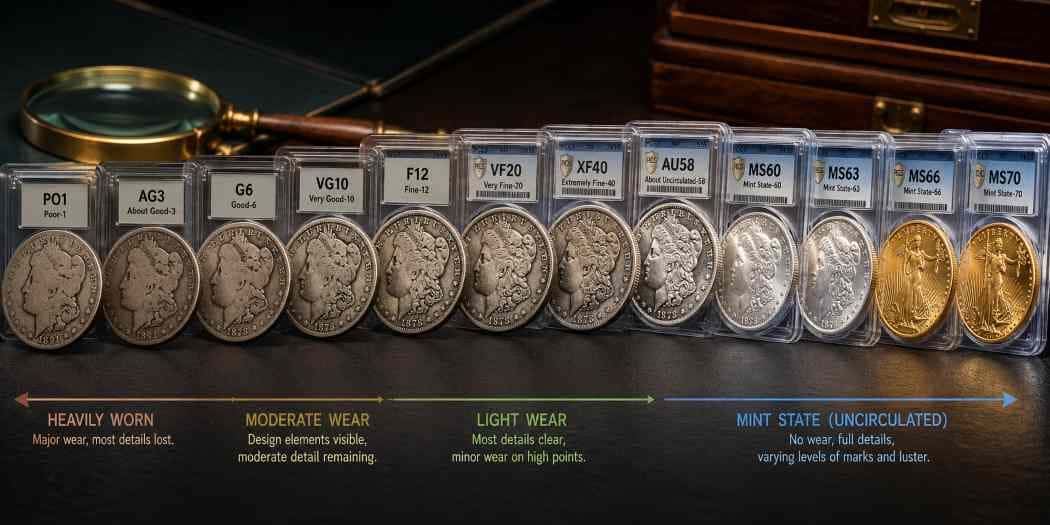
Why Coin Grades Matter More Than Ever in Today’s Market
The coin market has become increasingly condition-sensitive as bullion demand, registry competition, and certified numismatic investing continue expanding. A small difference in grade can dramatically affect a coin’s market value, especially for key dates, low-mintage issues, and modern collector releases. In some cases, a one-point increase on the Sheldon grading scale can mean the difference between a common collectible and a five-figure rarity.
As gold and silver spot prices remain elevated and collectors focus more heavily on quality, understanding the Sheldon grading scale has become essential for both investors and numismatists. Whether evaluating Morgan Dollars, Saint Gaudens gold coins, Lincoln cents, or modern bullion releases, the 1–70 grading system remains the universal standard that determines condition, scarcity perception, liquidity, and long-term collectible value.
The Sheldon Grading Scale Became the Industry Standard
The Sheldon grading scale originated in 1949 through the work of Dr. William Sheldon, who initially developed the system for early large cents. Over time, the framework expanded across all U.S. coinage and eventually became the dominant grading standard used by professional grading services such as PCGS and NGC.
The system ranges from PO1 (Poor-1) through MS70 (Mint State-70) and creates a structured way to evaluate preservation, strike quality, wear, luster, surface integrity, and eye appeal.
Today, the scale influences:
-
Auction pricing
-
Registry competition
-
Dealer buy/sell spreads
-
Investment-grade certification
-
Bullion-premium calculations
-
Insurance valuations
-
Estate appraisals
Without standardized grading, the modern rare coin market would struggle to maintain consistency and liquidity.
Understanding the Difference Between Circulated and Mint State Coins
The Sheldon grading scale divides coins into two primary categories:
-
Circulated coins
-
Mint State or Proof coins
Circulated coins show varying degrees of wear from commercial use, while Mint State coins display no actual circulation wear, even if they contain marks or imperfections from storage and handling.
This distinction is critical because many investors mistakenly assume older coins are automatically valuable. In reality, condition often matters more than age alone. A heavily worn 1900 coin may be worth less than a pristine modern issue if the newer piece survives in exceptionally high grade.
The transition point between circulated and Mint State generally occurs at:
-
AU58 (About Uncirculated)
-
MS60 (Mint State)
That boundary can significantly impact pricing.
PO1 Through AG3: Coins With Extreme Wear
The lowest grades on the Sheldon scale include:
-
PO1 (Poor-1)
-
FR2 (Fair-2)
-
AG3 (About Good-3)
Coins in these grades are heavily worn, often with partial rims, weak lettering, and major design loss. Dates and mint marks may barely remain visible.
While these grades sound undesirable, they still matter for several reasons:
-
Key-date coins may retain substantial value even heavily worn
-
Certain collectors intentionally pursue lowball sets
-
Authenticity remains important regardless of condition
-
Historic rarity can outweigh appearance
For example, an authentic 1916-D Mercury dime graded PO1 may still command significant premiums because of its rarity.
Low-grade collecting has actually become more popular in recent years due to affordability and niche registry competition.
G4 Through VG10: The Foundation of Early Coin Collecting
The Good and Very Good range includes:
-
G4 (Good-4)
-
G6 (Good-6)
-
VG8 (Very Good-8)
-
VG10 (Very Good-10)
Coins in this category display heavy circulation but retain stronger outlines and readable legends. Major design features remain identifiable, although finer detail is mostly gone.
This range is common among:
-
Early American copper
-
Seated Liberty coinage
-
Barber coinage
-
Key-date silver coins
-
Colonial-era pieces
Many classic 19th-century rarities are most accessible in these grades because higher-condition examples may become prohibitively expensive.
Collectors often prefer problem-free originality over artificially bright or cleaned higher-grade pieces.
Fine and Very Fine Grades Begin Showing Stronger Detail
The Fine and Very Fine categories include:
-
F12 (Fine-12)
-
F15 (Fine-15)
-
VF20 (Very Fine-20)
-
VF25
-
VF30
-
VF35
At this level, moderate wear remains present, but considerably more detail becomes visible. Hair strands, feathers, shield lines, and other design elements begin appearing clearly.
This range represents a balance between affordability and visual appeal for many collectors.
Key characteristics include:
-
Moderate but even wear
-
Clear major design definition
-
Full readable legends
-
Stronger eye appeal
-
Improved collector desirability
Many historical U.S. silver and gold coins trade actively within the VF range because they maintain attractive appearance without the extreme premiums attached to Mint State examples.
Extremely Fine and About Uncirculated Coins Command Strong Demand
The upper circulated range includes:
-
EF40 / XF40 (Extremely Fine-40)
-
EF45
-
AU50 (About Uncirculated-50)
-
AU53
-
AU55
-
AU58
Coins here show only light wear on the highest design points while retaining substantial original detail and partial mint luster.
AU58 is especially important in the modern market because it often resembles Mint State visually while trading at significantly lower prices than equivalent uncirculated examples.
Investors frequently target AU gold coins because they offer:
-
Historic appeal
-
Lower premiums than MS examples
-
Strong visual quality
-
Better liquidity
-
Reduced downside relative to top-population registry pieces
Pre-1933 U.S. gold commonly trades within the AU range due to its balance of affordability and preservation.
MS60 Through MS70 Defines the Mint State Spectrum
Mint State coins display no circulation wear, but quality still varies dramatically across the MS scale.
The range includes:
-
MS60–MS62: heavily marked uncirculated coins
-
MS63–MS64: average collector-grade Mint State
-
MS65–MS66: premium gem quality
-
MS67–MS68: elite preservation
-
MS69–MS70: near-perfect or theoretically perfect condition
Many investors misunderstand Mint State grading because they assume all uncirculated coins are equal. In reality, contact marks, weak strikes, poor luster, spotting, and eye appeal can drastically separate values.
For example:
-
A common Morgan Dollar in MS63 may trade near bullion-related levels
-
The same coin in MS67 could command thousands of dollars
Condition rarity often becomes more important than absolute mintage.
MS70 Represents Technical Perfection
MS70 is the highest numerical grade possible on the Sheldon grading scale.
A perfect MS70 coin displays:
-
No post-production imperfections visible under magnification
-
Exceptional strike quality
-
Full original luster
-
Outstanding eye appeal
-
Virtually flawless surfaces
Modern bullion coins frequently pursue MS70 certification because investors and registry collectors compete heavily for perfect populations.
However, true perfection remains extremely difficult to achieve consistently. Small grading differences can substantially impact pricing, especially for:
-
American Silver Eagles
-
First-release modern issues
-
Limited-edition mint products
-
Low-population modern rarities
MS70 premiums sometimes reflect registry demand more than intrinsic metal value.
Proof Coins Use a Different Prefix System
Proof coins are graded using the same 1–70 scale but use “PF” or “PR” prefixes instead of Mint State designations.
Examples include:
-
PF69
-
PR70DCAM
-
PF70UCAM
Proof coins differ from business strikes because they are specially manufactured using polished dies and planchets designed for collectors.
Additional proof designations may include:
-
Cameo (CAM)
-
Deep Cameo (DCAM)
-
Ultra Cameo (UCAM)
These terms describe contrast between frosted devices and mirrored fields.
Modern proof bullion products often carry substantial premiums due to low mintages, presentation quality, and collector demand.
Surface Quality and Eye Appeal Influence Grading Heavily
Technical wear alone does not determine a coin’s grade.
Professional grading services also evaluate:
-
Luster
-
Strike sharpness
-
Surface preservation
-
Cleaning
-
Toning
-
Scratches
-
Spots
-
Eye appeal
Two coins with identical wear may receive different grades based on visual presentation.
Eye appeal has become increasingly important as registry-set competition and high-resolution auction photography shape buyer behavior. Attractive natural toning, clean surfaces, and strong original luster often command premiums beyond the assigned numerical grade.
This is especially true for:
-
Rainbow-toned Morgan Dollars
-
Blast-white silver coins
-
Original copper coloration
-
Frosty Saint Gaudens gold
Market grading today combines technical evaluation with commercial desirability.
Third-Party Grading Changed the Coin Market Structure
Before third-party grading became dominant in the 1980s, grading disagreements created major pricing inconsistencies.
Today, companies like:
-
PCGS
-
NGC
-
CACG
provide standardized authentication and encapsulation services that dramatically improved market liquidity.
Certified grading helps:
-
Reduce counterfeiting risk
-
Stabilize pricing transparency
-
Improve online trading confidence
-
Create registry competition
-
Facilitate auction sales
-
Support investor participation
This institutional infrastructure transformed rare coins into a more investable alternative asset category.
Modern Bullion Investors Increasingly Care About Grade
The Sheldon grading scale no longer applies only to rare historical coins.
Modern bullion buyers now actively pursue:
-
MS70 Silver Eagles
-
PF70 Gold Eagles
-
First-strike labels
-
Special mint designations
-
Low-population registry coins
This trend reflects the merging of bullion investing and numismatic collecting.
A standard bullion coin may trade primarily for metal value, while the same coin in perfect certified condition may command significantly higher premiums due to collector demand and registry scarcity.
Understanding grading therefore helps investors distinguish:
-
Metal value
-
Numismatic value
-
Registry value
-
Population rarity
-
Long-term liquidity potential
The Sheldon Scale Remains the Backbone of Modern Numismatics
The Sheldon grading scale continues shaping nearly every part of the modern coin market because condition directly influences scarcity perception, demand, liquidity, and investment performance.
From heavily worn PO1 rarities to flawless MS70 registry pieces, the scale provides a universal language for collectors, dealers, grading services, and auction houses worldwide.
As precious metals prices rise and certified coin demand expands, understanding the 1–70 grading system becomes increasingly important for anyone buying, selling, inheriting, or investing in coins. A small grading difference can dramatically change value, and recognizing those distinctions helps collectors make more informed decisions in both bullion and numismatic markets.
Related reading you may find interesting:
PCGS First Strike vs First Day of Issue Explained