View Charts
Oil Prices and Gold: Why the Iran Conflict Moves Markets
 0
0
How the Iran Conflict Is Driving Oil and Gold Volatility
Recent geopolitical developments in the Middle East have brought renewed attention to the relationship between energy markets and precious metals. The conflict involving Iran, which began in late February, has created sharp volatility in global oil markets and renewed investor concern about inflation, supply disruptions, and geopolitical instability. Traders have been closely watching developments around the Strait of Hormuz, one of the most critical energy shipping routes in the world and responsible for a significant portion of global crude oil transport.
In the early days of the conflict, oil prices surged above $100 per barrel, with some trading sessions approaching $120 as markets reacted to the possibility of supply disruptions. This sudden spike in energy prices immediately raised inflation concerns and sent investors searching for safe-haven assets.
Because of these macroeconomic connections, movements in the energy market often influence the gold spot price and broader precious metals markets. When oil prices rise sharply, the resulting inflation fears, currency shifts, and geopolitical uncertainty frequently drive investors toward tangible assets such as gold and silver.
Understanding how oil prices influence precious metals has become particularly relevant today as global markets respond to the ongoing conflict and its potential economic consequences.
Why Oil Prices Can Influence Gold Markets
Oil is one of the most important commodities in the global economy. Energy costs affect transportation, manufacturing, agriculture, and industrial production, meaning that major oil price movements often ripple across financial markets.
When oil prices rise significantly, production and transportation costs increase across multiple sectors. Businesses frequently pass these higher costs on to consumers, which can contribute to rising inflation.
Gold has historically been viewed as a hedge against inflation, which means periods of rising energy costs can increase demand for gold bullion. When inflation expectations rise, investors often move capital into precious metals, pushing the gold price higher.
Silver can also benefit during commodity-driven inflationary cycles. Because silver functions as both a monetary metal and an industrial commodity, rising resource prices can sometimes influence the silver spot price as well.
The Inflation Connection Between Oil and Precious Metals
Inflation remains one of the strongest links between oil and the gold market. Energy costs affect nearly every aspect of the global economy, making oil price shocks a major driver of inflation expectations.
When oil prices surge:
-
Transportation costs rise
-
Manufacturing becomes more expensive
-
Agricultural production costs increase
-
Consumer prices often move higher
During these periods, investors often seek protection in assets that historically preserve purchasing power. Gold has served this role for centuries, which explains why the spot price of gold frequently responds to energy-driven inflation shocks.
The U.S. Dollar Link Between Oil and Gold
Another important connection between oil and gold lies in the global currency system. Both commodities are priced internationally in U.S. dollars.
When the dollar weakens:
-
Oil becomes cheaper for foreign buyers
-
Precious metals become more attractive globally
This dynamic can lead both oil and gold to rise at the same time.
Conversely, when the U.S. dollar strengthens, both markets can face downward pressure. Currency fluctuations therefore create another indirect link between energy markets and precious metals prices.
Energy Costs and Gold Mining
Oil prices also affect the cost of producing gold. Mining operations require large amounts of energy for equipment, transportation, and ore processing.
Higher energy prices can increase production costs for mining companies, particularly for operations located in remote regions where transportation and fuel expenses are significant. Over time, rising mining costs can influence the supply side of the gold market and contribute to higher long-term price floors for precious metals.
For this reason, analysts monitoring the gold price today often pay close attention to energy markets when evaluating mining economics and future supply trends.
Three Historical Periods When Oil and Gold Moved Together
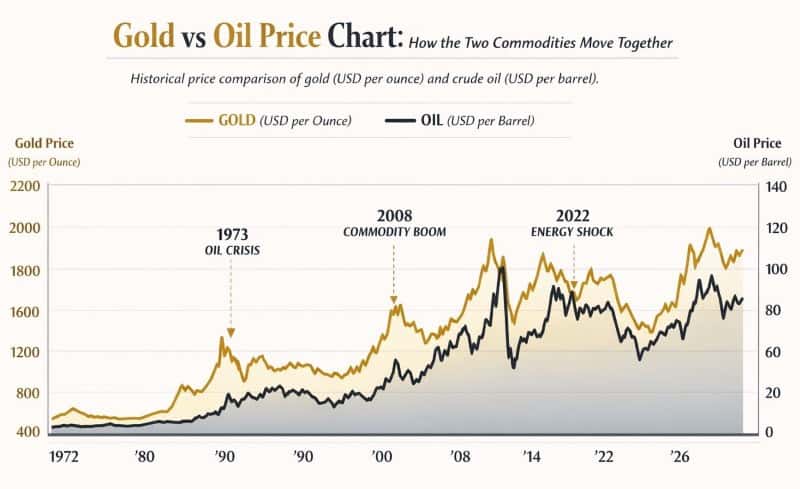
Throughout modern economic history, several major global events have caused oil and gold to rise together dramatically. These episodes demonstrate how inflation, geopolitical tension, and commodity cycles can drive both markets simultaneously.
The 1973 Oil Crisis and the Largest Gold Bull Market
One of the most dramatic examples occurred during the 1973 oil crisis. In October 1973, the Organization of Petroleum Exporting Countries (OPEC) imposed an oil embargo in response to geopolitical tensions in the Middle East. The embargo severely restricted oil supplies to Western nations and caused energy prices to skyrocket.
Oil prices quickly quadrupled, triggering severe inflation throughout the global economy. As inflation surged and economic uncertainty spread, investors turned to gold as a store of value.
At the time, gold had only recently been freed from the Bretton Woods system, which had fixed the price of gold at $35 per ounce. Once gold began trading freely, the combination of inflation, currency instability, and energy shocks created a powerful bull market.
Between the early 1970s and 1980, the gold price rose from approximately $35 per ounce to nearly $850 per ounce, representing one of the largest precious metals rallies in modern financial history. The oil crisis played a major role in triggering this extraordinary move.
The 2000–2008 Commodity Supercycle
Another major period of correlation occurred during the global commodity boom of the early 2000s. Rapid industrialization in China and expanding global demand for raw materials drove energy and metals prices sharply higher.
During this period:
-
Oil rose from roughly $20 per barrel to more than $140
-
Commodity demand surged globally
-
Gold climbed from about $270 per ounce to over $1,000
Rising energy prices helped fuel inflation expectations and encouraged investors to increase exposure to hard assets such as gold bullion.
The 2022 Energy Shock
More recently, geopolitical tensions surrounding the Russia-Ukraine conflict disrupted global energy markets and caused oil prices to surge above $120 per barrel in 2022.
At the same time:
-
Inflation reached multi-decade highs
-
Global economic uncertainty increased
-
Investors sought safe-haven assets
Gold responded by approaching record price levels as investors looked for protection against rising prices and geopolitical instability.
When Oil and Gold Move in Different Directions
Although oil and gold often move together during inflationary periods, the relationship is not always consistent. Interest rate policy, economic growth expectations, and currency movements can cause the two commodities to diverge.
For example, when central banks raise interest rates aggressively, the U.S. dollar often strengthens. A stronger dollar can suppress the gold prices, even if oil remains elevated due to supply constraints.
Because of these factors, the oil-gold relationship should be viewed as a macroeconomic influence rather than a fixed rule.
Why the Oil–Gold Relationship Matters Today
The ongoing conflict involving Iran highlights why investors continue to monitor energy markets when evaluating precious metals. Sharp increases in oil prices can quickly influence inflation expectations, global trade costs, and economic stability.
Recent volatility in crude oil markets—driven by concerns about potential supply disruptions in the Middle East—has already created significant uncertainty across financial markets. When energy prices rise rapidly, inflation concerns tend to follow, prompting investors to seek protection in assets such as gold and silver.
For those watching the gold spot price today, the relationship between oil markets, inflation expectations, and geopolitical risk remains a critical piece of the broader economic picture. As global events continue to unfold, the interaction between energy prices and precious metals will likely remain an important driver of investor behavior in commodity markets.
Related reading you may find interesting:
Trump Iran Deadline: Civilization Threat and Gold Impact