View Charts
July's Unexpected Surge: Wholesale Prices Rise 0.3%
 0
0
Source: Canva
Recent economic data has provided yet another unexpected twist to the ongoing inflation narrative.
In a move that caught many off-guard, the producer price index (PPI) – a metric that tracks the costs received by producers for their goods and services – rose 0.3% in July.
This marked the steepest monthly increase since the start of the year and comes after a stagnant June reading.
Breaking Down the PPI Numbers
The Bureau of Labor Statistics' (BLS) latest release shed light on the unexpected inflationary pressures building up in the wholesale space. A granular glance at the data reveals:
- Core PPI: Stripping out the often-volatile food and energy categories, core PPI too recorded a 0.3% uptick. This surge, the highest since November 2022, came after a 0.1% dip in June. When mapped on a 12-month basis, the core PPI clocked a 2.4% rise, a figure that mirrors the lowest record since January 2021.
- Anticipations Versus Reality: Economists polled by Dow Jones had pegged the likely rise at 0.2% for both standard and core PPI readings. While the standard index matched these expectations when food, energy, and trade services were excluded, the core reading surpassed them.
- Year-over-Year Trends: The headline PPI managed a year-over-year climb of a modest 0.8%. However, when omitting food, energy, and trade services, this figure touched 2.7% – consistent with June's numbers.
Market Reactions and Drivers
These surprising figures jolted the markets. Post the report, Dow Jones Industrial Average futures slipped, shedding approximately 70 points.
Meanwhile, the benchmark 10-year Treasury note yield edged up, clocking in at 4.137%, marking a 0.06 percentage point jump.
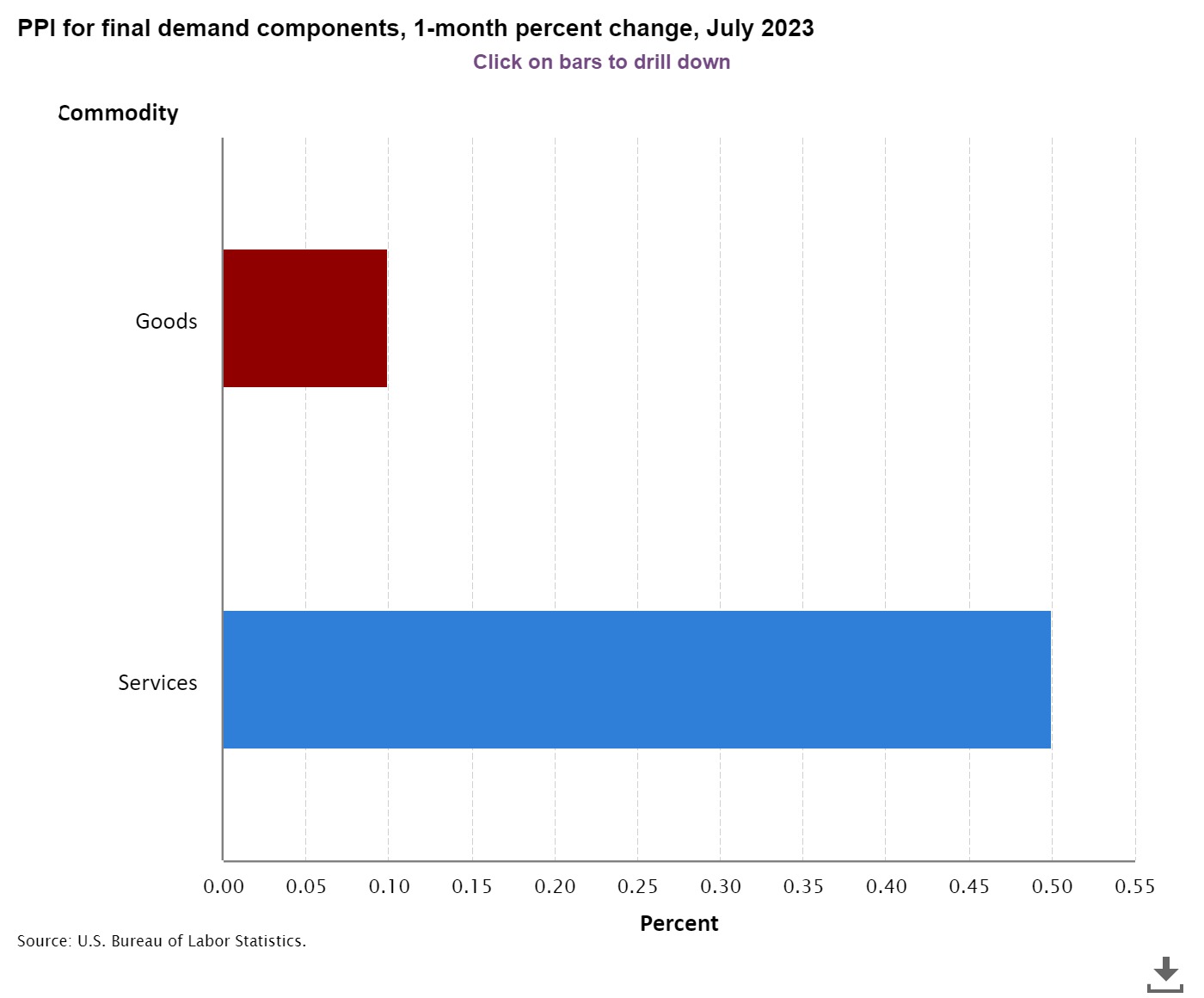
A deeper dive into the data attributes much of this inflationary push to the services sector. Services costs leaped by 0.5% in July, the highest since August the previous year.
Portfolio management fees, reflective of investment advice costs, skyrocketed by 7.6%.
Moreover, trade services experienced a 0.7% price escalation, accompanied by a 0.5% rise in transportation and warehousing costs.
Conversely, goods prices showed a mere 0.1% ascent. While food prices moved up by 0.5%, with meats seeing a considerable 5% increase, prices excluding these volatile components remained steady.
The energy sector painted a diverse picture, with increased costs for many gas fuels but a significant 7.1% drop in diesel prices.
The Larger Inflationary Picture
Interestingly, the PPI's revelation comes on the heels of the BLS announcement that the widely monitored consumer price index (CPI) also rose by 0.2% for July. This was both for headline and core readings.
Despite the CPI's 12-month rate standing at 3.2%, slightly below expectations, it solidified arguments for a relaxation in inflationary pressures.
Federal Reserve authorities closely monitor both PPI and CPI. Although CPI often finds itself in the limelight, many consider the PPI as a precursor, giving insights into the cost trajectory for an array of products and services.
The larger debate among policymakers revolves around the future trajectory of interest rates. With 11 hikes, summing up to 5.25 percentage points since March 2022, recent murmurs hint at a possible end to this rising trend as inflation aims for the Federal Reserve's 2% long-term objective.
With the markets almost certain that the Federal Reserve will bypass a rate surge in its upcoming September meet, all eyes remain on how the U.S. economy grapples with these inflationary dynamics.
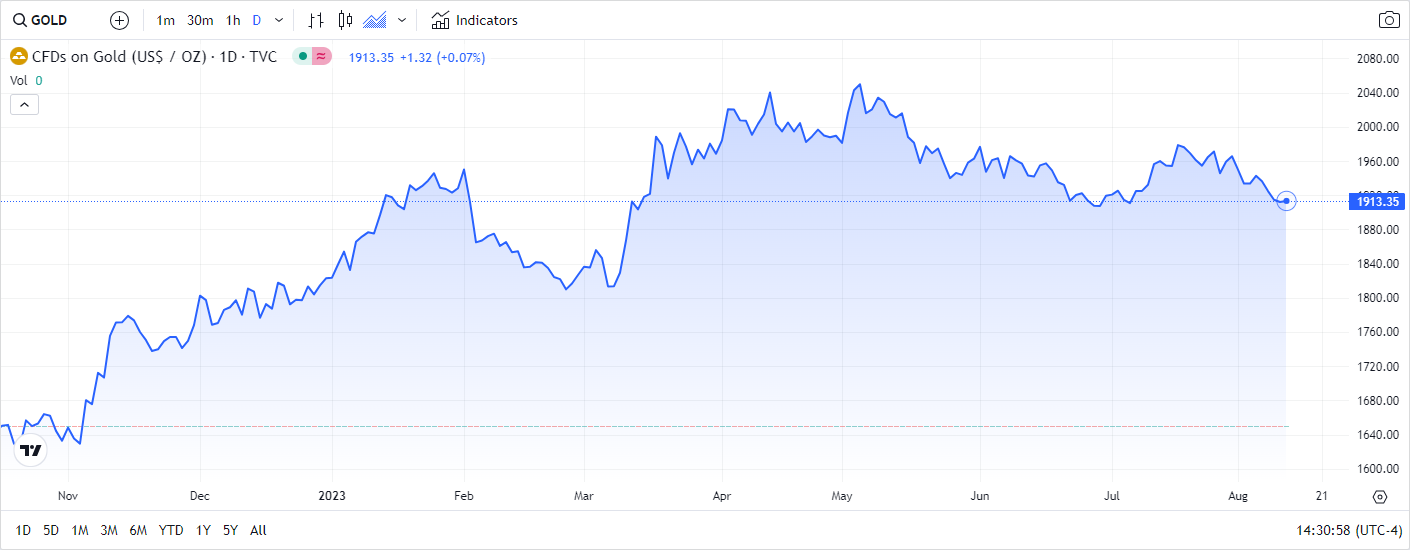
Today in precious metals, gold prices rose 0.07% to $1,913.35 per ounce. Silver dropped 0.04% to $22.68 per ounce. Platinum decreased by 0.11% to $908.00 per ounce, while Palladium spiked by 1.09% to $1,299.01 per ounce. Bitcoin sunk 0.26% to $29,346.00.
What potential impacts could the unexpected rise in July's PPI have on future monetary policies and the overall economic outlook?
Frequently Asked Questions (FAQs) about July's Wholesale Price Rise
-
What is the Producer Price Index (PPI)?
- The PPI is a metric that tracks the costs received by producers for their goods and services. It gauges the costs that goods and services producers receive for their products as opposed to those that consumers pay.
-
How much did the PPI increase in July 2023?
- In July 2023, the PPI rose by 0.3%. This marked its largest monthly increase since January of that year.
-
How does the Core PPI differ from the standard PPI?
- Core PPI excludes volatile categories like food and energy to provide a more stable measure. In July, Core PPI also registered a 0.3% increase.
-
How did the market respond to the PPI report?
- Following the release of the PPI report, Dow Jones Industrial Average futures dropped by roughly 70 points. Treasury yields, particularly the benchmark 10-year note, also saw an uptick.
-
Which sectors saw the most significant price changes in July?
- The services sector experienced the most substantial increase, with a 0.5% rise in costs. Within this, portfolio management fees surged by 7.6%, and trade services prices grew by 0.7%.
-
How did goods prices perform in comparison to services?
- Goods prices recorded a modest 0.1% rise, with food prices specifically going up by 0.5%. In contrast, energy showcased a mixed picture with costs for many gas fuels increasing, but diesel saw a decline of 7.1%.
-
How does the Consumer Price Index (CPI) relate to the PPI?
- The CPI is another measure that tracks inflation but focuses on the price consumers pay for goods and services. In July, the CPI also rose by 0.2%, both on the headline and core readings.
-
What's the Federal Reserve's stance on the current inflation trend?
- While the Federal Reserve closely monitors both PPI and CPI, there's an ongoing debate on the future direction of interest rates. Given the 11 rate hikes since March 2022, some indications suggest a possible halt as inflation aims for the Federal Reserve's 2% long-term objective.