View Charts
Is $50,000 Gold Possible? 2025 Insights and Scenarios
 0
0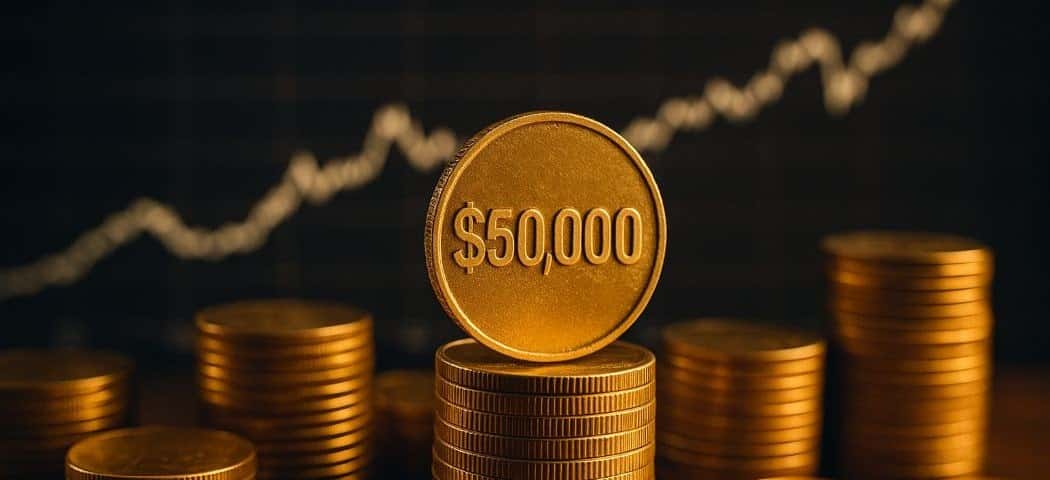
2025: A Defining Year for Gold
The year 2025 has already been historic for gold. Prices have surged past $3,600 per ounce, setting all-time highs and capturing global headlines. For investors, this rally has reaffirmed gold’s role as the ultimate safe-haven asset in times of economic and political uncertainty. But the extraordinary question remains: Could gold ever reach $50,000 per ounce?
What’s Driving Gold in 2025?
Gold’s current trajectory reflects several powerful forces:
-
Federal Reserve Policy: Anticipated rate cuts are pushing real yields lower.
-
Inflation Concerns: Even with moderation, sticky inflation keeps gold attractive.
-
Dollar Weakness: A softer U.S. dollar boosts international demand.
-
Geopolitical Risks: Conflicts and trade disputes sustain safe-haven flows.
These drivers explain gold’s climb above $3,600. But the leap to $50,000 would require a seismic monetary reset.
Is $50,000 Gold Really Possible?
Analysts estimate that to fully back the U.S. money supply, gold would need to be revalued at $50,000–$60,000 per ounce. On a global scale, with broad money exceeding $100 trillion, the price could be even higher.
This isn’t a projection of market momentum but a scenario of systemic revaluation — effectively the reintroduction of some form of the gold standard, where gold’s role in the monetary system fundamentally changes.
Historical Parallels: Radical Shifts Are Not New
History shows that dramatic gold price resets have happened before:
-
1933 Roosevelt Revaluation: FDR raised gold’s official price from $20.67 to $35, a 69% jump overnight, to combat the Great Depression.
-
1971 Nixon Shock: By ending dollar convertibility to gold, President Nixon unleashed a free-market era where gold climbed more than 20x within a decade.
These episodes reveal that when trust in money falters, governments are willing to revalue gold sharply. $50,000 per ounce may sound extreme, but history proves radical change is possible.
When and What Would Have to Happen?
For gold to approach $50,000, extraordinary conditions would be necessary — and importantly, there is no realistic foreseeable timeline for such a scenario. The convergence of multiple catastrophic events would likely be required:
-
Return to the Gold Standard: A decision by major economies to back currencies with gold reserves, forcing a systemic revaluation.
-
Currency Crisis: A collapse of trust in fiat money, driving governments and citizens alike back toward tangible, hard assets.
-
Debt or Inflation Shock: Hyperinflation or an unsustainable debt spiral that destabilizes financial systems and demands a reset.
-
Global Agreement: Unprecedented coordination among leading economies to re-anchor value in gold — a politically complex and unlikely undertaking.
Without these simultaneous conditions, the path to $50,000 gold remains speculative, serving more as a thought experiment than a realistic near-term forecast.
Central Bank Behavior: A Key Clue
Central banks have been net buyers of gold for over a decade, diversifying away from the U.S. dollar. In 2022 and 2023, global central bank purchases hit multi-decade highs. If they were to shift toward explicitly revaluing their reserves as part of a monetary reset, it could be one of the triggers for $50,000 gold.
Investor Strategies in a $50,000 Scenario
-
Physical Bullion Wins Big: Owners of coins and bars would see enormous wealth appreciation.
-
Numismatic Edge: Rare coins could command even higher premiums as both collectibles and bullion.
-
Silver as a Hedge: Silver may rise as the “poor man’s gold,” especially if gold becomes scarce.
-
ETFs vs. Physical: Exchange-traded products might track gains, but direct possession of bullion would carry the strongest claim in a reset world.
-
Diversification Still Matters: Even in a revaluation, volatility and liquidity risks would remain. Investors would need balanced portfolios to weather the transition.
Technical Outlook: Linking Present to Possibility
At current levels, gold faces resistance around $3,600–$3,650, with support near $3,500. Technically, a sustained close above resistance could open the door to $3,700–$3,750 in the near term. But long-term speculation on $50,000 gold highlights the contrast between short-term chart levels and long-term monetary scenarios.
Would the Gold Standard Return?
The Bretton Woods system that tied currencies to gold ended in 1971. Advocates argue that returning would restore discipline, but critics note it would be impractical given modern global trade volumes. The sheer scale of the world economy dwarfs gold reserves, making full convertibility nearly impossible without massive revaluation.
A Stress Test for Modern Money
While $50,000 gold is unlikely under today’s conditions, the thought experiment forces us to examine the fragility of fiat systems. History shows governments revalue gold when trust breaks down. In an era of ballooning debt, inflation fears, and rising interest in digital currencies, gold remains the anchor of confidence.
For investors, the lesson is timeless: whether gold trades at $3,600 or $50,000, it is still the ultimate hedge against uncertainty and the foundation of wealth preservation.
Another article that may interest you:
Could Silver Reach $1,000 an Ounce? 2025 Outlook