View Charts
Gold to Silver Ratio (GSR)
 0
0The gold to silver ratio (GSR) is the number of ounces of silver you need to purchase one ounce of gold. The timeline of the more aggressive move lower we were anticipating over the last several months has not been so. Instead, the ongoing consolidation between 65 – 74 on the ratio moves toward the upper end of the range over the last few weeks. This is as the gold price has remained steady above $1,260. Silver price falls to the low $17 range again. Recall that a rising Gold to Silver Ratio tends to correspond with falling gold and silver prices. We see this from 2011 to late 2015. The final close on the Gold to Silver Ratio was 73.4 as of Friday afternoon. 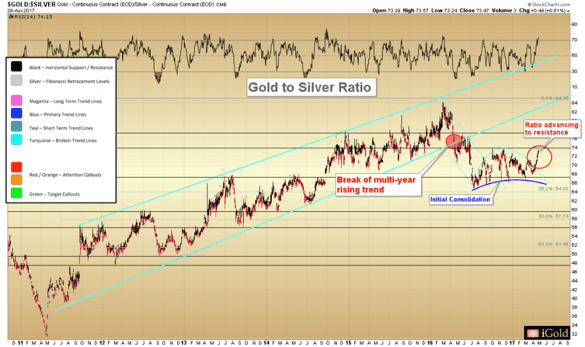 Still, the most crucial facet of the above chart is to note that the ratio remains healthfully below the 2011 – 2016 broken rising trend channel. (turquoise lines). This breakdown has held for over a year. It would be rare for such a decline to reverse and make new highs during the current cycle. It was the breaking of this clearly defined trend channel that alerted us to the changing nature of the precious metals market in early 2016. The ratio has not moved lower in favor of silver for the last few months. Still, it remains within the confines of an initial consolidation after the multi-year breakdown. Currently, the ratio is facing significant resistance at the 74 levels.
Silver to Catch Up
We Confirm evidence for silver to play catch up. You can see this from a study of the momentum of the ratio’s recent advance. This reaches the highest reading since late February 2016. The following chart contains the last two years of the GSR. The momentum indicator (RSI) is on top. The Gold to Silver Ratio is immediately below. It follows by the price of gold. Then follows the price of silver. They all plot along with the same timescale. Let us scrutinize it: The last time the RSI momentum indicator reached above 70 was in February 2016. This was when gold started advancing to nearly $1,260. It was clearly exceeding the previous peak from 2015 at $1,190. Even so, at that moment silver was “stuck” at $14.75. It was failing to eclipse its relative 2015 peak of $16.25. We should recall this early-2016 episode carefully. Many analysts at the time assert that the move in gold was suspect. This is because silver was not “confirming” gold’s advance each day. At the time we did not agree. We felt that other technical indicators were confirming a more significant advance to come in both metals. The lag in the move higher for silver was typical of early-cycle progress in the sector. What we can see at right is: The last time the GSR momentum RSI (top of the chart) reached 70--it marked the absolute high in the ratio. This was February 2016.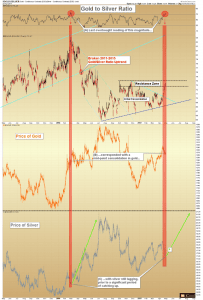 February 2016 also marked a mid-point consolidation in gold after a strong advance. Silver was lagging gold’s advance. It was only to play catch-up over the next four months. The takeaway is that silver does not need to confirm gold’s move across every timeframe. Silver can lag for weeks; months; or even years in certain instances. This does not negate the validity of gold. Nor does it negate the final catch-up effect that we can see in silver itself.
2008 – 2011 Example
Consider an example from the last precious metals advancing cycle. Gold peaks in March 2008 at $1,033 per ounce. Silver peaks at the same time at $21.50. After the crash of 2008-2009, gold regains its losses. It went on to several new all-time highs into 2010. First, it went above $1,033. Then, it went above $1,100. Finally, it went above $1,250. All the while, silver remains below its 2008 peak of $21.50. It was certainly frustrating for silver investors over at least 12 months.
Gold to Silver Ratio with prices of gold & silver: 2008 - 2010
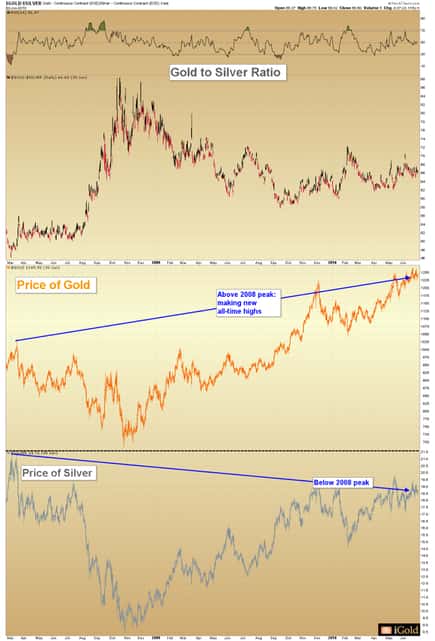 However, was gold’s advance suspect because silver was not confirming it? Or, was this an opportunity to accumulate silver, before the period of catch-up? The following extended version of the above chart will tell:
Gold to Silver Ratio with prices of gold & silver: 2008 - 2011
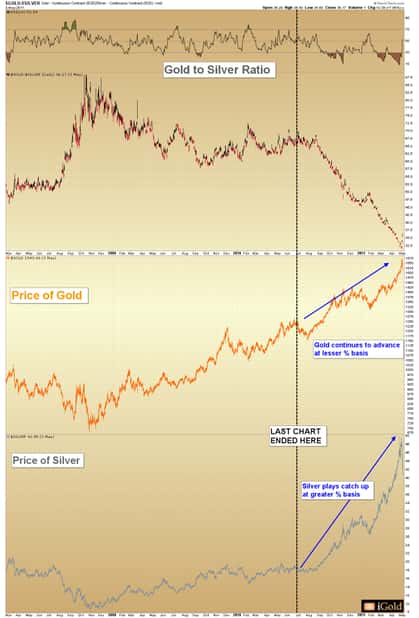 Note that the black vertical line shows the ending of the preceding chart. From that point in mid-2010, silver then advanced 180% toward its 2011 peak. Meanwhile, gold advanced 25% over the same timeframe. The primary point of this analysis is to be wary of analysts who claim that silver must confirm gold’s moves across every period. As silver investors, we must prepare to watch gold lead sometimes for weeks; months; or years. Other technical indicators must determine whether or not we are in a primary advancing cycle in the precious metals. It is not sufficient to merely watch silver lag and label the move suspect. The present opportunity looks ripe for silver to begin playing catch up over the near term. This is even if there are further periods of lag to come as the metal's advance through 2018. Our long-term target is for silver to reach at least 17-1 on the GSR. The level at the 1980 precious metals peak of $850 gold and $50 silver.
Christopher Aaron, Bullion Exchanges Market Analyst Christopher Aaron has been trading in the commodity and financial markets since the early 2000s. He began his career as an intelligence analyst for the Central Intelligence Agency. This is where he specialized in the creation and interpretation of pattern-of-life mapping in Afghanistan and Iraq. Technical analysis shares many similarities with mapping. They both base on the observations of repeating and embedded patterns in human nature. His strategy of blending behavioral and technical analysis has helped him and his clients. It helps to identify both long-term market cycles and short-term opportunities for profit. This article is a third-party analysis. It does not necessarily match the views of Bullion Exchanges. Readers should not consider it as financial advice in any way.
Articles you may like Should You Rollover Your 401k into a Gold IRA, Palladium Prices Soar as Supply Sags, US Mint Revamps 2021 American Eagle Coin Reverse.