View Charts
Gold and Silver Price Approaching Interim Lows
 0
02016 has been one of the most volatile years on record for the gold and silver price. The best first-half performance in 40 years went to gold. Additionally, ongoing retracement has seen the bulk of the gains for the metal itself given back.
False Rally?
These moves have left many wondering if this was just a "false rally" in the price of gold. It is on the way to a continuation of the 2011-2015 bear market. No one can ever say with 100% certainty what the future will bring. With a clear technical view of the markets, we are now in the best possible position to capture the moves that lie ahead. Of course, this is when they do indeed materialize. As there are still four trading days left in the year, we will wait until next week to offer a full 2016 year-end review of the precious metals markets. We will also look ahead to 2017.
Gold Analysis
The pre-Christmas week featured relatively light trading. Prices were finishing at $1,133. This was as of the final trade on the New York COMEX. This represents a loss of $3.80 (0.3%) from a week prior. Notably, this was the seventh weekly loss for gold in a row. Which is the longest such stretch since May 2004. This is an interesting statistic to contemplate. Consider, for instance, that the last time gold fell for so many weeks in a row was during the early stages of the 2001 - 2011 bull market. It was not during a bear market. The most severe (percentage per time unit) declines to happen during bull markets. This is because prices must climb a "wall of worry". Will this hold again? We will know shortly. 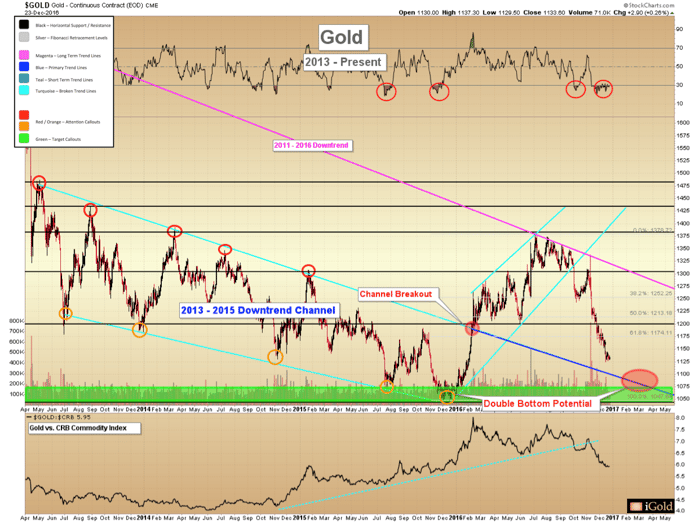
2013 - 2015 Trend Channel
Technically, gold is now within sight of the declining broken 2013 - 2015 trend channel. We have been monitoring this for several weeks. It shows in blue above. If the price were to use the broken trendline as support this week, the level to watch for a bounce would be $1,100 precisely. Such a rebound would indicate the potential for a higher-low to form in gold. The 2015 bottom zone is labeled by the green band above as between $1,045 - $1,080. We would place a stronger trust in the low if it were to form as a confluence of the broken blue trendline. With the $1,045 - $1,080 support zone. For those two regions to overlap, the bottom would need to wait for the trendline to decline from its current reading at $1,100. Based on the slope of the line, that convergence would happen between February and May of the coming year.
Oversold
Gold is still oversold mainly on the daily RSI indicator. (Red circle, top of chart). It is below the 30 levels, a reading which has corresponded with previous medium-term lows over the past 18 months. In sum, a short-term bounce should be at any moment in gold. However, long-term bottom signals still require several converging technical patterns. They are still waiting across both the metal and the mining complex.
Silver Analysis
Silver spot price fell further than gold again this week. It gave up the relative outperformance we had noted during late November and early December versus gold. For the week, silver declined 2.8% or 0.46 cents. It is to close at $15.76 as of the last trade in New York. 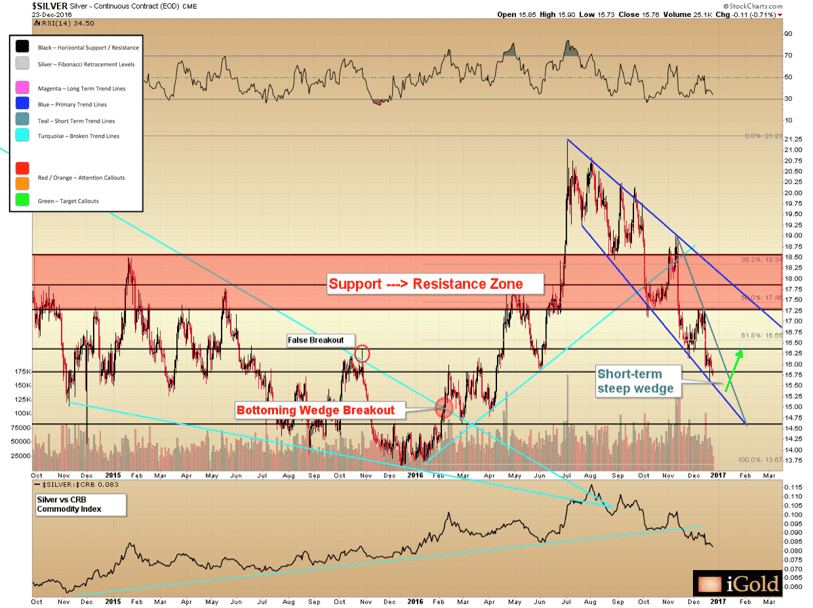
We would like to call your attention to the short-term steep wedge formation
It is now visible on the silver chart above. It shows between the teal and blue trendlines. As periodically mentioned, these wedge formations typically represent reversal or bottoming patterns. In this case, we see steep declining highs since early November. Additionally, we see fewer steep lows forming since July. Silver could fall further still within the wedge pattern. A break of the upper trendline should represent a tradable breakout for those so inclined to initiate short-term trades. On the breakout, an initial target will be $16.25. The broken support is from November, with the possibility of an advance toward $17.25. The resistance comes from early December.
However, a Word of Caution
Silver breaks from wedges as steep as above cannot be relied upon to represent terminal bottoms in and of themselves. Think of the old investment adage: "The steeper the trend, the less important the break." That comes to mind here and is relevant because the wedge in question is exceptionally steep. (For comparison, a less-steep long-term wedge was from 2013 - 2015 in the silver market. It shows a much stronger candidate for a bottom). This wedge is so steep that it may not represent the final low for this retracement in silver. However, it should mark an end to the most rigid portion of silver's decline.
Another way to visualize the steepness of silver's recent decline--
is a rebound shortly. Let's note that the slope can observe to be forming a reverse parabolic curve since the summer highs. This is approaching an infinite downward rate by late January. Such an infinite negative slope is impossible for an asset that cannot go to zero. We know that the current rate of decline will necessarily end in the next few weeks. And such should represent the tradable bounce at a minimum. The only question is: does silver make its bounce sooner? Or, after one final drop over the next two weeks? Both options are highlighted in green, below, on the SLV chart. (Proxy for silver bullion, used to show intraday price/volume data). 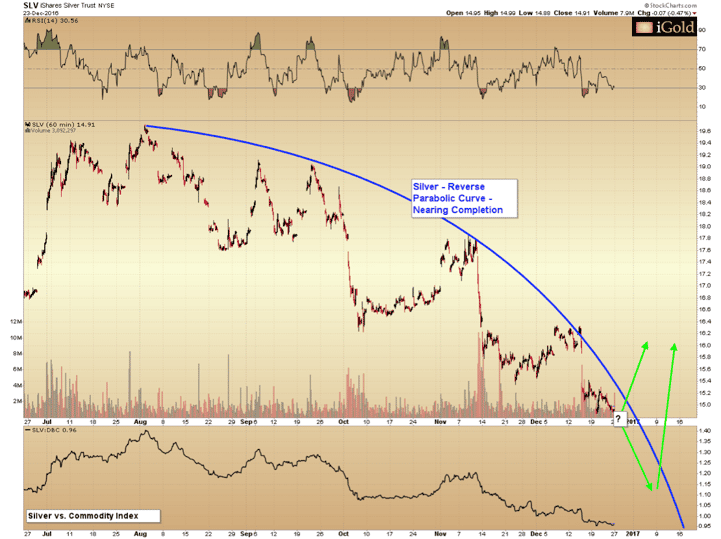 The key technical point is to watch for the break of the wedge showing on the main silver chart above. This will indicate when the worst of the retracement in silver is over. We will put the full-year relative price performance together for gold, silver, and related markets in our 2016 review. Which is next week.
More articles:
2023 Gold and Silver Libertads: Celebrating Mexico's Rich Legacy
What is a Better Investment: Gold, Silver, Platinum, or Bitcoin?
Christopher Aaron, Bullion Exchanges Market Analyst
Christopher Aaron has been trading in the commodity and financial markets since the early 2000s. He began his career as an intelligence analyst for the Central Intelligence Agency. The CIA is where he specialized in the creation and interpretation of the pattern of life mapping in Afghanistan and Iraq. Technical analysis shares many similarities with mapping. They both base on the observations of repeating and embedded patterns in human nature. His strategy of blending behavioral and technical analysis has helped him and his clients to identify both long-term market cycles and short-term opportunities for profit.