View Charts
Gold Prices Drop as Traders React to Fed Comments
 0
0
Gold prices fell while silver prices remained steady in early U.S. trading on Wednesday. This decline is attributed to recent remarks by Minneapolis Fed President Neel Kashkari, who indicated a hawkish stance on U.S. monetary policy, suggesting that interest rates may remain steady or rise if necessary. Consequently, June gold dropped by $14.90 to $2,341.60, and July silver decreased slightly by $0.007 to $32.13.
Market Overview
Asian and European stock indexes showed mixed to weaker results overnight. U.S. stock indexes are expected to open lower. Silver prices surged on Tuesday, nearing an 11-year high due to its dual role as both a precious and industrial metal. Strong economic growth and high inflation have bolstered precious metals as a hedge against rising costs, while anticipated interest rate cuts later this year could reduce the opportunity cost of holding non-interest-bearing assets.
Economic Data and Currency Trends
This week is significant for U.S. economic data releases, including the PCE inflation indexes in Friday’s personal income and outlays report. Meanwhile, the Chinese yuan hit its weakest level against the U.S. dollar since last November, and similar trends were observed with the Japanese yen, Thai baht, and Indonesian rupiah. China may be increasing its reserves of base and precious metals to mitigate the long-term effects of a weaker currency.
In other news, the Japanese yen, Thai baht, and Indonesian rupiah are also at multi-year lows against the U.S. dollar, reflecting broader currency trends in the region. Broker SP Angel suggested that China could be bolstering its metal reserves, including base metals like copper and zinc and precious metals such as silver and gold, to counter the longer-term implications of a weaker currency.
Key Market Indicators
The U.S. dollar index is slightly up, with Nymex crude oil prices trading around $80.50 per barrel. The yield on the 10-year U.S. Treasury note has risen recently to 4.57%. A Wall Street Journal article noted that the inverted U.S. Treasury market yield curve, a historical recession indicator, has been inverted for an unusually long period. The past eight U.S. economic recessions have been preceded by an inverted yield curve, and the current inversion has persisted since 2019, depending on the Treasury maturities measured.
An interesting development in the market is that one of Wall Street’s favorite recession indicators, the inverted yield curve, appears to be "broken." The inversion, where shorter-term government debt yields higher than longer-term debt, has traditionally signaled an impending recession. However, this inversion has been in place for an extended period, leading to questions about its current reliability as a predictor.
Technical Analysis
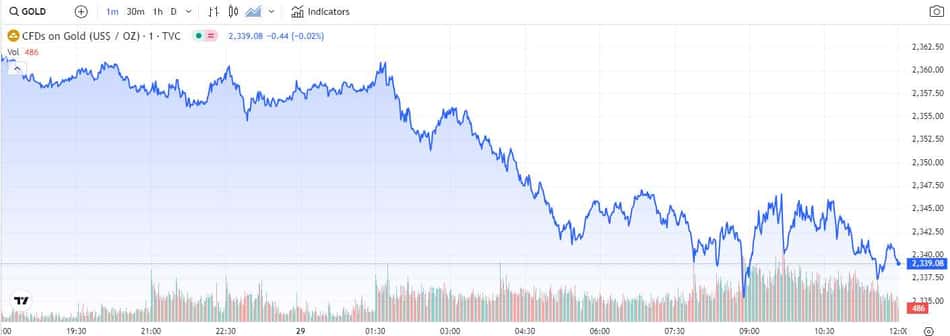
For June gold futures, bulls maintain a near-term technical advantage but have shown signs of fading. A bearish double-top reversal pattern suggests a potential market top. The bulls aim to push gold prices above the record high resistance at $2,454.20, while bears target a drop below the May low support at $2,285.20. Immediate resistance levels are at $2,365.50 and $2,375.00, with support at $2,326.30 and $2,315.00.
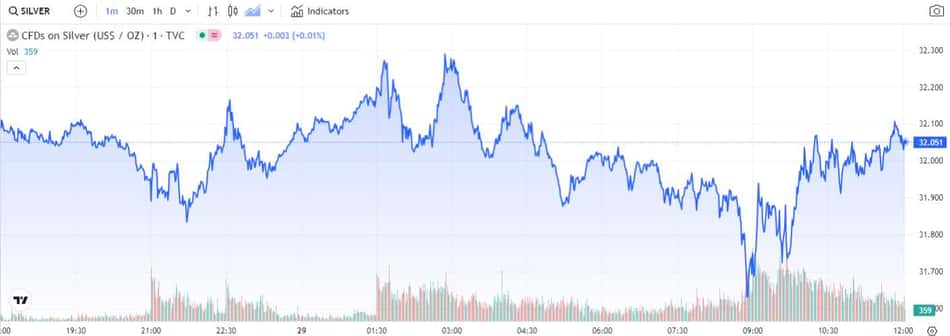
For July silver futures, bulls maintain a strong near-term advantage with a four-week uptrend. Their goal is to surpass the May high resistance at $32.75. Bears aim to drop prices below $29.00, with immediate resistance at $32.515 and support at $31.50 and $31.00.
Broader Implications and Market Sentiment
The broader market implications of these trends indicate that while gold is experiencing pressure due to hawkish monetary policy signals, silver continues to benefit from its dual role in the market. The performance of these precious metals reflects investor sentiment toward economic growth, inflation, and potential changes in interest rates. As traders and investors navigate these dynamics, the precious metals market remains a key area of focus.
Market sentiment is also influenced by expectations of future interest rate movements and the potential for economic slowdown. While gold faces bearish pressure from a hawkish monetary policy outlook, silver’s role as both a precious and industrial metal provides it with a unique advantage, especially in a high-inflation environment.
In summary, gold prices have declined due to recent Fed comments, while silver continues to gain from strong economic growth and inflation trends. Market participants will closely watch upcoming economic data releases and global currency trends for further direction. The evolving economic landscape and central bank policies will play crucial roles in shaping the future trajectories of these precious metals.