View Charts
From Wheat Pennies to Abolition: The Rise and Fall of the One-Cent Coin
 0
0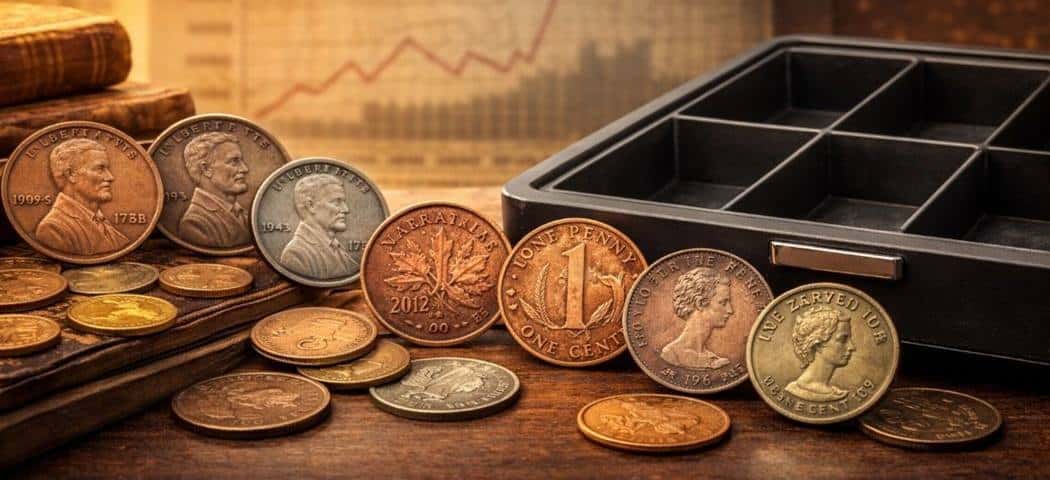
The Smallest Coin With the Biggest Story
For more than two centuries, the one-cent coin shaped everyday commerce across the globe. In the United States, Lincoln Wheat pennies became one of the most collected and searched coins in history, while similar one-cent pieces circulated in Canada, Australia, and beyond.
Yet inflation, rising production costs, and shifting payment habits have steadily reduced the cent’s practical value. From the iconic Wheat penny to the recent discontinuation of the U.S. penny in 2025 and earlier abolitions abroad, the rise and fall of the one-cent coin reflects broader economic change — and leaves collectors wondering what these small coins are worth today.
The Birth of the One-Cent Coin
The one-cent coin emerged as countries adopted decimal currency systems in the 18th and 19th centuries. By dividing a primary unit of currency into 100 smaller units, governments simplified trade and pricing.
Early cents were typically struck in copper — an affordable, widely available industrial metal. These coins allowed precise pricing and supported expanding economies during periods of industrial growth.
Over time, however, inflation eroded the purchasing power of the cent. What once bought goods became symbolic spare change.
United States: The Penny’s 232-Year Run (1793–2025)
The U.S. one-cent coin debuted in 1793 as a large copper cent. It evolved through several iconic designs, including:
-
The Indian Head cent (1859–1909)
-
The Lincoln Wheat penny (1909–1958)
-
The Lincoln Memorial cent (1959–2008)
-
The Lincoln Shield cent (2010–2025)
The Lincoln Wheat penny remains one of the most searched coins in American numismatics. Key dates such as the 1909-S VDB, 1914-D, 1922 No D, and the famous 1943 copper cent continue to command strong collector interest.
As copper prices rose and production costs exceeded face value, the penny’s economic viability declined. The U.S. Mint shifted from 95% copper to copper-plated zinc in 1982 to reduce costs.
In November 2025, the United States officially discontinued production of the one-cent coin, ending a 232-year minting history. While still legal tender, new pennies are no longer struck for circulation.
Canada: The Final Cent (1858–2012)
Canada introduced its one-cent coin in 1858. For more than 150 years, the penny played a central role in everyday commerce.
By the early 2010s, however, inflation and production costs made the coin impractical. The Royal Canadian Mint struck its final pennies in May 2012, and the coin was withdrawn from circulation in 2013.
Today, cash transactions in Canada are rounded to the nearest five cents. Though no longer minted, Canadian pennies remain collectible — particularly rare varieties such as the 1936 “Dot” cent and the 1955 No Shoulder Fold.
Australia: Early Abolition (1966–1992)
Australia introduced its one-cent coin in 1966 during decimalization. Struck in bronze, it served daily commerce for over two decades.
Persistent inflation diminished its purchasing power, and by 1992 the government withdrew the coin from circulation. Like Canada, Australia adopted rounding practices for cash transactions.
New Zealand: Inflation’s Impact (1967–1990)
New Zealand adopted a one-cent coin in 1967 as part of its decimal currency reform. However, inflation and declining utility led to its demonetization in 1990.
The country later eliminated additional small denominations as part of broader currency simplification.
The United Kingdom and the Eurozone
The United Kingdom’s modern decimal one penny coin was introduced in 1971 during decimal reform and remains in circulation today, though debates about its future continue.
The euro 1-cent coin debuted in 2002. While still legal tender across the Eurozone, several member countries discourage its use and apply rounding practices for cash payments.
Why Countries Eliminate One-Cent Coins
Across nations, the pattern is consistent:
-
Inflation:
As purchasing power declines, the smallest denominations lose practical relevance. -
Rising Production Costs:
When it costs more to mint a coin than its face value, continued production becomes fiscally inefficient. -
Metal Market Pressures:
Fluctuations in copper and other industrial metals influence minting economics. Commodity trends — alongside broader movements that also affect the gold spot price and silver spot price — indirectly shape currency decisions. -
Digital Payment Growth:
Electronic transactions reduce reliance on physical coins, further diminishing demand.
From Spare Change to Collectible Asset
Although one-cent coins often contain minimal intrinsic metal value, their numismatic appeal remains strong.
Collectors pursue:
-
Key dates
-
Low mintage issues
-
Final-year strikes
-
High-grade uncirculated examples
Unlike bullion coins that track the gold spot price or silver spot price, collectible cents derive value from rarity, condition, and historical significance.
In some cases, rare one-cent coins have sold for thousands — or even hundreds of thousands — of dollars.
What Should You Do With Your Lincoln Cents After 2025?
With U.S. penny production discontinued, many Americans now wonder whether to keep, sort, or exchange their Lincoln cents. While most modern pennies remain common, certain dates, varieties, and condition levels can carry significant collector value.
Here are practical considerations:
Check for Key Dates and Errors
Certain pennies remain highly valuable, including:
Sorting through older Lincoln cents can uncover collectible finds, especially among Wheat pennies struck between 1909 and 1958. If you discover promising examples, a comprehensive rarity guide can provide deeper insight. Our detailed resource, The Top 100 Most Valuable Wheat Pennies: Unlocking History, Rarity, and Value, examines the rarest Wheat pennies, explains what determines Wheat penny value, and highlights the key dates and error coins that collectors pursue most aggressively.
Separate Pre-1982 Copper Cents
Pennies minted before 1982 contain 95% copper. While melting U.S. cents remains restricted by law, many collectors save pre-1982 copper cents due to their metal content and long-term numismatic interest.
Preserve Condition
Never clean old coins. Cleaning can significantly reduce collector value. Store potential finds in proper coin holders, flips, or archival-safe containers to maintain condition.
Keep Final-Year 2025 Issues
Last-year-of-issue Lincoln cents may attract long-term collector interest, particularly in uncirculated condition or mint sets.
Exchange Common Cents
Common modern pennies can still be deposited at banks or exchanged while they remain legal tender.
For serious collectors, consulting a reputable coin dealer before selling potentially valuable Lincoln cents is always recommended.
The End of the Cent — or a New Beginning?
The disappearance of the one-cent coin reflects economic reality: inflation, production costs, and modernization reshape monetary systems.
Yet while governments retire these small denominations, collectors preserve them. From Wheat pennies to Canada’s final cent, the one-cent coin has transitioned from pocket change to historical artifact.
Its face value may be one cent — but its legacy is worth far more.
Related reading you may find interesting:
2026 Lincoln Cent (1776–2026): Value, Mint Sets & Release