View Charts
Could Artificial Intelligence Trigger a Precious Metals Supercycle?
 0
0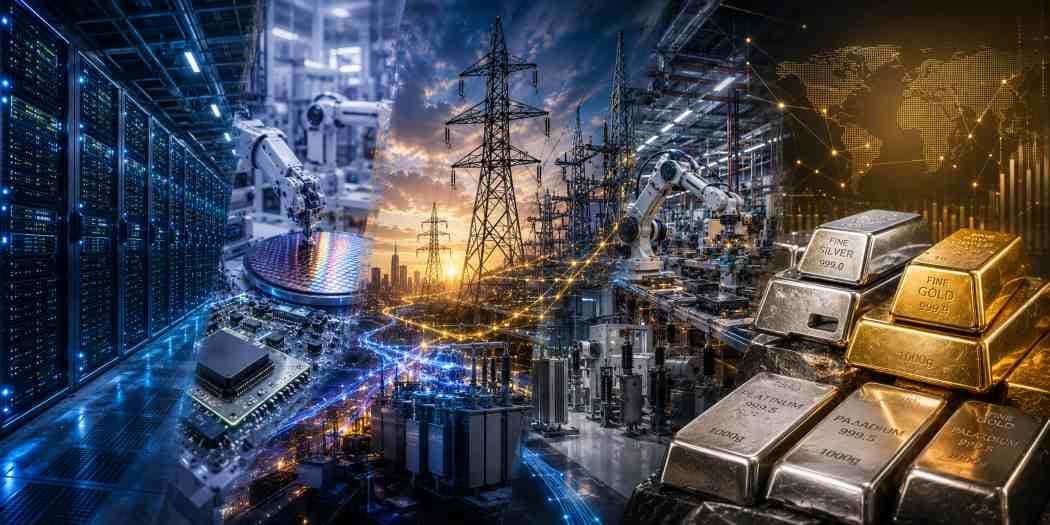
The AI Boom Is Beginning to Look Like a Commodity Story
For most investors, artificial intelligence still feels like a software revolution. The headlines focus on increasingly powerful AI models, record-breaking semiconductor sales, and the handful of technology giants spending billions to dominate the next phase of computing. Capital has poured into chipmakers, cloud providers, and data-center operators, helping drive one of the most concentrated technology rallies in recent market history.
Yet beneath the excitement surrounding algorithms and computing power sits a reality that commodity investors understand well: every technological revolution eventually becomes a resource story.
Artificial intelligence may operate in the digital world, but the infrastructure supporting it is overwhelmingly physical. Massive data centers must be built, powered, cooled, connected, and maintained. Electrical grids must expand. Semiconductor fabrication plants require enormous quantities of materials and energy. Networks need upgrades. Storage systems need expansion. Every layer of the AI ecosystem depends on real-world assets that must be mined, manufactured, transported, and deployed.
That shift in perspective raises an intriguing question. Could artificial intelligence become a long-term demand catalyst powerful enough to reshape parts of the precious metals market?
The answer is unlikely to emerge through a sudden surge in consumption. Commodity supercycles rarely begin that way. Instead, they tend to develop gradually as investors recognize that a structural change is creating persistent demand growth while supply struggles to respond. AI may be entering that conversation today.
Investors May Be Underestimating the Physical Scale of AI
The market has become accustomed to viewing technology as a relatively asset-light sector. Software companies can scale rapidly without building factories, mines, or transportation networks. Artificial intelligence, however, appears to be changing that assumption.
Each new generation of AI models requires substantially more computing power than the one before it. Technology companies are responding by constructing larger facilities, deploying more advanced hardware, and consuming increasing amounts of electricity. Industry forecasts now discuss gigawatt-scale data centers that resemble industrial infrastructure projects more than traditional technology campuses.
This distinction matters because commodity demand often emerges from secondary and tertiary effects rather than the headline trend itself. Investors see AI and think about semiconductors. The market then begins realizing that semiconductor production requires manufacturing facilities. Those facilities require power systems, advanced electronics, cooling networks, transmission infrastructure, and construction materials. Each layer creates additional demand further down the supply chain.
The result is a growing recognition that artificial intelligence may become one of the largest infrastructure investment themes of the coming decade. If that occurs, the metals required to support that expansion could benefit from a demand environment far different from what many investors currently anticipate.
This is where precious metals begin entering the discussion.
Silver Is Quietly Positioned at the Center of Multiple Growth Trends
No precious metal appears more directly connected to the AI buildout than silver. That connection is not always obvious because silver occupies an unusual position in the market. It functions simultaneously as an investment asset, an industrial metal, and a monetary metal. Most commodity sectors rely on a single dominant demand source. Silver's demand profile is considerably more diverse.
Artificial intelligence arrives at a time when silver was already benefiting from several long-term trends. Solar panel production continues consuming record amounts of silver. Electrification projects are expanding globally. Advanced electronics require highly conductive materials. Smart manufacturing systems, telecommunications infrastructure, and next-generation power networks all rely on technologies where silver plays a role.
AI does not replace those demand drivers. It layers on top of them. That may ultimately prove more significant than AI demand alone. Commodity markets often become strained when multiple growth trends begin reinforcing one another simultaneously. Silver's future may depend less on any single industry and more on the cumulative effect of several expanding sectors competing for the same finite resource.
This dynamic helps explain why discussions surrounding a potential silver supercycle have become increasingly common among analysts. The argument is not that artificial intelligence will suddenly consume unprecedented quantities of silver. Rather, AI may become another structural source of demand in a market where supply growth has already struggled to keep pace with existing consumption trends.
The market has seen similar conditions before. The most powerful commodity bull markets often emerge when demand growth broadens rather than concentrates.
Gold's Opportunity Could Come Through Capital Flows Instead of Consumption
Gold's relationship with artificial intelligence is fundamentally different. Unlike silver, gold is unlikely to experience a meaningful demand surge from data-center construction or semiconductor manufacturing. Industrial consumption remains a relatively small component of the gold market. Yet that does not mean AI is irrelevant to gold's outlook. In many ways, artificial intelligence may support gold through financial channels rather than physical ones.
Major technological transformations have historically created periods of extraordinary wealth creation alongside substantial uncertainty. Investors celebrate new opportunities while simultaneously trying to understand how economic power, labor markets, productivity growth, and corporate leadership might evolve. The resulting concentration of capital can generate significant market imbalances.
The current AI cycle already displays some of these characteristics. A relatively small group of technology companies has attracted an enormous share of investor attention and capital. Valuations have expanded rapidly. Discussions about market concentration, speculative behavior, and long-term sustainability have become increasingly common.
Those conditions often create a favorable environment for portfolio diversification. Gold has traditionally benefited when investors begin looking beyond the dominant market narrative. It does not compete directly with AI investments. Instead, it may benefit from the uncertainty created when transformative technologies reshape financial markets. If artificial intelligence contributes to greater volatility, larger capital flows, or heightened concern about asset concentration, gold's role as a portfolio stabilizer could become increasingly valuable. In that sense, AI may influence gold not as an industrial commodity but as a monetary asset.
Supply Growth May Be the Missing Piece of the Story
Demand narratives attract attention, but commodity supercycles are ultimately determined by supply. This is where the bullish case for precious metals becomes particularly interesting. The mining industry has spent much of the past decade navigating rising costs, regulatory complexity, declining ore grades, geopolitical risks, and capital discipline. While demand forecasts continue evolving, bringing meaningful new supply online remains a lengthy and expensive process.
Silver faces an additional complication. Much of global production comes as a byproduct of mining operations focused on copper, lead, zinc, or gold. This limits the industry's ability to rapidly increase silver output in response to stronger spot prices or growing demand.
As a result, supply growth often lags consumption growth. That imbalance does not immediately create a supercycle. Markets can remain balanced for years despite structural pressures. What matters is whether multiple demand drivers continue strengthening while supply remains relatively constrained. Artificial intelligence alone may not create that environment. Combined with electrification, renewable energy expansion, advanced manufacturing growth, and ongoing investment demand, however, the picture becomes more compelling.
Commodity markets rarely move because of a single catalyst. They move when several supportive forces begin pulling in the same direction.
Governments Are Transforming AI Into a Strategic Priority
One reason the AI investment cycle may prove more durable than previous technology booms is that it has expanded beyond the private sector. Artificial intelligence is increasingly viewed as a strategic national priority. Governments around the world are investing in domestic semiconductor manufacturing, digital infrastructure, energy security, and advanced computing capabilities. These initiatives are motivated by economic competitiveness, national security concerns, and long-term technological leadership.
This shift changes the nature of demand.
Corporate spending cycles can slow during economic downturns. Government-backed infrastructure programs often operate on much longer timelines. When public and private capital begin pursuing similar objectives, demand becomes more resilient than traditional market models might suggest.
For precious metals investors, this matters because AI infrastructure is no longer dependent solely on technology company budgets. Increasingly, it is becoming part of broader industrial and economic policy. That support may help sustain investment even during periods of market volatility or slower economic growth.
Why This Supercycle Would Look Different From China's
Comparisons between artificial intelligence and China's industrialization are becoming more common, but the two demand stories differ in important ways. China's commodity boom was driven primarily by construction, urbanization, manufacturing expansion, and physical infrastructure development. Demand surged across steel, iron ore, copper, coal, and energy markets because entire cities were being built at an unprecedented pace.
An AI-driven metals cycle would operate differently. Rather than roads, bridges, and apartment towers, demand would be concentrated around computing infrastructure, electricity generation, transmission networks, semiconductor production, automation systems, and digital connectivity. The physical footprint remains substantial, but the demand profile is far more technology-oriented.
This distinction may be particularly important for silver. The metal's role in electronics, energy systems, and advanced technologies positions it closer to the center of an AI-driven expansion than many traditional industrial commodities. The next commodity supercycle, if one emerges, may therefore look less like a construction story and more like an electrification and computing story.
The Bigger Opportunity May Be Infrastructure, Not Artificial Intelligence
Artificial intelligence is often discussed as though it exists entirely within the digital economy. The market's growing realization is that AI depends on an enormous physical foundation.
Data centers require electricity. Electricity requires infrastructure. Infrastructure requires metals.
That chain may ultimately become one of the defining investment themes of the next decade. Whether artificial intelligence triggers a full-fledged precious metals supercycle remains uncertain. Commodity markets are influenced by countless variables, including interest rates, economic growth, investor sentiment, government policy, and supply conditions. No single trend guarantees a sustained bull market.
What appears increasingly difficult to ignore, however, is the scale of the infrastructure being built to support AI. The technology revolution attracting so much investor attention may also be creating a quieter demand story beneath the surface—one measured not in lines of code, but in physical resources. If that demand continues expanding while supply remains constrained, investors may eventually conclude that artificial intelligence was never just a technology story. It was a metals story all along.