View Charts

2026 Herbert Hoover Presidential Silver Medal Revives a 1929 Design
 0
A Presidential Tribute From the Brink of the Great Depression
The U.S. Mint's newest Presidential Silver Medal revisits an unusually revealing moment in American history. Scheduled for release on November 18, 2026, the Herbert Hoover Presidential Silver Medal reproduces artwork associated with the nation's 31st president, whose administration began amid economic optimism and soon became inseparable from the Great Depression. The medal offers a portrait of Hoover as Americans understood him at the beginning of his presidency, before the financial catastrophe transformed his political legacy.
Designed by John Ray Sinnock, the medal presents Hoover through the accomplishments that had made him internationally respected: engineering, scholarship, public service, and humanitarian relief. Its imagery creates an interesting contrast between the expectations surrounding his inauguration in March 1929 and the economic crisis that unfolded later that year. For collectors, the historical perspective is arguably more compelling than the silver content alone.
John Ray Sinnock's Portrait Captures Hoover's Early Reputation
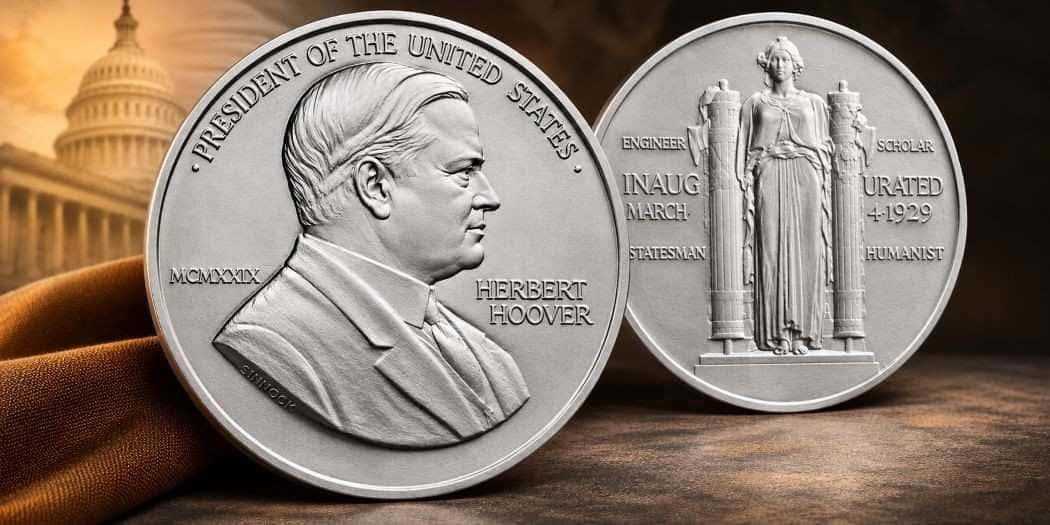
The U.S. Mint's Herbert Hoover Presidential Silver Medal features an obverse bust of Hoover accompanied by three inscriptions: “PRESIDENT OF THE UNITED STATES,” “MCMXXIX,” and “HERBERT HOOVER.” The Roman numerals identify 1929, the year Hoover assumed office. Sinnock's formal portrait follows the tradition of presidential medallic art, emphasizing the dignity of the office through carefully modeled relief and restrained composition.
The reverse provides a more revealing account of how Hoover's presidency was initially presented. A standing female figure, wearing an eagle decoration on her bodice, appears between fasces bearing symbols of war and peace. Surrounding inscriptions identify Hoover as “ENGINEER,” “SCHOLAR,” “STATESMAN,” and “HUMANIST,” alongside the inauguration date of March 4, 1929. Those four descriptions were carefully chosen expressions of his public reputation, reflecting a career that had extended far beyond electoral politics.
Sinnock's contribution gives the design additional numismatic significance. The artist later became widely recognized for the Roosevelt dime, introduced in 1946, and the Franklin half dollar, introduced in 1948. His earlier presidential medals demonstrate how his portraiture developed before those familiar circulating designs. The Smithsonian's National Portrait Gallery documents a 1929 Hoover medal attributed to Sinnock, providing a historical reference for the artwork's origins.
The Humanitarian Career That Defined Hoover Before 1929
Hoover's international reputation developed long before he entered the White House. Born in West Branch, Iowa, in 1874, he studied geology at Stanford University and established a successful career as a mining engineer. His work took him across several continents, providing experience in industrial management, international negotiations, and the coordination of complex operations. These skills later became central to his public-service career.
When World War I disrupted European food supplies, Hoover organized the Commission for Relief in Belgium in 1914. The organization negotiated access across military and political boundaries, arranged shipments, and supervised food distribution in occupied territory. According to the Herbert Hoover Presidential Library and Museum, the operation ultimately provided food assistance to as many as ten million civilians. Its scale helped establish Hoover as one of the most prominent humanitarian administrators of his generation.
He subsequently served as U.S. Food Administrator during World War I and Secretary of Commerce under Presidents Warren G. Harding and Calvin Coolidge. His approach emphasized technical expertise, voluntary cooperation, and organizational efficiency. By the time he won the 1928 presidential election, Hoover was widely associated with practical problem-solving and economic modernization. Sinnock's reverse design reflects this earlier reputation, especially its emphasis on engineering and humanitarianism.
Why the Year 1929 Changes the Medal's Historical Meaning
Hoover entered office on March 4, 1929, during the final months of a decade characterized by expanding consumer credit, industrial production, and stock-market speculation. His reputation suggested that an experienced administrator could manage the nation's increasingly complicated economy. The October 1929 stock-market crash disrupted those expectations, although the Great Depression developed through a broader series of banking failures, monetary contractions, collapsing demand, and policy responses over subsequent years.
The economic downturn ultimately dominated Hoover's presidency. His administration pursued measures including public-works spending, agricultural support, and the creation of the Reconstruction Finance Corporation in 1932. Nevertheless, unemployment rose dramatically, bank failures multiplied, and public confidence deteriorated. Hoover lost the 1932 presidential election to Franklin D. Roosevelt, leaving office in March 1933 with his earlier accomplishments overshadowed by the country's economic suffering.
That sequence makes the medal's language particularly striking. Its inscriptions commemorate a president celebrated for competence, scholarship, and humanitarian service, yet they were conceived before the events that would define his historical reputation for generations. The design preserves the expectations of 1929 without incorporating the retrospective judgment that followed.
Unlike a newly invented commemorative design, this historical artwork allows collectors to examine the gap between contemporary celebration and subsequent historical interpretation. It also provides a useful companion to the previously released Calvin Coolidge Presidential Silver Medal, whose imagery reflects the administration immediately preceding Hoover's.
A Historic Presidential Design in Modern Silver
The 2026 medal contains one troy ounce of 99.9% fine silver, measures 1.598 inches in diameter, and features a matte finish with a plain edge. It has no denomination, mint mark, or privy mark. These specifications distinguish it from legal-tender coinage, even though its precious-metal content is comparable to that of many modern one-ounce silver products.
The distinction matters when evaluating its place in a collection. A Presidential Silver Medal is an official U.S. Mint collectible, but it is not a circulating coin or an American Silver Eagle. Its identity rests on historical artwork, presidential subject matter, and its connection to the Mint's longstanding medallic tradition. Collectors exploring the broader category can compare related issues among U.S. commemorative silver coins and medals.
The Mint currently lists no mintage limit, product limit, or household order limit for the Hoover release. Consequently, there is no confirmed numerical production ceiling that would justify describing it as inherently scarce. Final availability, collector demand, and long-term secondary-market interest will depend on circumstances that cannot be established before the release.
Its precious-metal content also creates a measurable component of value. Movements in the silver spot price affect the intrinsic value of one-ounce silver collectibles, although historical significance, condition, and collector demand may influence their premiums independently. A medal's retail or resale value should therefore not be confused with its silver melt value.
What the Hoover Medal Adds to Presidential Collecting
The Herbert Hoover release illustrates the value of treating presidential medals as historical documents rather than simply portraits of former presidents. Sinnock's design captures the public image of a leader whose career initially appeared to demonstrate the promise of technical expertise and international cooperation. The subsequent economic collapse transformed that image, creating a contrast that modern collectors can appreciate with nearly a century of hindsight.
The medal also strengthens the chronological relationship among early twentieth-century presidential designs. Collectors following the series can examine changing artistic conventions, the work of individual engravers, and the way different administrations chose to represent presidential authority. The Hoover issue is especially effective because its reverse inscriptions provide a direct statement of the qualities that contemporaries associated with the incoming president.
As the November 18 release approaches, its strongest historical appeal is already clear. The U.S. Mint medal preserves an optimistic interpretation of Hoover at the precise moment his presidency began, allowing collectors to consider both the accomplishments that brought him to office and the events that permanently changed his legacy.