View Charts
Calvin Coolidge Presidential Silver Medal Revisits a 1920s Design
 2
2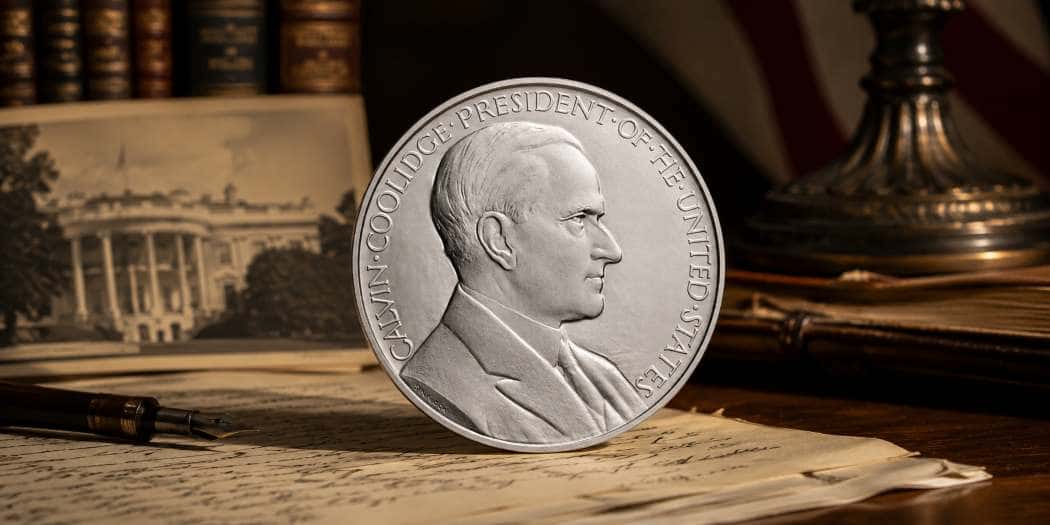
A Presidential Portrait With a Deeper Numismatic History
Calvin Coolidge is remembered for an understated presidency, but the medallic portrait associated with him belongs to a surprisingly eventful period in American coinage. The U.S. Mint’s Calvin Coolidge Presidential Silver Medal brings John Ray Sinnock’s portrait of the 30th president into the modern Presidential Silver Medal series, pairing one troy ounce of .999 fine silver with artwork rooted in the Mint of the 1920s.
That connection gives the medal more historical weight than a newly created presidential tribute. Its imagery reaches back to Coolidge’s own administration, when Sinnock was building the career that would eventually make him one of the most recognizable names in 20th-century U.S. coin design. The reverse also records the unusual circumstances of Coolidge’s path to the presidency: an unexpected succession in 1923 followed by an elected term beginning in 1925. For collectors, the result is both a modern silver medal and a compact artifact of presidential and Mint history.
From a Vermont Farmhouse to the White House
Coolidge did not begin his presidency with the ceremony normally associated with the office. Vice President Coolidge was at his family home in Plymouth Notch, Vermont, when President Warren G. Harding died on August 2, 1923. In the early hours of August 3, Coolidge took the presidential oath there, administered by his father, John Calvin Coolidge Sr., a notary public and justice of the peace. He later won the 1924 election and took the oath for his elected term on March 4, 1925.
Those two beginnings are preserved directly on the medal. The reverse includes the dates August 3, 1923, and March 4, 1925, rather than reducing Coolidge’s presidency to a single inauguration. It is an unusually effective use of dates because they explain, in miniature, how he came to serve.
Coolidge remained president until March 4, 1929, choosing not to seek another term in 1928. His public identity became closely associated with restraint, thrift and economy in government. The Library of Congress notes that his administration pursued debt reduction, lower taxes and the elimination of government waste, policies consistent with the deliberately plain image Coolidge cultivated. That reputation earned “Silent Cal” an enduring place in popular memory, but the medal presents him through the more formal visual language of the presidency.
John Ray Sinnock Captured Coolidge Before His Famous Coins
The name behind both sides of the Calvin Coolidge Presidential Silver Medal is significant. John Ray Sinnock became Chief Engraver of the United States Mint in 1925, during Coolidge’s administration, and remained in the post until his death in 1947. Modern collectors know him principally for the Roosevelt dime and for his work on the Franklin half dollar, two designs that placed his art into everyday American commerce.
His Coolidge portrait belongs to an earlier chapter of that legacy. The Smithsonian’s National Numismatic Collection identifies Sinnock as the designer of a U.S. Mint presidential medal honoring Coolidge, while a 1928 U.S. Assay Commission medal also used a Sinnock portrait of the president. In other words, Coolidge was not a historical figure whom a modern artist had to reconstruct generations later. Sinnock was depicting the sitting president during the period itself.
That distinction changes how the modern medal can be read. Rather than offering a contemporary interpretation of the 1920s, it revives the medallic vocabulary of Coolidge’s own era. Collectors familiar with Sinnock’s later Roosevelt dime and Franklin half dollar can see an artist whose presidential portraiture preceded the circulating designs for which he became best known.
The Reverse Tells More Than the Portrait
The obverse is deliberately direct: a right-facing bust of Coolidge accompanied by his name and presidential title. The reverse carries the more elaborate symbolism. A stylized laurel wreath surrounds a seated female figure holding fasces, historically an emblem of authority. Beside her appears a heraldic eagle positioned above the shield of the United States, while a cornucopia introduces a traditional symbol of abundance.
Together, those elements reflect the allegorical style that remained central to American medallic art in the early 20th century. The design does not attempt to illustrate a particular Coolidge policy or event. Instead, authority, national identity, civic honor and prosperity are expressed through symbols that would have been readily understood within the medallic tradition of the period.
The dates provide the historical specificity the allegory lacks. Along with “INAUGURATED,” the reverse records both August 3, 1923, and March 4, 1925, while the date 1928 also appears in the composition. That final date places the design firmly within Coolidge’s presidency and Sinnock’s tenure as Chief Engraver. The combination of portraiture, classical symbolism and presidential chronology makes the reverse more than decorative accompaniment; it effectively turns the medal into a record of Coolidge’s unusual route through the office.
One Troy Ounce of Silver, but Not a Bullion Coin
The modern format gives the historic design a different physical character. The U.S. Mint specifies one troy ounce of 99.9% fine silver, a diameter of 1.598 inches, a plain edge and a matte finish. There is no denomination, mint mark or privy mark. Those details matter because a Presidential Silver Medal occupies a different category from a legal-tender silver coin, even though both may contain investment-grade precious metal.
A medal has no face value and is not issued as circulating money. Its appeal therefore rests on the intersection of silver content, U.S. Mint manufacture, design and subject matter rather than monetary status. That distinction is especially relevant for collectors accustomed to products such as the American Silver Eagle, where bullion content and legal-tender coinage coexist.
The Coolidge medal also demonstrates why modern U.S. Mint medals can attract interest beyond straightforward silver ownership. Its one-ounce composition gives it an easily understood precious-metal foundation, but the reason to distinguish it from a generic silver round is the design history carried on its surfaces. In this case, the artist, president and original era overlap in a way that gives the piece a direct connection to the period it commemorates.
Where Coolidge Fits in the Presidential Silver Medal Series
The U.S. Mint launched its Presidential Silver Medal program in 2018 and has added four presidents annually since 2019. The program brings the Mint’s long presidential medal tradition into a consistent modern silver format, allowing successive administrations to be viewed not only through presidential history but through changing approaches to American medallic art.
Coolidge’s entry is particularly well suited to that approach because Sinnock links several strands of U.S. numismatic history. His portrait belongs to Coolidge’s era, his later circulating coin designs became fixtures of American money, and his work as Chief Engraver stretched from the prosperity of the 1920s through the Depression and most of World War II. The medal therefore rewards more than an interest in presidential biography.
For collectors following new U.S. Mint coin and medal releases, the Calvin Coolidge Presidential Silver Medal offers a useful reminder that a modern issue can derive much of its character from older artwork and artistic traditions. Its silver content is straightforward; the more interesting story lies in what the design preserves. Nearly a century after Sinnock portrayed a sitting president, that image continues a second life in silver, connecting Coolidge’s quiet public persona with one of the Mint’s consequential 20th-century engravers.
Related reading you may find interesting:
Perth Mint Releases 2027 Lunar Year of the Goat Coins
2 Comments