View Charts
1944 Wheat Penny Value: Mint Marks, Errors and Rare Steel Cents
 0
How Much Is a 1944 Wheat Penny Worth Today?
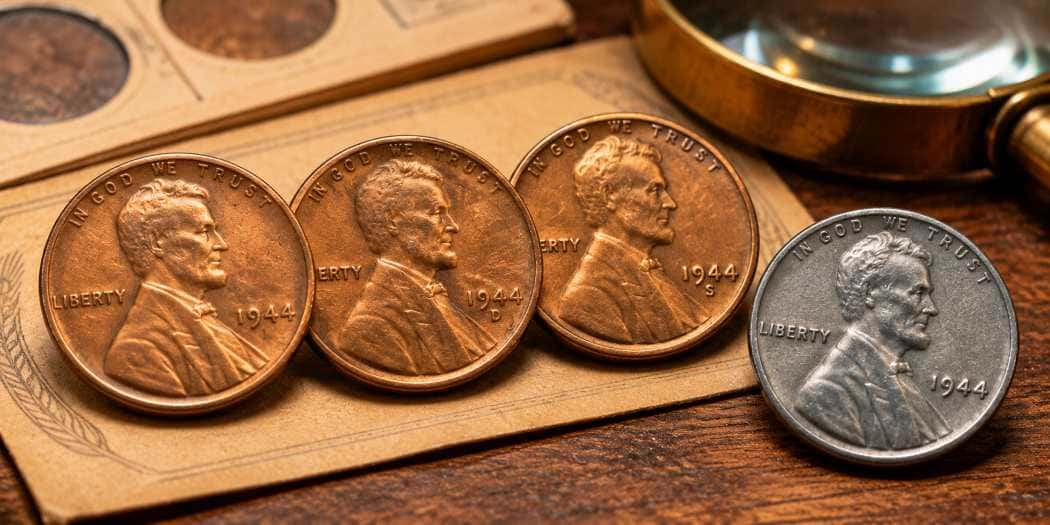
A 1944 Wheat penny can be worth only a few cents or, in exceptional circumstances, hundreds of thousands of dollars. The difference depends on which coin a collector actually owns. Ordinary copper cents from Philadelphia, Denver and San Francisco were produced in enormous quantities, while a tiny number of 1944 pennies were mistakenly struck on steel planchets left over from the previous year's production.
For most owners, the first step is identifying the mint mark and evaluating condition—not searching for the highest auction result. Circulated bronze examples generally sell for modest premiums, while exceptionally preserved coins with original red surfaces can attract considerably stronger prices. Rare die varieties and authenticated wrong-planchet errors belong to separate markets.
This guide focuses on practical identification and valuation, complementing the earlier history of the 1944 Lincoln Wheat Cent.
1944 Wheat Penny Value Chart by Mint Mark and Condition
The three regular 1944 issues are common in circulated condition. The estimates below are broad retail reference ranges for ordinary bronze cents, not guaranteed dealer purchase offers. Actual prices depend on grading, color, eye appeal and the market for a particular coin.
|
1944 penny |
Circulated |
Typical uncirculated |
Gem red MS65 |
|
No mint mark (Philadelphia) |
$0.05–0.50 |
$1–5 |
$10–25 |
|
1944-D (Denver) |
$0.05–0.50 |
$1–5 |
$10–30 |
|
1944-S (San Francisco) |
$0.05–0.75 |
$2–8 |
$15–40 |
These indicative ranges apply to ordinary, problem-free examples. Exceptional grades, recognized varieties and unusual auction results can fall far outside them. Professional grading fees may exceed the value of a typical circulated coin.
1944 No Mint Mark Penny Value
Philadelphia struck 1,435,400,000 Lincoln cents in 1944, making this the most plentiful issue of the year. A missing mint mark is normal for Philadelphia production and does not indicate an error.
Worn examples are readily available, and even attractive uncirculated pieces can be affordable. The substantial premiums appear at the highest certified grades, where surviving coins must combine exceptionally clean surfaces with strong original red color.
According to PCGS CoinFacts, a Philadelphia 1944 cent graded MS68RD sold for $24,400 at Heritage Auctions in January 2026. That result reflects extraordinary condition rarity, not the typical value of a 1944 penny.
1944-D Wheat Penny Value
Denver produced 430,578,000 cents in 1944. Its identifying D mint mark appears beneath the date on Lincoln's portrait side.
Ordinary circulated 1944-D pennies are common, with values generally comparable to Philadelphia examples. Collectors may pay more for sharply struck, uncirculated pieces retaining their original red color, especially at advanced certified grades.
Denver also produced recognized varieties involving repunched or overpunched mint marks. These should be evaluated separately from standard 1944-D cents because the appearance and classification of the mint mark can materially affect value.
1944-S Wheat Penny Value
San Francisco struck 282,760,000 cents, the smallest regular 1944 production total among the three mints. Its S mint mark appears beneath the date.
Although this lower mintage makes the issue comparatively less plentiful, hundreds of millions were produced. A worn 1944-S penny is not automatically rare or valuable simply because it carries an S.
Collectors seeking complete date-and-mint-mark sets often favor attractive uncirculated examples. Original surfaces, sharp detail and red color become increasingly important as grades rise, but the ordinary 1944-S remains accessible.
Why Condition and Copper Color Change the Price
Copper coins are particularly sensitive to surface preservation. Over time, their original reddish appearance may darken as the metal reacts with its environment. Professional grading services distinguish three broad color designations:
-
BN (Brown): Predominantly brown surfaces.
-
RB (Red and Brown): A mixture of original red and brown coloration.
-
RD (Red): Substantial original mint-red color.
Color is only one component of value. Contact marks, wear, corrosion, cleaning and strike quality also matter. An uncirculated red coin with distracting damage may be less desirable than a cleaner example at a comparable grade.
The distinction between circulated and uncirculated condition is equally important. Wear on Lincoln's cheek, jaw or hair can help identify a circulated coin, while preserved mint luster supports an uncirculated assessment. Collectors should avoid cleaning pennies to improve their appearance; polishing can permanently damage surfaces and reduce numismatic value.
For a broader comparison of collectible cents, The Penny Vault includes Lincoln Wheat pennies, certified varieties and other historic U.S. one-cent coins.
Rare 1944 Steel Pennies: The Errors Worth Investigating
The most valuable 1944 Wheat pennies are not ordinary copper examples. They are rare transitional errors struck on zinc-coated steel planchets associated with the 1943 wartime cent.
Regular 1944 pennies contain approximately 95% copper and weigh 3.11 grams. A genuine 1944 steel cent weighs approximately 2.70 grams and is attracted to a magnet. Confirmed examples exist from Philadelphia, Denver and San Francisco, but they are exceptionally scarce.
Documented auction results illustrate their significance:
|
Rare error |
Certified grade |
Recorded auction result |
|
1944 steel, Philadelphia |
PCGS MS64 |
$180,000 |
|
1944-D steel |
NGC MS63 |
$115,000 |
|
1944-S steel |
PCGS MS66 |
$408,000 |
These are historical sales of specific authenticated specimens, not current price estimates for unidentified coins. The PCGS Lincoln Cent guide documents the unusual off-metal strikes from both 1943 and 1944.
A silver-colored 1944 penny should never be assumed genuine based on appearance alone. Copper cents can be plated, altered or chemically treated, and some counterfeit pieces use modified dates. Magnetic response and weight provide useful preliminary evidence, but professional authentication is essential before assigning a rare-error valuation.
Other 1944 Penny Errors and Varieties
Not every collectible 1944 error involves the wrong metal. Denver cents include recognized D/S overmintmark varieties, where evidence of an earlier S appears beneath the D. Some repunched mint marks and doubled-die varieties are also cataloged.
These distinctions matter because genuine die varieties must match documented diagnostic features. An irregular mint mark caused by wear, corrosion or mechanical damage does not automatically qualify as a collectible variety.
The 1944-D/S FS-511 variety provides a useful example. A certified MS67+RD specimen realized $49,938 in an October 2020 Legend Rare Coin Auctions sale, according to PCGS. That extraordinary result reflects the specific attribution and grade; ordinary 1944-D cents do not share its valuation.
Collectors can also encounter off-center strikes, clipped planchets and other minting errors. Their premiums depend on the error's severity, visibility, authenticity and overall condition. Minor irregularities are not necessarily valuable.
How to Identify and Evaluate Your 1944 Penny
Start with the date and mint mark. A 1944 cent without a mint mark is from Philadelphia; D indicates Denver, and S indicates San Francisco. Examine both sides under good lighting and compare the coin with authenticated reference photographs.
Next, inspect wear and surface color. Avoid cleaning, scraping or polishing the coin, even when dirt obscures details. For a suspected steel error, use a small magnet and an accurate digital scale without performing destructive tests.
If the coin is magnetic and weighs near 2.70 grams, professional evaluation becomes appropriate. A reputable numismatic dealer or recognized grading service can assess the date, composition and authenticity. Coins with unusual mint marks should similarly be compared with documented variety diagnostics before submission.
The practical lesson is that rarity must be established before a high value can be assigned. Most 1944 pennies are inexpensive collectibles, but exceptional preservation, verified varieties and genuine transitional errors can change that assessment dramatically. For anyone sorting inherited coins or old collections, careful identification is more useful than assuming that every wartime cent is a hidden fortune.