View Charts

1851 Gold Rush $50 Coin With Upside-Down Error Heads to Auction
 0
A 175-Year-Old Mistake Returns to the Auction Market
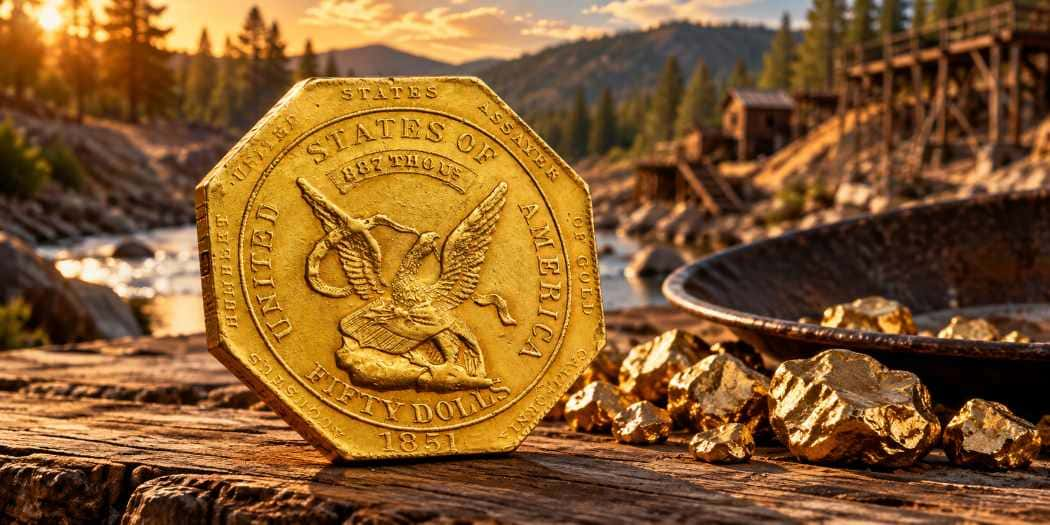
A single upside-down word on an 1851 California Gold Rush coin offers a glimpse into the challenges of producing money in early San Francisco. The massive octagonal $50 gold piece, struck under United States Assayer Augustus Humbert, is scheduled to appear in VCD Auctions' November 19, 2026, sale. Its defining feature is an inverted ASSAYER inscription on the coin's edge, a mistake made during a labor-intensive manufacturing process.
Identified as Kagin-4 and graded PCGS VF35, the coin belongs to a historic series commonly called Gold Rush slugs. Its appeal extends beyond the unusual error. The piece also has a documented auction history spanning more than five decades, connecting California's improvised monetary system with today's specialized rare-coin market.
Why California Needed Its Own $50 Gold Pieces
The discovery of gold in California in 1848 transformed the region's economy almost overnight. Prospectors arrived with dreams of wealth, while newly mined gold entered commerce in enormous quantities. Yet reliable coinage remained scarce, leaving merchants to conduct transactions using gold dust, nuggets, and privately issued pieces of varying quality.
Determining the value of raw gold required weighing and assaying it, a process that complicated everyday transactions. Private firms attempted to solve the problem by converting gold into standardized pieces, but differences in purity and public confidence continued to create uncertainty.
Congress authorized a federal assay office in San Francisco in September 1850, providing a temporary solution before the establishment of a permanent branch mint. Moffat & Co. received the contract, and Augustus Humbert was appointed United States Assayer of Gold. Humbert arrived in San Francisco in January 1851 with dies prepared for the new issues, allowing production to begin shortly afterward.
The resulting octagonal $50 pieces occupied an unusual position between bullion ingots and conventional coins. Although officially treated as assayed gold pieces, they circulated commercially and provided a more dependable means of conducting substantial transactions. Their distinctive shape and government association made them recognizable symbols of California's developing monetary system.
As NGC's history of territorial gold coinage explains, the assay office filled an important gap before the San Francisco Mint began operations. The Humbert pieces illustrate how rapidly the region's financial infrastructure had to develop to accommodate the Gold Rush.
How One Word Ended Up Upside Down
The 1851 coin scheduled for auction is a lettered-edge variety with .887 gold fineness and a numeral 50 on its reverse. Its main design features an eagle with outstretched wings, while the opposite side carries an intricate engine-turned pattern. Unlike ordinary round coins, its octagonal shape provided eight separate edge panels for inscriptions.
Producing these pieces required several individual operations. Workers struck the principal designs, punched identifying information into the coin, and applied lettering to the edge panels. Each step created an opportunity for mistakes, particularly when individual sections had to be positioned and stamped by hand.
On the upcoming auction specimen, the word ASSAYER appears upside down relative to the surrounding inscriptions. The error did not result from improperly aligned obverse and reverse dies. Instead, it occurred during the separate edge-lettering operation, when one section was stamped in the wrong orientation.
The mistake is especially revealing because it preserves evidence of the manufacturing process. Modern collectors often associate mint errors with off-center strikes, doubled impressions, or incorrect planchets. Humbert's inverted inscription instead reflects the manual procedures used to produce these early California gold pieces.
The PCGS CoinFacts guide to Humbert issues documents the different varieties within the series, including variations in fineness, edge treatment, and reverse configuration. These distinctions are important because seemingly similar $50 slugs can represent separate numismatic issues with different rarity levels and collector demand.
A Documented Auction History Adds to the Appeal
The November offering is not the first time this particular coin has appeared before collectors. Its documented auction history begins with a Harmer Rooke sale in November 1969, followed by a Bowers appearance in May 1973. Later records include the 1993 Baltimore ANA sale and Heritage Auctions offerings in 2003 and 2007.
In August 2007, Heritage sold the piece as part of the Pacific Rim Collection for $48,875. That result provides a historical reference for the upcoming auction, although it should not be interpreted as a prediction of the next sale price. Rare-coin values depend on factors including condition, variety, provenance, competing bidders, and market demand.
Its PCGS VF35 grade indicates circulated condition rather than Mint State preservation. For early California gold, however, circulation can contribute to a coin's historical character. These large pieces were produced to facilitate commerce, and many surviving examples show evidence of handling, edge contact, or other signs of use.
The combination of a recognizable manufacturing error and decades of recorded auction appearances makes this specimen particularly interesting. Its documented history helps establish continuity between earlier collections and the present offering, while the inverted inscription provides an unusual physical characteristic that distinguishes it from ordinary examples.
Collectors exploring related American gold issues can examine pre-1933 gold coins at Bullion Exchanges. Although Humbert's assay-office pieces differ from conventional federal Mint denominations, both categories offer insight into the development of American gold coinage.
What Makes a Pioneer Gold Error Collectible?
The inverted ASSAYER inscription is the coin's most immediately recognizable feature, but its importance cannot be separated from the underlying issue. Humbert $50 pieces represent a transitional period when California's rapidly expanding economy required monetary solutions before permanent federal minting facilities became available.
Authentication is especially important in this field. Collectors must distinguish genuine period pieces from later reproductions, altered specimens, and coins with modified surfaces or edges. Specialists examine weight, dimensions, design characteristics, die varieties, edge lettering, and preservation together rather than relying on a single unusual feature.
Provenance provides another useful layer of evidence. Documented auction appearances can connect a coin to earlier descriptions and photographs, supporting its identification and attribution. However, even an extensive ownership history does not replace professional examination.
Condition also plays a substantial role in value. Two examples of the same variety may command very different prices because of differences in wear, surface quality, damage, or eye appeal. Errors can introduce additional collector interest, but their presence does not automatically establish rarity or a particular market premium.
For collectors beginning to explore historic American gold, Bullion Exchanges' guide to collecting pre-1933 gold and rare coins explains how grading, authenticity, preservation, and historical significance influence numismatic value.
What to Watch at the November 19 Auction
The Humbert coin is Lot 17 in VCD Auctions' The Collector's Cabinet, which also features rare Capped Bust half dollars and Proof Saint-Gaudens double eagles. Bidding opened October 19, with the first lot scheduled to close November 19 at 8 p.m. Eastern. The sale carries a 10% buyer's premium, an important consideration when interpreting the final amount paid.
The auction result will provide another market reference for this particular survivor. However, the coin's historical significance is already established. Its inverted inscription preserves evidence of the manual craftsmanship and production challenges that characterized early California gold coinage.
For collectors interested in similarly distinctive pieces, The Collector's Vault at Bullion Exchanges features authenticated historic and collectible coins from different periods of numismatic history.
More than 175 years after it was struck, the Humbert $50 piece demonstrates how a small manufacturing mistake can become a lasting record of American monetary history.