View Charts

1838 Silver Dollar Struck Decades Later Heads to November Auction
 0
An 1838 Date, an 1869 Mystery, and a November 17 Auction
An 1838 silver dollar scheduled for auction on November 17, 2026, presents an unusual question: How can a coin bearing an 1838 date have been struck more than 30 years later? The answer lies in the Philadelphia Mint's 19th-century practice of producing restrikes for collectors, and in tiny changes to the original coin dies that specialists have spent decades studying.
The coin is an 1838 Gobrecht dollar, Judd-85, certified PCGS Proof-65 and approved by CAC. Stack's Bowers Galleries will offer it as Lot 2088 during its November Rarities Night auction. Research places its manufacture around 1869, making the date on the coin a record of the original design rather than the year this particular specimen was produced. Its appearance at auction offers a rare opportunity to examine how numismatists reconstruct a coin's history when contemporary Mint records are incomplete.
The Silver Dollar That Helped Redesign American Coinage
The Gobrecht dollar emerged from an effort to revive a denomination that had largely disappeared from American production. Regular silver dollar coinage ended in the early 1800s, and although the restriction on further production was lifted in 1831, the Mint did not immediately resume issuing the denomination. By the middle of the decade, Mint Director Robert Maskell Patterson was pursuing a broader redesign of American coins, creating an opening for an ambitious new silver dollar.
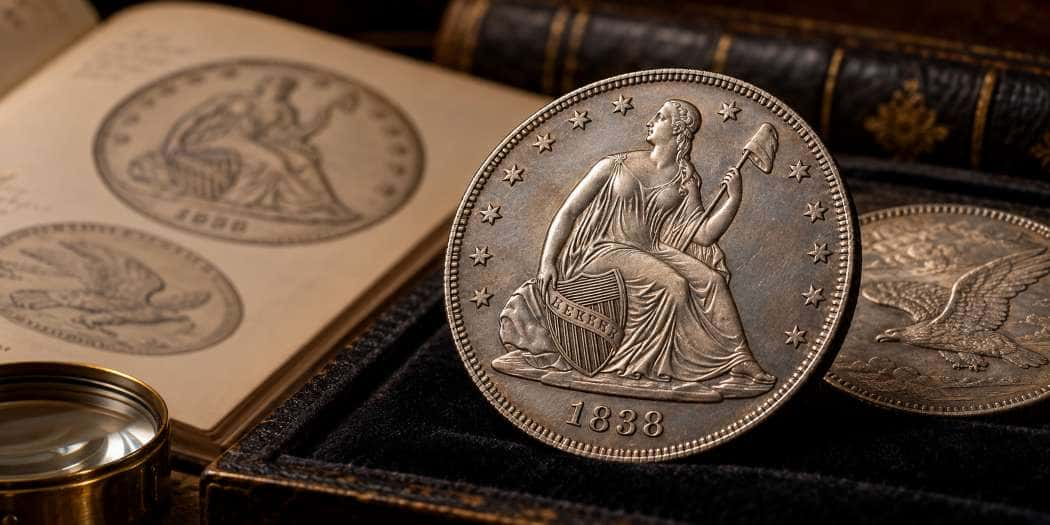
The resulting design brought together several artists. Thomas Sully developed the seated figure of Liberty, Titian Peale contributed the flying eagle, and Mint engraver Christian Gobrecht translated their concepts into coinage dies. The composition was strikingly different from the earlier Flowing Hair and Draped Bust dollars. Liberty sat beside a shield, holding a staff topped by a liberty cap, while an eagle flew across the reverse with its wings spread.
These experiments helped establish the visual language of subsequent American coinage. Seated Liberty would appear across multiple silver denominations, although the regular Seated Liberty dollar introduced in 1840 used a different reverse. The earlier Gobrecht pieces occupy an important transitional position: they were both technical experiments and artistic predecessors to a major federal coinage series. That combination helps explain why their appeal extends beyond the small number of surviving examples.
The 1838 version introduced further revisions. Thirteen stars appeared around Liberty on the obverse, the stars surrounding the eagle on earlier reverses disappeared, and Gobrecht's prominent signature was no longer visible. The Stack's Bowers guide to Type 2 Gobrecht dollars documents these design changes and distinguishes original issues from later restrikes.
Why a Coin Dated 1838 Was Made Around 1869
The key to the upcoming auction is the distinction between an original pattern and a later Mint-produced restrike. The 1838 date belongs to the period when the dies and design originated, but those dies remained useful long after the original experimental coinage had ended. As American coin collecting expanded during the 1850s and 1860s, the Mint faced growing interest in unusual early issues that few private collectors could otherwise obtain.
Mint Director James Ross Snowden encouraged exchanges involving specially struck rarities to improve the Mint Cabinet, the federal coin collection that eventually became part of the Smithsonian's holdings. Producing coins from surviving historical dies helped supply pieces desired by collectors. The practice also created complications: examples bearing the same date could have been manufactured at substantially different times, sometimes with different edge treatments or die combinations.
The auction specimen belongs to a later group known as Cabinet Coin Restrikes. Research associated with John Dannreuther, Craig Sholley, and Saul Teichman places their production around April 1869, during Henry R. Linderman's first tenure as Mint director. Unlike a modern commemorative reissue, the piece was struck at the Mint using historical coinage dies. It is therefore a genuine Mint product, but it should not be mistaken for an original 1838 striking.
The distinction also explains why identifying a Gobrecht dollar requires more than recognizing its design. Bullion Exchanges previously examined the broader difference between coin restrikes and reproductions. In this case, the question is more precise: which period of Mint activity produced a particular coin, and what physical evidence can establish that sequence?
The Tiny Die Crack That Helps Date the Restrike
The most revealing evidence appears near Liberty's wrist. Specialists identify a small crack extending from the area below her left wrist toward the drapery. Although almost inconspicuous compared with the coin's overall design, the defect helps place the specimen late in the working life of the 1838 obverse die.
Coin dies deteriorate through repeated use, storage, corrosion, polishing, and mechanical stress. Those changes can leave recognizable traces on the coins they strike. Researchers compare surviving specimens to determine which characteristics appeared first and which developed later. When a crack is absent on one group but present on another, it can help establish the relative order of production, particularly when supported by additional die markers.
The Judd-85 offered in November is attributed to DTS Die State B, associated with the final known use of the 1838 obverse die. Specialists also examine advanced cracks on the reverse, including those affecting portions of the lettering. Together, these characteristics support its identification within the later restriking sequence. The evidence is unusually compelling because it comes from the physical condition of the tools used to manufacture the coin, rather than from a date or inscription intended to identify it.
The proposed striking date of around 1869 is based on numismatic research and die-state analysis rather than a documented production date. Changes in the dies, including progressive cracking and deterioration, help researchers establish the sequence in which different specimens were produced. Although these physical characteristics provide valuable evidence of later restriking, they cannot establish an exact striking date without supporting Mint records.
What Makes the November Auction Specimen Distinctive?
The upcoming lot is classified as Judd-85, a plain-edge silver restrike. Its edge distinguishes it from the reeded-edge Judd-84, even though the two share the basic 1838 design. Such differences can be decisive in pattern-coin attribution: specimens that appear nearly identical in photographs may belong to separate varieties with different manufacturing histories and surviving populations.
The coin's PCGS Proof-65 grade and CAC approval add important information about its assessed preservation and quality. Nevertheless, certification is only one part of its identity. Its attribution depends on the combination of design, edge, die state, and historical research. Collectors studying U.S. pattern coins encounter the same problem across many experimental issues: a familiar denomination and date do not necessarily indicate a regular circulation coin.
Its auction record provides another useful reference. The specimen appeared in Heritage Auctions' February 2013 Long Beach sale, where it realized $123,375 including the buyer's premium. It was then certified NGC Proof-65. That transaction documents a previous public sale of this particular coin, but it should not be treated as an estimate of its November 2026 value. Rare-coin results depend on the bidders present, the specimen's characteristics, and market conditions at the time of sale.
The coin also differs fundamentally from bullion acquired chiefly for precious-metal exposure. Its silver content is a minor component of its potential market value; collectors are evaluating an exceptionally scarce historical object whose identity depends on specialized research. Bullion Exchanges' Collector's Vault features other collectible and historic coins, illustrating the wider category in which provenance, attribution, and preservation can matter far more than intrinsic metal value.
November 17 Will Add Another Chapter to Its Auction History
The 1838 Gobrecht dollar is scheduled to appear as Lot 2088 in Stack's Bowers Galleries' November 17, 2026, Rarities Night auction. Prospective bidders should consult the auction house's current catalog, terms, and bidding schedule for any changes, and account for the applicable buyer's premium when interpreting the eventual result.
Whatever price the coin achieves, the auction will bring renewed attention to an unusually revealing chapter of American Mint history. A design created during the revival of the silver dollar was reused decades later to satisfy a developing collector market. The surviving dies retained evidence of that second life, including a minute crack that researchers could use to place the coin within a manufacturing sequence.
For collectors following the sale, the central question extends beyond how much a rare silver dollar might bring. It is how convincingly its physical characteristics, provenance, and historical context can explain an object whose visible date tells only part of its story.