View Charts
10 Major Gold Refineries: Who Makes the Bars Investors Buy?
 0
The Name on a Gold Bar Tells Only Part of Its Story
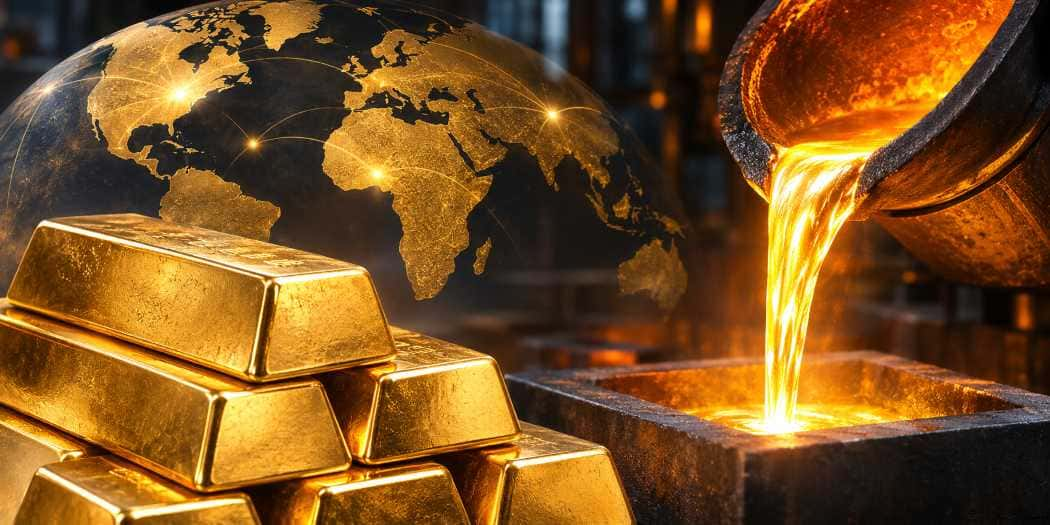
Two gold bars containing identical amounts of .9999 fine gold can sell at different premiums. The difference may reflect their manufacturers, authentication features, packaging, or recognition among bullion dealers. Although the metal content determines their underlying gold value, the refinery responsible for producing each bar can influence how the finished product is perceived and priced.
Gold refining connects mining, recycled precious metals, wholesale trading, and retail investment. Some refiners are internationally recognized for their investment bars, while others specialize in large-scale processing or industrial supply. Their histories reveal how bullion reaches the market and why certain hallmarks have become familiar to investors.
The following ten companies are established refiners selected for their industry presence, recognized products, and relevance to bullion buyers. They are not ranked by production volume or capacity, which companies report using different measures.
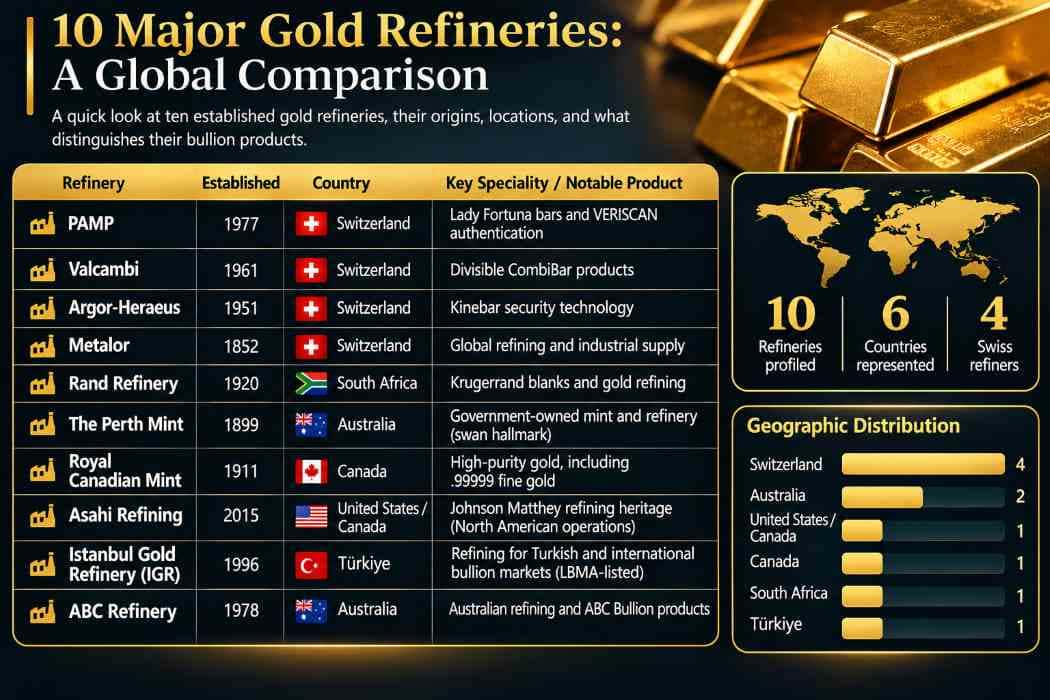
Ten established gold refineries compared by founding history, operating country, and distinguishing bullion specialties. The list is not ranked by refining capacity or production volume.
Ten Established Gold Refineries and Their Specialties
1. PAMP — Castel San Pietro, Switzerland
Founded in 1977, PAMP developed into one of the most recognizable manufacturers of minted precious-metal bars. Its refinery operates in Castel San Pietro, in Switzerland's Ticino region. The company subsequently became part of the MKS business, creating the international precious-metals group now known as MKS PAMP.
PAMP is particularly associated with its Lady Fortuna gold bars, introduced in 1979, and authentication technologies such as VERISCAN. Its reputation combines refining expertise, distinctive product presentation, and global distribution. The company's refinery maintains LBMA Good Delivery accreditation, while its smaller investment bars serve a separate retail market.
2. Valcambi — Balerna, Switzerland
Valcambi was established in 1961 as Valori & Cambi and operates its refinery in Balerna, near the Swiss-Italian border. Over subsequent decades, it developed into a major international precious-metals processor and manufacturer of investment bullion.
Its product range includes conventional cast and minted bars alongside CombiBar, introduced in 2011. CombiBars contain divisible sections designed to provide smaller units of precious metal within a larger product. This format appeals to buyers seeking flexibility, although its premium and resale treatment still require comparison with conventional bars.
Valcambi's published refining capacity covers multiple precious metals and should not be confused with actual annual gold output. The company is owned through Global Gold Refineries Ltd., with connections to India's Rajesh Exports group.
3. Argor-Heraeus — Mendrisio, Switzerland
Argor-Heraeus traces its origins to 1951, when Argor SA was established in Switzerland's Ticino region. Heraeus became involved in 1986, and the company's Mendrisio refinery opened in 1988. Today, the operation forms part of the Heraeus precious-metals business.
Its strengths include gold refining, minted and cast bullion, and specialized security features. The company's Kinebar products incorporate an optical feature designed to assist identification.
Argor's historical listing with the London gold market dates to 1961, predating the establishment of the LBMA in 1987. That distinction matters when interpreting accreditation histories. Its current refinery remains recognized within the international Good Delivery system.
4. Metalor — Marin, Switzerland
Metalor has one of the longest corporate histories among the companies featured. Its origins date to 1852 in Le Locle, Switzerland, while its dedicated precious-metal refining activities developed during the following century. A refinery was established in 1924, and the present Marin facility dates to 1987.
The company became part of Japan's Tanaka Kikinzoku Group in 2016, adding another dimension to its international operations. Metalor's refining activities extend beyond Switzerland, including facilities in North America and Asia.
Metalor manufactures investment bars and supplies precious metals for industrial and commercial applications. Its history demonstrates how a refinery can evolve from a regional precious-metals business into a multinational operation serving several markets.
5. Rand Refinery — Germiston, South Africa
Rand Refinery was incorporated in 1920 to support South Africa's expanding gold-mining industry. Its operations remain centered in Germiston, Gauteng, near Johannesburg, where it processes precious metals for domestic and international customers.
The refinery is closely associated with the South African Krugerrand, introduced in 1967. Rand Refinery manufactures the precious-metal blanks, while the South African Mint strikes the finished coins.
Beyond this connection, Rand Refinery produces wholesale and investment bars and provides refining, smelting, and precious-metal services. Its history reflects South Africa's long-standing importance in the global gold supply chain.
6. The Perth Mint — Western Australia
Established in 1899 as a branch of Britain's Royal Mint, the Perth Mint is owned by the Government of Western Australia. It combines precious-metal refining, bullion manufacturing, coin production, and investment services within a government-owned institution.
The historic Mint occupies its well-known East Perth premises, but modern refining takes place at a separate facility near Perth Airport. That refinery began operations in 1990 and processes gold from Australia's mining industry and other sources.
The Perth Mint manufactures cast and minted gold bars bearing its recognizable swan hallmark. Its operations illustrate how a sovereign mint can connect domestic mine production with internationally traded bullion and consumer investment products.
7. Royal Canadian Mint — Ottawa, Canada
The Royal Canadian Mint's Ottawa refinery has operated since 1911, giving it a long history in precious-metal processing and assaying. The institution manufactures investment bars, grain, and other bullion products alongside its better-known coinage.
Its technical capabilities include refining gold to exceptionally high purity. The Mint introduced .9999 fine Gold Maple Leaf coins in 1982 and subsequently developed .99999 fine gold products.
The Ottawa refinery remains an established participant in international bullion markets. Its combination of refining expertise, sovereign-mint identity, and high-purity manufacturing helps distinguish it from privately owned commercial refiners.
8. Asahi Refining — United States and Canada
Asahi Refining's North American business developed through its 2015 acquisition of Johnson Matthey's gold and silver refining operations. Its principal facilities are located in Salt Lake City, Utah, and Brampton, Ontario.
The acquisition explains why collectors and investors encounter both Asahi and older Johnson Matthey bars. Although the businesses share an operational history, their hallmarks represent different corporate periods and should be identified accordingly.
Asahi manufactures wholesale bullion and smaller investment products, including bars and rounds. Its North American facilities demonstrate the continuing importance of refining operations outside the traditional Swiss bullion centers.
9. Istanbul Gold Refinery — Istanbul, Türkiye
Istanbul Gold Refinery, commonly known as IGR, operates in Istanbul's Kuyumcukent district. Its refining business serves Türkiye's established precious-metals industry and international bullion markets.
The refinery entered the LBMA gold Good Delivery List in December 2011. Its products include investment bars bearing the IGR identity, and the company has used different registered bar marks over time.
IGR illustrates the international reach of gold refining beyond Western Europe and North America. Its recognition within the wholesale market also shows why buyers should distinguish current accreditation from historical bar designs or corporate branding changes.
10. ABC Refinery — Sydney, Australia
ABC Refinery has operated in precious-metal processing since 1978 and forms part of Pallion, an Australian precious-metals group whose broader history dates to 1951.
Based in Sydney, ABC refines gold and silver and manufactures bullion associated with the ABC Bullion brand. Its refining operations received LBMA gold Good Delivery accreditation in December 2015, followed by silver accreditation.
ABC's development reflects Australia's position as both a major gold producer and a center for downstream precious-metal processing. Refining and bullion manufacturing allow Australian businesses to participate in the supply chain beyond the initial extraction of gold.
What LBMA Accreditation Means for Gold Buyers
The LBMA's current gold Good Delivery List identifies refiners approved to manufacture qualifying wholesale-market gold bars. Accreditation involves technical standards, assaying capabilities, production requirements, and other conditions relevant to institutional bullion trading. It provides a useful reference when evaluating a refinery's standing in international markets, but it should not be confused with certification of every product bearing that company's name.
Wholesale Good Delivery bars generally contain approximately 400 troy ounces, substantially more than the 1 gram, 10 gram, or 1 oz bars purchased by most retail investors. An accredited refinery may manufacture all these sizes, but its smaller products are not themselves London Good Delivery bars. Buyers must still evaluate individual product authenticity, accurate weight, and stated purity.
Refinery oversight also extends to responsible sourcing. The LBMA's Responsible Gold Guidance establishes due-diligence requirements addressing supply-chain risks. These standards support accountability within the industry without guaranteeing the authenticity or suitability of any individual retail transaction.
Why Refinery Recognition Can Affect Gold Bar Premiums
Recognizable manufacturers sometimes command higher premiums because buyers value familiar hallmarks, established reputations, or specialized security features. PAMP's Lady Fortuna designs and Argor-Heraeus Kinebars, for example, offer characteristics beyond their precious-metal content. Other buyers may prefer straightforward cast bars from established refiners when the primary objective is acquiring gold at a competitive price.
Those differences become particularly important when comparing products of equal weight and purity. A higher purchase premium does not guarantee a proportionally higher resale offer, since dealers consider prevailing gold prices, authenticity, inventory needs, and market demand. Brand recognition may support resale confidence, but the underlying metal content remains the principal source of bullion value.
Buyers can compare available gold bars, including 1 oz gold bars and smaller gram gold bars, to evaluate how manufacturers, denominations, and packaging influence retail premiums. Comparing equivalent products provides a clearer assessment than treating every recognized refinery brand as interchangeable.
Choosing a Refinery Without Overpaying for Its Reputation
These ten refiners represent different strengths, from Swiss investment-bar manufacturing and authentication technology to sovereign-mint operations and industrial precious-metal processing. Their histories establish credibility, but no single manufacturer is automatically the best choice for every bullion purchase.
A reputable refinery provides an important starting point for evaluating a gold bar. The final decision should also consider verified gold content, authenticity, the premium over the gold spot price, and potential resale conditions. Understanding what a refinery contributes beyond its hallmark helps buyers distinguish meaningful product differences from premiums driven primarily by branding.