View Charts
World Space Week: The Precious Metals Behind Rocket Technology
 0
0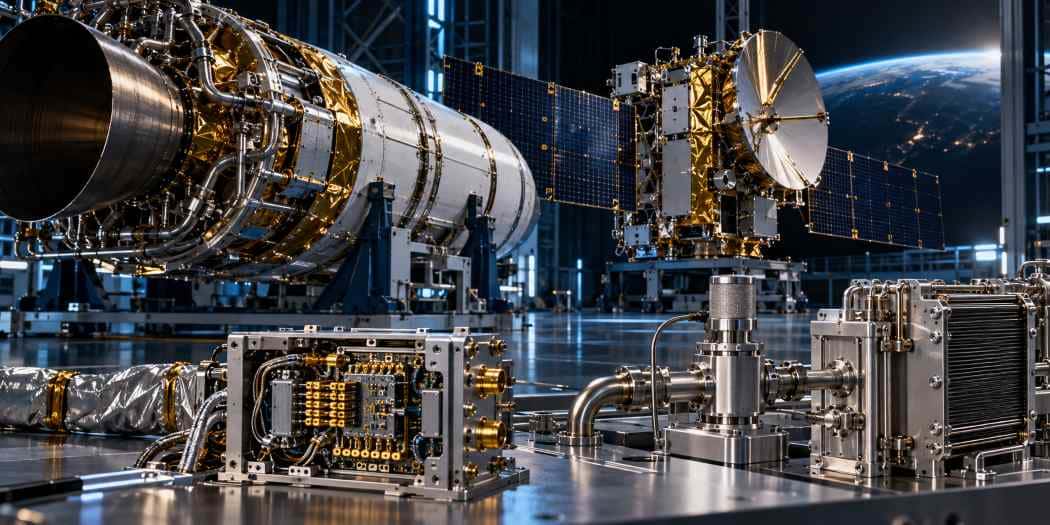
The Rocket Revolution Depends on Materials Most People Never See
World Space Week 2026 is built around the theme “Rocket Revolution,” highlighting reusable launch systems, expanding commercial access to orbit, and the rapid growth of space activity. Yet the transformation is not only about engines or boosters. It also depends on materials that keep electronics, sensors, thermal systems, connectors, and instruments working in environments that punish ordinary components.
That is where precious metals enter the story. Gold, silver, platinum, and palladium are not used in rockets because they are rare or valuable in a financial sense. Engineers use them selectively because their physical and chemical properties solve specific problems: conducting electricity, resisting corrosion, reflecting infrared radiation, catalyzing reactions, or detecting gases. In space hardware, a tiny amount of the right metal can matter more than a much larger amount of a cheaper substitute.
Gold Works Where Oxidation and Heat Become Engineering Problems
Gold is probably the most visually recognizable precious metal associated with spacecraft, but appearances can be misleading. The gold-colored blankets wrapped around many spacecraft are usually multilayer insulation made with aluminized films such as Kapton; the color does not mean the spacecraft is covered in solid gold. NASA explains that actual gold is highly effective at reflecting infrared radiation and can protect critical components from radiant heat.
Gold also resists oxidation. That makes thin gold coatings useful on electrical contacts and other components where corrosion or degraded conductivity can create problems. NASA guidance for spaceflight connectors has identified gold plating as a preferred finish in certain applications requiring strong conductivity, shielding performance, or low residual magnetism.
Those uses explain why engineers can justify gold even when only microscopic layers are required. The goal is not to add mass, but to put a stable, conductive surface exactly where failure could be mission-ending.
The same logic extends beyond thermal protection. Gold can be deposited in extremely thin layers, allowing engineers to capture useful surface properties without carrying the mass or cost of a solid-gold component.
Silver Is Valuable for Conductivity—but Space Changes the Rules
Silver has the highest electrical conductivity of any metal, helping explain its broad role in electronics, solar technology, semiconductors, data centers, vehicles, and communications hardware. Bullion Exchanges recently examined that wider demand theme in its article on SpaceX, AI infrastructure, and silver demand.
Spacecraft engineering, however, shows why a superior property does not make a material ideal everywhere. NASA materials standards warn that exposed silver plating can tarnish, can suffer conductivity problems in certain environments, and is vulnerable to atomic oxygen in low Earth orbit. In some connector applications, NASA specifically restricts silver finishes and favors alternatives such as gold or electroless nickel.
That is an important correction to the simplistic claim that rockets and satellites “need silver” merely because silver conducts electricity well. Space systems use highly engineered material combinations. Silver may appear in electronic assemblies, conductive materials, thermal-control products, and specialized components, but its use depends on the mission environment.
For investors, that distinction matters when considering silver’s industrial story. Aerospace can contribute through electronics and communications supply chains, but it should sit alongside much larger sources of demand rather than replace them. Buyers tracking that broader market can follow the live silver price or compare physical silver bullion products.
Palladium Can Turn Hydrogen Into a Detectable Signal
Launch vehicles introduce another challenge: hydrogen. Liquid hydrogen has long been used in rocket propulsion, and detecting leaks can be critical because the gas is highly flammable and difficult to contain.
NASA Glenn developed microfabricated hydrogen sensors using palladium-alloy materials because palladium interacts strongly with hydrogen. In these devices, the metal helps translate hydrogen exposure into an electrical signal measurable across a broad concentration range. Palladium-chromium sensors were demonstrated during Space Shuttle missions and later commercialized for leak-detection applications.
That differs from palladium’s best-known terrestrial role in automotive catalytic converters, but the underlying advantage is similar: useful chemical reactivity. The amount of palladium in an individual sensor is tiny. Its importance lies in function, not tonnage. In a launch system containing millions of dollars of hardware, a small sensor element can still perform a critical safety role.
Platinum’s Strength Is Catalysis, Including Space Power Systems
Platinum enters space technology through another specialized route. The metal is an effective catalyst and has a long history in fuel-cell research. NASA has studied platinum-based fuel-cell electrodes for decades, while regenerative fuel cells remain under development for future lunar and planetary missions.
A regenerative fuel cell operates somewhat like a rechargeable energy-storage system. Hydrogen and oxygen can be combined to generate electricity and water, while an electrolyzer reverses the process when external power is available. NASA is testing regenerative fuel-cell technology for long-duration applications where energy storage must continue through periods without solar generation.
Engineers continually work to reduce precious-metal loading and modern systems can use different catalyst formulations, so it would be misleading to treat every space fuel cell as a major new source of platinum demand. The larger point is that platinum remains relevant where catalytic performance justifies its cost.
Why Space Uses Precious Metals Differently From the Bullion Market
The space sector demonstrates something easy to miss when precious metals are discussed only as investments: a material does not have to be consumed in large quantities to be technologically important.
Spacecraft face vacuum, radiation, severe temperature swings, vibration, contamination risk, and, in some orbits, reactive atomic oxygen. Materials must therefore be tested against conditions that ordinary terrestrial equipment may never encounter. A coating that performs well on Earth may degrade in orbit; an inexpensive contact material may become unacceptable if oxidation raises resistance.
Engineers therefore tend to use precious metals as thin coatings, catalysts, sensor materials, or specialized interfaces rather than bulk structural materials. Aluminum, titanium, nickel alloys, composites, and other materials account for far more of a launch vehicle or spacecraft by mass. Precious metals appear where surface behavior, conductivity, reflectivity, or chemical response matters more than volume.
For investors watching the broader precious-metals market, aerospace should be viewed as one part of a much larger industrial picture. Silver’s electronics and energy markets, and platinum-group-metal demand from transportation, chemicals, and energy systems, remain more consequential to overall consumption.
The Next Rocket Revolution Is Also a Materials Revolution
World Space Week’s “Rocket Revolution” theme focuses attention on reusable launch vehicles and wider access to orbit, but higher launch frequency also increases the importance of materials science. Reusability depends on engines, avionics, sensors, connectors, and thermal systems surviving repeated stress without compromising reliability.
Precious metals matter in that equation for specific reasons. Gold can protect surfaces and preserve electrical performance. Silver can deliver exceptional conductivity where the environment permits it. Palladium can detect hydrogen. Platinum can catalyze electrochemical reactions. None of those applications means rockets are filled with bullion, and none by itself is likely to transform global metal demand.
The stronger lesson is that advanced technology keeps finding places where the cheapest material is not necessarily the best one. In spaceflight, the premium paid for a precious metal can be justified by a few microns of coating, a tiny sensor element, or a catalyst that performs when failure is not an option. That is a fitting materials story for a week devoted to changing how humanity reaches space.