View Charts
Why Are Silver, Platinum and Palladium Falling Faster Than Gold?
 0
0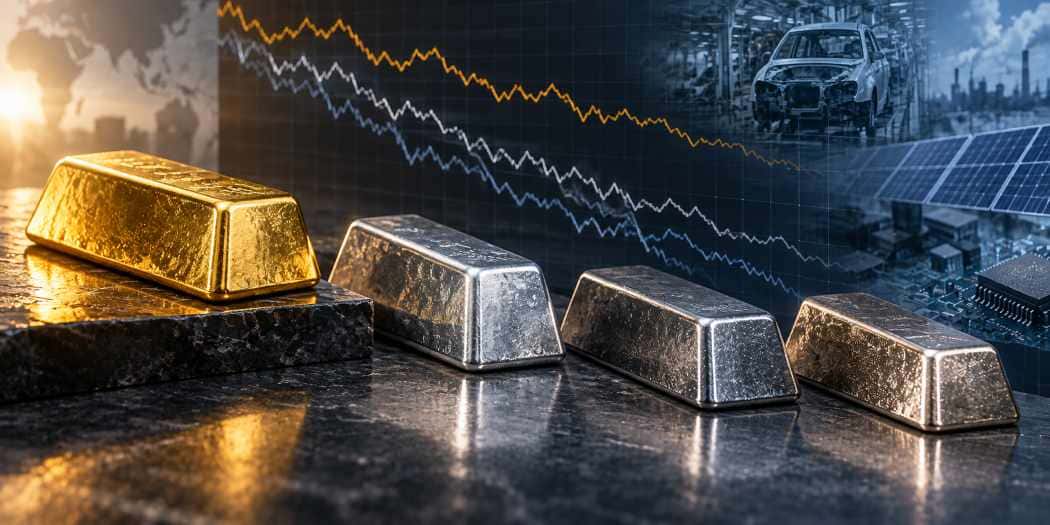
One Selloff Is Revealing Four Different Precious-Metals Markets
Precious metals are broadly lower on September 23, but the more revealing development is not the direction of the move. It is the widening gap between the metals. Morning trading showed gold down around 1%, while silver was off roughly 3%, platinum about 3.5%, and palladium suffered an even steeper decline. That divergence has emerged as a stronger U.S. dollar and restrictive Federal Reserve expectations pressure the entire complex.
Richmond Fed President Tom Barkin reinforced that backdrop Tuesday, arguing that inflation risks remain greater than employment risks following the Fed's latest rate increase. A dollar near a two-month high has added another obstacle for dollar-denominated commodities. Yet those forces alone do not explain why gold has been comparatively resilient.
The answer lies in what buyers ultimately use each metal for. Gold, silver, platinum, and palladium share the precious-metals label, but their demand structures are strikingly different. When monetary pressure coincides with uncertainty about manufacturing and global growth, those differences can suddenly become visible in price.
Gold Has a Monetary Demand Base the Others Cannot Match
Gold is unusual among commodities because much of its demand has little connection to industrial production. Central banks hold it as a reserve asset, investors use bullion and gold-backed products for portfolio diversification, and physical demand can respond to currency movements, geopolitical uncertainty, and concerns about the financial system.
That does not insulate gold from higher interest rates. A more restrictive Fed outlook can increase yields available on competing assets, while a stronger dollar generally makes gold more expensive in other currencies. Those forces help explain today's retreat.
But gold enters that environment with another source of demand. The World Gold Council's analysis of central-bank gold reserves continues to document substantial official-sector holdings and purchases around the world. That reserve function does not disappear because expectations for factories, automobile production, or industrial output weaken.
The contrast becomes especially important on days such as September 23. Investors can reduce exposure to economically sensitive commodities without necessarily abandoning gold to the same degree. The resulting price gap is therefore not an anomaly. It reflects the different reasons people own these metals in the first place.
Silver Sits Directly Between Money and Industry
Silver complicates the comparison because it belongs convincingly to both worlds. Investors buy coins, bars, and exchange-traded products, giving silver many of the monetary characteristics associated with gold. At the same time, manufacturers consume large quantities of silver in electronics, photovoltaics, electrical applications, vehicles, brazing alloys, and other industrial uses.
According to the Silver Institute's World Silver Survey, industrial fabrication remains a major component of global silver demand. That gives silver exposure to economic expectations that gold does not share to the same extent.
Today, both sides of that identity are working against it. The stronger dollar and restrictive rate outlook weigh on silver as an investment metal, while uncertainty surrounding manufacturing and trade creates another channel through which investors can reassess its near-term prospects. President Xi Jinping's arrival in Washington ahead of Thursday's meeting with President Trump adds an important event risk because trade, technology, tariffs, and critical-mineral supply chains have direct implications for industrial activity.
That does not mean weaker silver prices signal that solar, electronics, or other physical users have suddenly stopped consuming metal. Daily market prices often react to changing expectations much faster than physical demand changes. Silver simply has more economic channels through which those expectations can influence trading.
Platinum and Palladium Carry Much Heavier Industrial Baggage
The distinction becomes sharper with the platinum-group metals. Platinum has investment and jewelry markets, but industrial consumption is central to its demand profile. Palladium is even more concentrated, with automotive catalytic converters historically accounting for the majority of annual demand.
The World Platinum Investment Council tracks a platinum market shaped by automotive demand, industrial applications, jewelry, investment, recycling, and geographically concentrated mine production. Palladium is similarly exposed to vehicle production and emissions-control technology, while substitution between platinum and palladium adds another variable absent from the gold market.
That helps explain why the PGMs can react violently when macroeconomic conditions deteriorate even without a new mine closure or supply disruption. No fresh platinum- or palladium-specific supply shock emerged this morning that adequately explains their disproportionate declines. The price action instead appears consistent with investors applying a heavier discount to metals whose demand is more closely connected to manufacturing and automotive activity.
Palladium can exaggerate those moves because its market is considerably smaller and less liquid than gold's. When positioning changes quickly, comparatively modest shifts in capital can translate into large percentage moves. A sharp daily decline therefore does not necessarily mean the underlying physical palladium balance changed by an equivalent amount overnight.
A Strong Dollar Does Not Hit Every Metal Equally
The dollar provides the common thread across today's precious-metals weakness. Because international commodity benchmarks are generally quoted in dollars, a stronger U.S. currency raises the effective cost for many non-U.S. buyers. Higher interest-rate expectations can reinforce that effect by supporting the dollar while increasing the opportunity cost associated with holding non-yielding metals.
If that were the only force operating, however, the four metals might be expected to move more closely together. Today's separation shows why cross-market analysis matters.
Gold is absorbing the monetary shock while retaining its reserve and defensive characteristics. Silver receives the same monetary pressure but carries an industrial component as well. Platinum adds still greater sensitivity to industrial and automotive conditions, and palladium concentrates that exposure further.
This is also why comparing precious metals solely by their percentage moves can obscure more than it reveals. Investors following gold prices and silver prices are watching assets whose demand responds differently to the same economic signal. The same principle applies when comparing gold with the PGMs.
Tomorrow's Trade Talks Could Test the Divergence
Thursday's Trump-Xi meeting gives the market an unusually relevant test of this distinction. The talks are expected to keep trade restrictions, tariffs, technology, and strategic supply chains in focus. A meaningful shift in the outlook for U.S.-China commerce could therefore matter differently across the precious-metals complex.
For silver and the PGMs, changes in manufacturing expectations can alter the demand outlook alongside the usual effects of the dollar and interest rates. Gold could respond more strongly to what the talks imply for geopolitical risk, currencies, and investor demand. Those channels can even point in opposite directions.
That makes today's divergence more useful than a simple statement that precious metals are falling. It demonstrates why there is no single precious-metals trade. The same Fed policy, currency move, or economic concern passes through four different demand structures before reaching market prices.
The next reversal could expose the same distinction from the other direction. If monetary pressure eases but confidence in manufacturing remains weak, gold may respond differently from platinum or palladium. If global industrial expectations improve while yields remain restrictive, the industrial precious metals could regain ground without requiring an equivalent move in gold. September 23 offers a particularly clear example of that underlying reality: sharing a precious-metals label does not mean sharing the same price drivers.
Related reading you may find interesting:
Does the Silver Used in Electronics Ever Come Back?
Why Palladium Can Move Faster Than Gold and Silver