View Charts
Does the Silver Used in Electronics Ever Come Back?
 0
0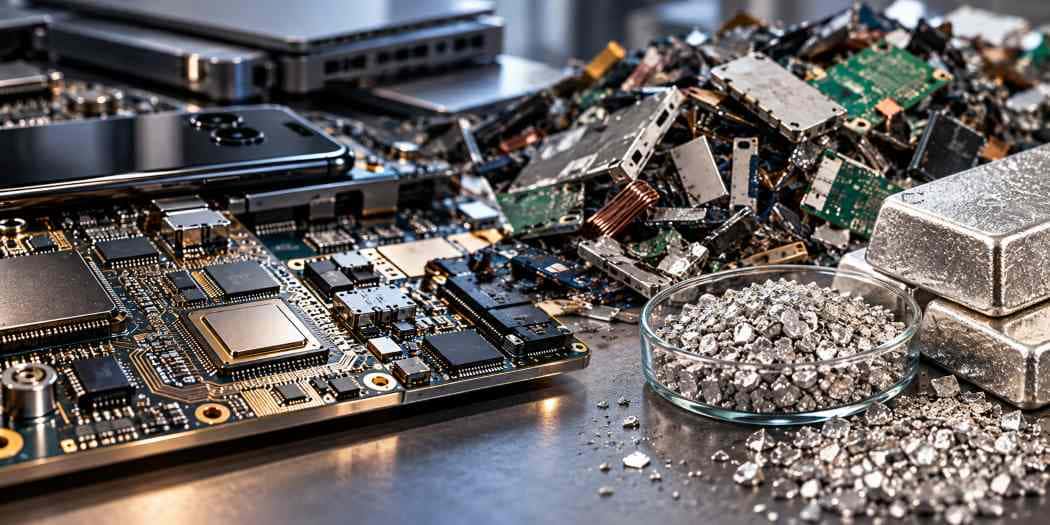
Silver Does Not Vanish, but It Can Become Unavailable
Silver does not disappear when a smartphone, server, vehicle control unit or other electronic device leaves the factory. The atoms remain somewhere in the product. But from the perspective of the silver market, that is only the beginning of the story.
Once silver is fabricated into contacts, conductive pastes, circuit boards and other components, it stops behaving like a readily available commodity. Instead of sitting in a recognizable bar that can be melted and refined, the metal may be divided into tiny quantities across millions of products, mixed with copper, plastics and other materials, and held in use for years. When those products reach the end of their lives, whether that silver returns to the market depends on collection, concentration, technology and economics.
That distinction—between silver that physically exists and silver that is realistically recoverable—is one of the least visible parts of industrial silver demand.
From Refined Metal to Microscopic Components
Silver's electrical conductivity makes it useful wherever manufacturers need reliable current flow, including electrical contacts, printed electronics, automotive systems, power infrastructure and sophisticated digital equipment. The Silver Institute's World Silver Survey 2026 reports that global industrial fabrication consumed 657.4 million ounces in 2025. Electrical and electronics demand declined modestly after several years of expansion, but continued to benefit from AI infrastructure, automotive applications and grid investment.
The important question is what happens after fabrication. A bullion bar concentrates silver in an obvious, standardized form. Electronics do almost the opposite. Manufacturers use small amounts exactly where silver's properties are valuable, often as thin layers, pastes or contacts. Research on waste printed circuit boards has found silver concentrated in component pins and microchips, while the boards themselves contain complicated mixtures of base metals, precious metals, polymers and other materials.
This dispersal changes the economics. A device can contain silver and still be a poor source of recoverable silver on its own. Recovery becomes more practical when large quantities of suitable electronic scrap are collected and processed together.
Recovery Starts Before the Refinery
Recycling is often imagined as a metallurgical problem: dismantle a device, separate its materials and extract the valuable metals. In practice, the recovery chain begins earlier. The discarded product first has to enter a recycling stream capable of preserving its valuable components.
At end of life, some electronics enter formal collection programs and are dismantled and sorted. Others remain forgotten in drawers or warehouses, are reused for years, or enter waste streams where valuable metals are never captured efficiently.
Silver can therefore be physically present above ground without being available as secondary supply. A phone sitting unused for years is not lost chemically, but its silver is removed from the active market. Industrial silver may remain locked in products long after the original fabrication demand was recorded.
Once suitable electronic waste reaches a specialized recycler, the economics become more interesting. Waste printed circuit boards are often described as "urban mines" because they can contain valuable metals at concentrations well above those found in many natural ores. Research into precious-metal recovery from electronic waste has identified silver alongside gold, palladium and substantial quantities of copper in these boards.
Yet high metal concentration does not make recovery simple. Printed circuit boards can contain dozens of elements integrated with plastics. Processing may involve dismantling and physical separation followed by thermal or chemical treatment; hydrometallurgy, for example, uses leaching and separation techniques to recover target metals.
Crucially, silver is rarely the only metal determining whether an operation pays. A 2026 techno-economic study of precious-metal recovery from waste printed circuit boards found gold to be the principal driver of project revenue in the systems examined. Silver may therefore come back because it travels inside a waste stream valuable enough to process for several metals at once. The economics can be driven by gold, copper or the combined material value rather than by silver alone.
Why Some Silver Is Effectively Lost
Silver's usefulness can work against its recyclability. Modern manufacturing can achieve the required electrical performance with very small amounts of metal. That reduces material costs, but it also spreads silver more thinly through the economy.
The U.S. Geological Survey's study of the silver lifecycle identified high-technology applications using silver at very small scales as a source of potential "dissipative loss" and reduced recycling capability. The element has not ceased to exist. Instead, collection and processing can consume more money, energy and effort than the recovered silver justifies.
Loss can occur at several points. A product may never reach an appropriate recycler, a silver-bearing component may not be separated, or processing may prioritize higher-value materials. Extremely dilute silver can remain in residues where further extraction is technically possible but economically unattractive.
This is the difference between theoretical and economic recoverability. Sophisticated processing can extract metals from remarkably complex feedstock, but recyclers still have to pay for collection, sorting, transport, labor, energy, equipment, chemical inputs and environmental controls. The question is not simply whether silver can be recovered; it is whether recovering it makes economic sense.
Higher Silver Prices Can Move the Recovery Line
The boundary between recoverable and uneconomic silver is not fixed. When the silver price rises, material that once offered too little value can become more attractive to collect or process. Higher prices can also encourage owners to sell high-grade scrap, which is why recycling often responds to price signals.
Electronics complicate that relationship. The Silver Institute reported that total silver recycling increased 2% to a 12-year high of 197.6 million ounces in 2025, yet e-scrap volumes declined. Jewelry and silverware selling and industrial catalyst scrap played larger roles in the increase. Higher prices therefore do not automatically release every hidden ounce from obsolete electronics.
Concentration still matters, as do collection systems and the value of accompanying metals. A higher silver price can improve the economics at the margin, but it cannot instantly retrieve millions of tiny deposits scattered through products worldwide. Some silver remains tied up in working products; some eventually enters efficient recovery systems; some waits years before recycling; and some becomes so dispersed that it is effectively unavailable.
That distinction adds another layer to silver's dual identity as an industrial commodity and investment metal. Demand statistics record fabrication when it occurs, while secondary supply may not respond until years later—and may never recover all of the original metal.
An Ounce Can Return—but Not Necessarily Soon
Following an imaginary ounce through the industrial economy reveals several possible endings. It might remain in long-lived equipment for a decade, sit in a discarded device rather than being recycled, reach a sophisticated processor and return as refined metal, or become too dispersed to justify recovery.
That makes "consumption" a misleading word if interpreted as physical destruction. Industry does not annihilate silver. It changes the metal's form, location, concentration and accessibility.
For the silver market, however, accessibility is what counts. Mine supply and recycled supply deliver metal that can satisfy new demand; silver trapped in an obsolete circuit board at the back of a drawer cannot. As technology expands the number of places where small amounts of silver perform essential work, the more useful question is not simply how much silver industry consumes. It is how much of that metal can economically find its way back.
For investors, that lifecycle helps put headline demand figures into context. Industrial use can temporarily—or in some cases effectively permanently—remove metal from readily accessible supply, while recycling returns only part of it and often on a substantial delay. That dynamic is one reason the industrial side of silver should be considered alongside mine production, investment demand and secondary supply when evaluating the market. Investors interested in the physical side of that market can also explore silver coins and silver bars as forms in which silver remains concentrated, standardized and readily tradable.
Related reading you may find interesting:
Does Tarnish Reduce the Value of Silver Bullion?