View Charts
Which Countries Hold the Most Gold? Central Bank Reserves Explained
 0
0
Why the World's Biggest Gold Buyers Aren't Individual Investors
Gold has regained global attention in recent years as central banks purchase bullion at the fastest pace in decades. While individual investors often focus on the gold spot price or exchange-traded funds, the world's largest buyers are national governments quietly expanding their official reserves. Their actions have helped reinforce gold's position as a strategic financial asset despite a monetary system no longer backed by the precious metal.
That raises an important question: if modern currencies are no longer tied to gold, why do central banks continue holding thousands of tonnes of it? The answer extends far beyond tradition. Gold remains one of the few reserve assets that carries no counterparty risk, is recognized worldwide, and can help strengthen confidence during periods of economic uncertainty or geopolitical tension.
Understanding which countries hold the largest gold reserves—and why those holdings continue to grow—offers valuable insight into how governments manage financial stability. It also provides investors with important context for evaluating long-term demand, market liquidity, and the role gold continues to play within the global monetary system.
Why Central Banks Continue to Hold Gold
For much of modern history, gold formed the foundation of the international monetary system. Under the classical gold standard and later the Bretton Woods system, currencies were either directly convertible into gold or indirectly linked through the U.S. dollar. Although those arrangements ended decades ago, central banks never abandoned the metal entirely.
Instead, gold evolved from a monetary anchor into a strategic reserve asset. Unlike foreign currencies or government bonds, physical bullion does not depend on another country's fiscal policy or creditworthiness. It cannot be created by central banks, default on its obligations, or lose value because of monetary expansion. Those characteristics continue to make gold an attractive component of national reserves.
Reserve managers also value diversification. Most central bank portfolios consist primarily of foreign currencies—particularly U.S. dollars and euros—along with government securities. Gold provides balance by behaving differently from many financial assets during periods of market stress. When confidence in paper assets weakens, bullion has historically helped stabilize reserve portfolios.
Recent geopolitical developments have reinforced gold's importance. Economic sanctions, frozen foreign assets, persistent inflation, and growing geopolitical fragmentation have encouraged many countries to reassess how their reserves are allocated. Rather than relying exclusively on reserve currencies, many central banks have steadily increased their gold holdings as an additional layer of financial security.
Which Countries Hold the Largest Gold Reserves?
Although more than 100 central banks own gold, a relatively small group controls the majority of official reserves. According to the World Gold Council, these countries maintain the largest national holdings.
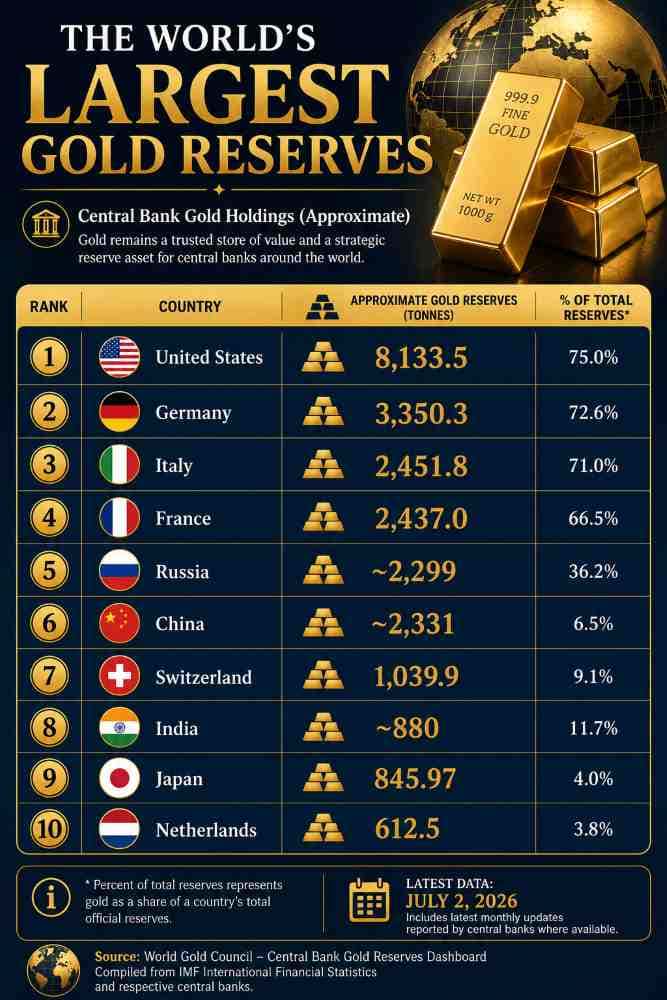
China reports periodic reserve updates, and many analysts believe its total holdings may be higher than officially disclosed.
The United States remains the world's largest official gold holder by a substantial margin, accounting for roughly one-quarter of all reported central bank reserves. Much of that bullion has been held for generations and is stored primarily at Fort Knox, West Point, and the Denver Mint.
Several European countries continue to rank near the top despite reducing their reliance on gold-backed currencies decades ago. Germany, Italy, and France have largely maintained their reserves, viewing them as long-term strategic assets rather than relics of an earlier monetary system.
The most notable changes have come from emerging economies. Russia and China have significantly expanded their holdings over the past two decades, while countries including India, Poland, Netherlands, and several Central Asian nations have also become consistent buyers as they diversify away from traditional reserve assets.
Why Central Banks Have Been Buying More Gold
Central bank gold purchases accelerated sharply in the early 2020s, with official-sector demand reaching record levels in 2022 and remaining historically strong through 2025. That sustained buying has made central banks one of the most important sources of long-term demand in the bullion market, but the shift is not simply a reaction to higher prices. It reflects a broader reassessment of how national reserves should be structured in a period marked by inflation, geopolitical fragmentation, and greater uncertainty around the security of foreign assets.
Persistent inflation renewed interest in gold as a store of value, while sanctions and frozen reserves reminded policymakers that financial assets held within another country’s system may carry political risk. Gold’s independence from any issuing authority makes it especially attractive in that environment. Diversification also plays a central role. Many countries continue to hold substantial reserves in U.S. dollars and Treasury securities, but adding gold can reduce concentration risk and create a more resilient balance of assets with different characteristics.
These purchases are typically part of multi-year reserve strategies rather than short-term trades. Central banks tend to accumulate gradually, often with little concern for daily fluctuations in the gold spot price, because their objective is not immediate performance but long-term financial flexibility.
Does Central Bank Buying Move the Gold Market?
Central bank purchases rarely cause dramatic one-day price swings, yet they can exert meaningful influence over time. Reserve managers generally buy gradually and hold gold bullion for extended periods, effectively removing metal from the available market and reducing the supply accessible to private investors, funds, jewelers, and commercial users.
Official buying also carries considerable psychological weight. When national reserve managers continue accumulating gold despite elevated prices, investors often interpret that behavior as confirmation that bullion remains a trusted asset during periods of economic and geopolitical uncertainty. That signal can reinforce private investment demand, particularly when concerns about inflation, currency stability, or financial-system risk are already elevated.
Even so, central bank activity is only one part of the gold market. Interest rates, inflation expectations, the U.S. dollar, economic growth, and geopolitical developments all influence prices. Official purchases are best understood as a durable source of support rather than the sole explanation for any particular move.
What Central Bank Reserves Mean for Individual Investors
Individual investors do not need to imitate central bank portfolios, but they can learn from the principles that guide them. Reserve managers focus on diversification, liquidity, and long-term stability rather than short-term returns, and that perspective helps explain why gold continues to occupy a distinct place in both official and private portfolios.
Unlike stocks or bonds, gold is not tied to corporate earnings or the finances of a single government. That independence has often made it useful during periods when traditional markets become more volatile or confidence in currencies weakens. The rankings of the world’s largest gold holders are therefore less important than the persistence of official demand itself. Central banks continue adding bullion even within a fiat currency system because they still view it as a strategic reserve asset capable of supporting confidence and financial resilience.
For investors, the clearest lesson is one of time horizon. Daily attention may center on the gold spot price, but central banks are making decisions measured in years and decades.