View Charts
Precious Metals Market Cap: Why Size Matters
 0
0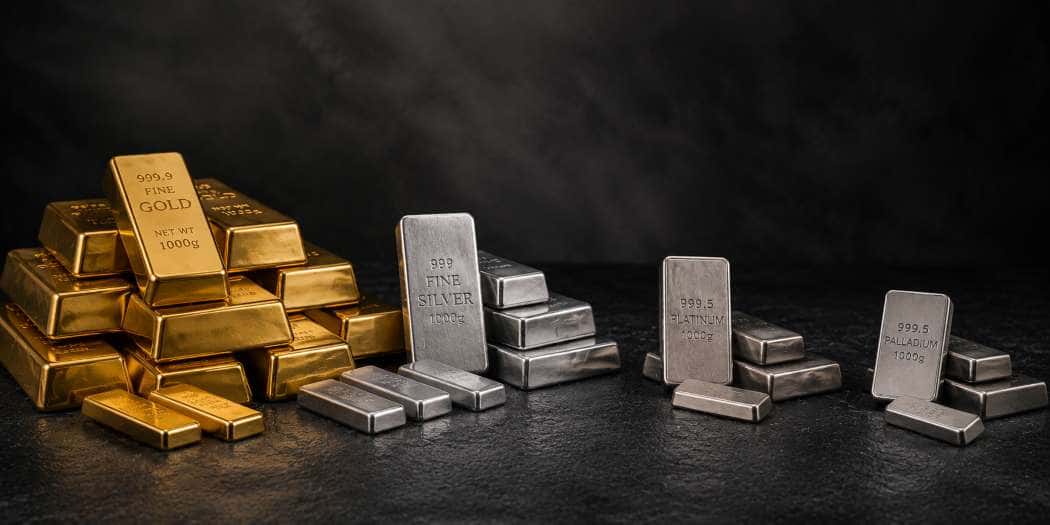
Market Size Explains More Than Price Ever Can
Gold may trade at thousands of dollars per ounce while silver costs only a fraction of that amount, but price alone tells investors surprisingly little about the markets behind those metals. The same principle applies to platinum and palladium, whose prices have each spent time above and below gold over the past two decades. A higher or lower spot price does not necessarily indicate a larger market, greater investment opportunity, or stronger long-term fundamentals.
That distinction is where market capitalization becomes one of the most useful—yet often overlooked—tools in precious metals investing. By estimating the total value of a metal's above-ground supply, market capitalization provides a broader perspective on the size, liquidity, and maturity of each market. It helps explain why gold typically moves differently than silver, why platinum and palladium can experience dramatic swings from relatively modest changes in supply or demand, and why smaller markets are not automatically better investments.
Understanding market capitalization also encourages investors to think beyond simple price comparisons. A lower-priced metal may seem more affordable, but affordability is not the same as opportunity. Likewise, a larger market may appear less exciting, yet its depth and liquidity can offer advantages during periods of economic uncertainty. Rather than predicting which metal will perform best, market capitalization helps explain why each responds differently when market conditions change.
Looking Beyond Spot Prices
Market capitalization measures the estimated total value of a precious metal based on its current market price and the amount of above-ground supply available. While investors often focus on the gold spot price when tracking daily market movements, market capitalization provides a much broader perspective on the overall size and depth of the market. Unlike publicly traded companies, which calculate market capitalization by multiplying outstanding shares by share price, precious metals rely on estimates of refined metal held in bullion, jewelry, industrial products, and official reserves.
Although these figures change as new metal is mined, recycled, or consumed, they provide a practical way to compare markets operating on vastly different scales. Gold's market capitalization is measured in the tens of trillions of dollars, making it the world's largest asset by estimated market value. Silver represents a much smaller market despite its widespread industrial use and investment demand, while platinum and palladium occupy comparatively specialized positions within the global precious metals landscape.
For investors, this perspective is valuable because it places daily price movements into context. A billion dollars flowing into gold represents only a small fraction of its overall market. The same amount entering platinum or palladium can have a much greater influence simply because those markets are considerably smaller. Market capitalization therefore serves as a guide to market structure, helping investors understand how easily prices may respond to changing conditions rather than suggesting whether a metal is expensive or inexpensive.
Gold's Scale Has Made It the World's Monetary Metal
Gold's enormous market capitalization reflects more than its price—it reflects thousands of years of accumulation. Unlike many industrial commodities that are consumed during manufacturing, most of the gold ever mined still exists in some form. It is held by central banks, investment funds, private investors, jewelry owners, and governments around the world, creating an exceptionally deep and liquid market.
That broad ownership base helps explain why gold has maintained its role as the world's primary monetary metal. During periods of financial uncertainty, investors can buy or sell significant quantities without dramatically disrupting prices. Central banks continue to hold gold as a reserve asset because its market is large enough to absorb substantial transactions while maintaining global confidence and liquidity.
Gold's size also influences its behavior. While its price responds to interest rates, inflation expectations, currency movements, and geopolitical developments, the market is generally less susceptible to sudden shocks than its smaller counterparts. That relative stability has made gold the benchmark against which other precious metals are often measured—not because it always delivers the highest returns, but because its scale provides resilience that few other tangible assets can match.
Smaller Markets Create Different Opportunities—and Different Risks
Gold's sheer size makes it unique, but smaller markets are not simply scaled-down versions of gold. Silver, platinum, and palladium each occupy distinct positions within the global economy, and their comparatively modest market capitalizations help explain why they often experience greater volatility.
Silver sits between the monetary and industrial worlds. Investors buy it as a store of value, yet manufacturers rely on it for products ranging from solar panels and electronics to medical technologies. Because investment and industrial demand can strengthen or weaken independently, silver often responds to a broader mix of economic forces than gold. Its smaller market also means shifts in investor sentiment can produce larger percentage price moves, which helps explain why silver has historically outperformed gold during some bull markets while experiencing steeper corrections during downturns.
Platinum and palladium operate on an even smaller scale. Their markets are heavily influenced by industrial demand—particularly the automotive sector—and mine production is concentrated in relatively few regions. This combination makes both metals especially sensitive to supply disruptions, changes in manufacturing activity, and technological developments that alter industrial consumption. When those factors align, prices can move rapidly in either direction because there is less market depth to absorb sudden changes in buying or selling.
These differences illustrate why market capitalization matters. It does not determine whether one metal is superior to another, but it does provide insight into how each is likely to react when market conditions change.
Market Cap Should Inform Decisions—Not Make Them
One of the most common investing misconceptions is that a smaller market automatically offers greater upside. While it is true that less capital is required to influence a smaller market, the same characteristic increases volatility and liquidity risk. Faster gains are often accompanied by sharper declines, and concentrated markets can change direction quickly when demand shifts or supply conditions improve.
Market capitalization should therefore be viewed as one component of a broader investment framework rather than a stand-alone indicator. Interest rates, inflation, central bank policy, industrial demand, mine supply, recycling activity, and geopolitical events all influence precious metals prices, often simultaneously. Market cap helps investors understand how those forces may affect different metals, but it cannot predict future performance on its own.
For long-term investors, the greatest value of market capitalization lies in setting realistic expectations. Gold's enormous market explains its relative stability and enduring role as a reserve asset. Silver's intermediate size helps account for its blend of monetary and industrial characteristics. Platinum and palladium demonstrate how specialized, supply-constrained markets can experience outsized price movements from comparatively modest changes in global demand.
Viewed together, these markets illustrate an important lesson: the size of a market shapes its behavior far more than it determines its potential. Investors who understand that distinction are better equipped to evaluate opportunities based on fundamentals rather than assumptions. Market capitalization is not a measure of which precious metal is 'best'—it is a lens through which the unique characteristics of each market become easier to understand.
Related reading you may find interesting:
Which Countries Hold the Most Gold? Central Bank Reserves Explained