View Charts

How Much of the World's Gold Supply Comes From Recycling?
 0
Gold Recycling Supplies More Than You Might Think
Gold recycling accounted for approximately 28% of global gold supply in 2025, according to the World Gold Council. That makes recovered gold a significant contributor to the market, even though mining remains the dominant source. The surprising part is that recycling's contribution remains relatively modest compared with the enormous quantity of gold already owned around the world.
Unlike oil or other commodities consumed through use, gold can be recovered, refined, and reused without losing its essential properties. Jewellery can become investment bars, industrial scrap can return to manufacturing, and unwanted gold items can reenter circulation. Yet the existence of recyclable gold does not mean its owners are willing to sell it, even when prices reach historic highs.
This distinction helps explain why gold recycling is an important but unpredictable component of global supply. Its contribution depends not simply on how much gold exists, but on how much existing metal becomes available for recovery.
How Much Gold Supply Comes From Recycling?
According to the World Gold Council's 2025 annual supply statistics, recycled gold contributed approximately 1,404 metric tonnes to the global market. Total reported supply reached about 5,002 tonnes, including approximately 3,672 tonnes from mining and a negative adjustment from producer hedging. Recycling therefore represented roughly 28% of annual supply, while newly mined gold remained the largest contributor.
These figures measure gold entering the market during a particular year, not the total amount of gold that exists. A necklace kept in a jewellery box, a coin held by an investor, or a bar stored in a vault contributes to the world's above-ground gold stock. None becomes recycled supply until the metal enters a recovery or refining process. Similarly, a bullion coin sold from one investor to another does not automatically count as recycled gold.
The distinction becomes particularly important when comparing annual production with the world's accumulated holdings. The World Gold Council estimates that more than 220,000 tonnes of gold existed above ground by mid-2026, representing centuries of mining and accumulation. Only a small portion of that enormous stock returns to the market through recycling each year.
Why Isn't More of the World's Gold Recycled?
Gold's durability makes it highly recyclable, but its value also encourages people to retain it. Jewellery frequently carries sentimental or cultural importance, while investors purchase bullion specifically to preserve wealth over extended periods. Central banks may hold gold reserves for decades, and families can pass precious-metal possessions between generations without ever considering a sale.
Consequently, the amount of gold technically available for recycling is much larger than the amount offered to refiners. Ownership decisions determine whether recoverable material enters the market. Someone holding an inherited necklace may have little interest in its scrap value, while an investor expecting further price appreciation might prefer to retain existing bullion rather than liquidate it.
Recovery costs create another limitation. Gold contained in electronics, industrial components, and other manufactured products can be difficult to collect and separate economically. Processing small quantities dispersed across millions of devices requires specialized infrastructure, transportation, and equipment. Even when recovery is technically possible, the value of the recovered metal must justify those expenses.
This combination of financial incentives, personal attachment, and processing costs helps explain why a substantial above-ground gold stock does not translate into an equally substantial recycling flow.
Why Higher Gold Prices Don't Always Increase Recycling
Higher gold prices generally encourage recycling because unwanted jewellery and other gold-bearing items become more valuable. Selling an old bracelet or damaged chain can provide immediate cash, particularly when households face financial pressure. Dealers and refiners may also experience increased activity when rising prices attract sellers hoping to capitalize on stronger market conditions.
However, the relationship is not automatic. The World Gold Council reported that recycled gold supply increased by only about 3% in 2025, despite a 44% increase in the annual average U.S. dollar gold price. That relatively restrained response illustrates how ownership decisions can offset the incentive created by higher prices.
Some owners interpret rising prices as a reason to keep their gold rather than sell it. Others regard jewellery as long-term savings or family wealth, making short-term price movements less important. Local economic conditions, currency fluctuations, and access to reputable buyers also influence whether existing gold reaches the market.
These competing incentives make recycling difficult to forecast. A price increase may encourage selling in one region while strengthening the desire to retain gold in another. For investors following gold price movements, recycling figures offer useful context, but price trends alone cannot explain changes in available supply.
Where Recycled Gold Comes From and Why It Matters
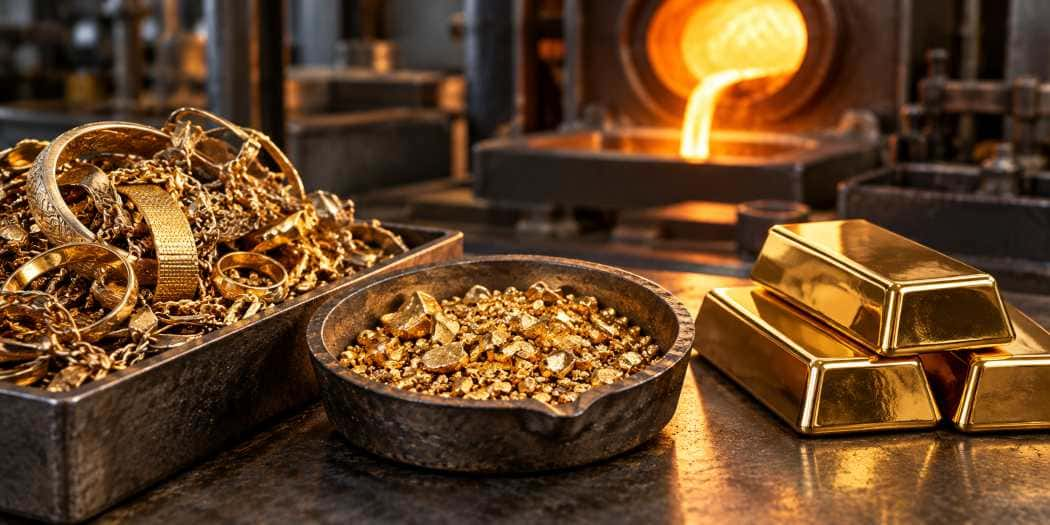
Jewellery represents a major source of recycled gold because it is widely owned and often contains relatively high concentrations of recoverable metal. Broken chains, unwanted rings, and outdated pieces can be evaluated, purchased, and sent for refining. Manufacturing scrap, dental materials, and electronic components provide additional sources, although their recovery processes differ considerably.
Industrial scrap can be comparatively straightforward to process when its composition is known and collection occurs within established manufacturing systems. Electronic waste presents greater challenges because gold must be separated from other metals, plastics, and potentially hazardous materials. Responsible recovery therefore requires appropriate equipment, waste management, and environmental controls.
Once properly refined, recycled gold can meet the same purity standards as newly mined material. Its original source does not inherently affect the quality of the finished metal. For buyers comparing gold bars or coins, purity, weight, authenticity, and manufacturer reputation remain more relevant than whether the gold originated from a mine or a previously owned product.
Recycling can also reduce the need for additional extraction by returning existing metal to productive use. However, it is not environmentally impact-free. Refining consumes energy and may involve chemical processing, transportation, and waste management. The environmental advantages depend on the recovery method, energy source, and material being processed.
These considerations make recycling an important complement to mining rather than a simple replacement. Although gold can be reused indefinitely, the amount recovered each year depends on economic conditions, collection infrastructure, and the willingness of owners to release their holdings.
What Gold Recycling Means for Investors
Recycling helps connect the world's enormous existing gold stock with the comparatively small quantity available for new purchases each year. When more owners sell unwanted gold, additional metal can enter the market without an equivalent increase in mine production. When owners retain their holdings, recycled supply may remain limited even during periods of strong prices.
This is one reason gold prices cannot be explained solely through mining output. Investment demand, central bank purchases, economic uncertainty, and the availability of existing metal all influence market conditions. Recent Bullion Exchanges coverage of gold and silver's reaction to inflation data illustrates how financial conditions can affect precious-metal prices independently of changes in physical production.
For bullion buyers, the distinction between recycled and newly mined gold is less important than the characteristics of the finished product. Recognized purity, transparent pricing, and reliable authentication remain central considerations, whether purchasing newly manufactured bullion or established investment products. The broader supply picture is useful for understanding market behavior, not for determining the quality of an individual gold bar or coin.
The Bottom Line
Recycled gold accounted for approximately 28% of global gold supply in 2025, making it a substantial source of metal alongside mining. However, that percentage describes annual market supply rather than the share of existing gold that could eventually be recovered.
Gold's recyclability gives the market access to a vast reservoir of previously mined metal, but availability depends on ownership decisions, recovery economics, and broader financial conditions. Understanding those limitations explains why mining continues to dominate annual supply even though so much gold already exists above ground.