View Charts
2027 Britannia Coins Celebrate Gold and Silver Anniversaries
 0
0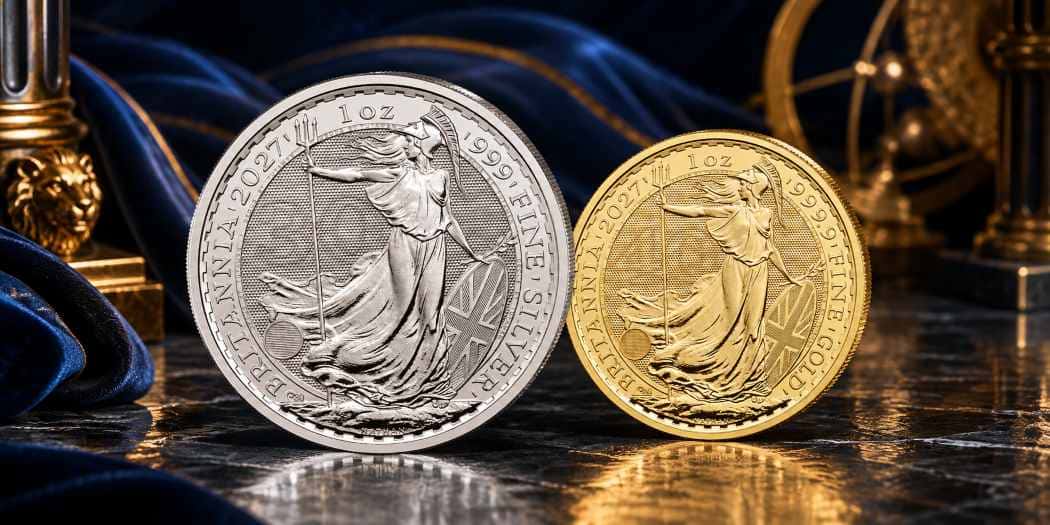
Two Milestones Meet in the 2027 Britannia
Four decades after the first Gold Britannia appeared, Philip Nathan’s familiar figure is getting an anniversary treatment. The 2027 bullion release marks the Gold Britannia’s 40th anniversary and, at the same time, 30 years since silver joined the series. Rather than replace Nathan’s reverse with a commemorative design, The Royal Mint has worked both milestones into the Britannia itself, giving the anniversary issues a distinct identity without separating them visually from the wider series.
Gold coins carry a “40” wave privy mark, while silver coins receive a corresponding “30.” The field behind Britannia also incorporates textures built around the respective anniversary numbers. These additions sit alongside a design that still shows Britannia with her trident, shield and olive branch and retains the visual security technology associated with recent issues. The result is recognizably Britannia but unmistakably tied to 2027, an approach that suits a bullion series whose identity has developed through gradual changes rather than frequent redesigns.
How Gold and Silver Arrived Ten Years Apart
The two anniversary numbers tell different parts of the same story. Gold came first in 1987, when sculptor Philip Nathan created the standing Britannia specifically for a new British bullion coin. His interpretation drew on a figure that had appeared on British coinage for centuries but gave her a modern bullion identity: the shield represents protection, the olive branch peace, and the trident Britain’s connection to the sea. That composition became the visual foundation on which the modern Britannia program developed.
Those first Gold Britannias were not the .9999 fine coins buyers know today. The original composition was 22-karat, .9167 fine gold, before The Royal Mint changed the specification in 2013 to .9999 purity. The shift brought Britannia in line with the high-purity standard common among modern bullion programs while preserving Nathan’s central design and the specified amount of fine gold. Collectors can see how the series has evolved across earlier dates through Bullion Exchanges’ Gold Britannia collection.
Silver entered the program a decade after gold. Introduced in 1997, the Silver Britannia initially used .958 fine “Britannia silver,” a traditional British silver standard with a higher purity than sterling silver. It also changed in 2013, moving to the .999 fine silver specification used for the bullion series today. The ten-year separation explains why 2027 carries two anniversaries: the gold “40” reaches back to the program’s 1987 origin, while silver’s “30” marks the expansion of Britannia into another major investment metal in 1997.
The Anniversary Marks Become Part of the Design
Privy marks can sometimes feel like small additions placed on an otherwise unchanged coin, but the 2027 Britannia takes a more integrated approach. Gold receives its “40” wave privy and a textured field showcasing the same number, while silver substitutes “30.” The treatment works particularly well because waves already play an important role in the appearance and authentication system of modern Britannias, allowing the anniversary details to become part of the existing visual structure rather than competing with Nathan’s artwork.
Since 2021, Britannia bullion coins have incorporated four advanced visual security features. Surface animation creates the impression that waves behind Britannia move as the viewing angle changes, while a latent feature alternates between a padlock and Britannia’s trident. Micro-text and tincture lines provide additional fine detail intended to make reproduction more difficult. For 2027, the anniversary numerals join that security-focused design language, preserving the familiar standing Britannia while giving collectors a straightforward way to distinguish the milestone year from surrounding dates.
Martin Jennings’ official coinage portrait of His Majesty King Charles III remains on the obverse. That pairing creates an interesting historical contrast within the anniversary issue: Nathan’s reverse connects the coins directly to the Gold Britannia’s beginnings in 1987, while the current royal portrait fixes the release firmly within the present era of British coinage. The changes are therefore substantial enough to identify 2027 at a glance without turning the coins into an unrelated commemorative series.
2027 Britannia Weights Range From Fractional to Kilo
The anniversary treatment extends beyond the standard one-ounce coin. The 2027 Gold Britannia lineup includes 1 ounce, 1/2 ounce, 1/4 ounce and 1/10 ounce sizes, all struck in .9999 fine gold. This established fractional structure gives buyers and collectors four different gold formats carrying the 40th-anniversary treatment rather than restricting the special design to the flagship one-ounce issue.
Silver covers an even broader range. The 2027 Silver Britannia lineup includes 1 Kilo, 1 ounce, 1/2 ounce, 1/4 ounce and 1/10 ounce coins in .999 fine silver. That means the same 30th-anniversary concept spans pieces ranging from a compact tenth-ounce coin to a Kilo containing approximately 32.15 troy ounces of silver, giving the silver release considerably more variation in physical scale than its gold counterpart. Bullion Exchanges’ Silver Britannia collection also provides context for how the silver series has developed across previous years.
The smallest silver format has an additional distinction in 2027. The Royal Mint identifies the 1/10-ounce Silver Britannia as the first of its kind to incorporate all four of the Britannia bullion security features, bringing the complete modern security treatment to the fractional coin. A 1-ounce .9995 fine Platinum Britannia is also part of the broader 2027 bullion family, although it does not share the “40” or “30” anniversary treatment because those milestones belong specifically to the gold and silver programs.
Britannia Has Changed Without Losing Its Identity
Viewed across four decades, Britannia is less static than Nathan’s enduring reverse might suggest. Gold purity changed, silver joined the series and later changed purity itself, and the range expanded to encompass fractional and larger formats. The introduction of increasingly sophisticated security technology altered the fields around Britannia, while changes to the monarchy brought new portraits to the obverse. Through each stage, however, Nathan’s standing figure continued to provide a visual connection between generations of bullion coins.
That continuity is what makes the 2027 approach effective. A completely different anniversary reverse would have emphasized the milestone by temporarily interrupting the series, whereas the “40” and “30” treatments reward a closer look at a familiar coin. Someone accustomed to an ordinary Britannia still encounters the same central figure, but the wave privy and numbered background immediately separate the anniversary edition from neighboring years.
The security features reinforce that balance between old and new. Nathan could not have designed the original 1987 Britannia around today’s latent imagery, micro-text and animated surfaces, yet those technologies have been incorporated without overwhelming his composition. In 2027, the anniversary numerals become another layer in that evolution, turning parts of the modern visual architecture into markers of the series’ history. The Royal Mint’s retrospective, Britannia at 40: Four Decades of Change, places the anniversary in the context of the broader changes the program has experienced since 1987.
What Will Determine the 2027 Coins’ Collector Appeal?
A special privy mark can distinguish an issue without guaranteeing future rarity. Production levels, surviving supply, condition, demand and market availability will ultimately play a larger role in determining whether particular 2027 Britannias develop lasting collectible premiums. The anniversary treatment establishes the coins as identifiable varieties, but it should not be interpreted by itself as evidence that every size will become scarce.
What 2027 already has is a clearly defined place in the Britannia timeline. A collector can connect the Gold Britannia directly to its 1987 beginning and the Silver Britannia to its 1997 debut, while buyers following the modern series receive a one-year visual variation incorporated into the security architecture they already recognize. The range of weights broadens that anniversary story further, with four gold sizes and five silver sizes carrying the respective milestone treatments.
That breadth also illustrates how much Britannia has evolved since the original gold coin appeared 40 years ago. What began as a modern bullion interpretation of an ancient British symbol has developed into a family spanning several metals, fractional through Kilo formats, changing purity standards and multiple generations of anti-counterfeiting technology. The 2027 release captures that progression without abandoning the image that connected those developments in the first place: Gold needs only a “40,” silver needs only a “30,” and Britannia remains at the center of both.