View Charts

2027 Austrian Philharmonic Coins: Three Metals, One Design
 0
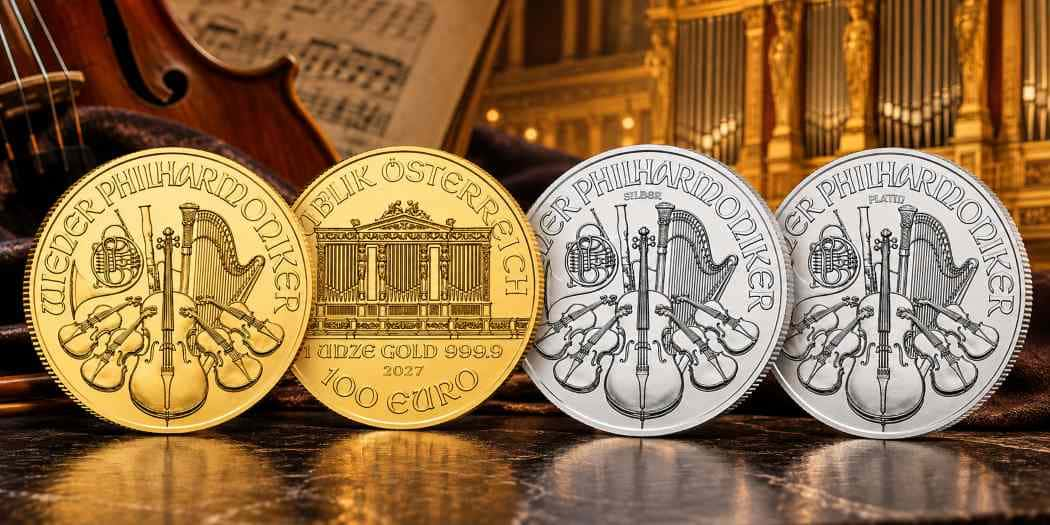
Why the 2027 Philharmonic Series Deserves a Closer Look
A bullion coin can retain the same design for nearly four decades and still present buyers with a different decision each year. The 2027 Austrian Philharmonic series illustrates that distinction. Its familiar musical imagery connects gold, silver, and platinum issues, but the choice among them involves more than selecting a preferred precious metal.
The Austrian Mint introduced the Gold Philharmonic in 1989, when international bullion markets were already served by established sovereign coins. Silver followed in 2008 and platinum in 2016, creating three related products with different market characteristics. Although their designs remain consistent, the metals vary in purity, available weights, premiums, and resale considerations.
For buyers evaluating the 2027 issues, the more revealing question is how the Philharmonic's established reputation translates into three distinct bullion markets. Understanding those differences begins with the series' unusual history.
How a Musical Design Became an International Bullion Standard
When the first Gold Philharmonic appeared on October 10, 1989, it entered a market dominated by coins associated with gold-producing nations. Austria pursued a different advantage, drawing on its minting tradition and Vienna's international reputation for classical music.
Designed by Austrian Mint engraver Thomas Pesendorfer, the coin depicts the pipe organ of Vienna's Musikverein Golden Hall on its obverse. The reverse features a cello surrounded by violins, a viola, a harp, a bassoon, and a Vienna horn. These designs have remained essentially unchanged, giving the series a recognizable identity across metals and annual releases.
That continuity has practical consequences. Buyers familiar with older Philharmonics can readily identify newer issues, while the shared artwork allows the three metals to form a visually consistent collection. However, a new date alone does not establish rarity or justify a substantial collectible premium. Standard bullion Philharmonics are primarily valued for their precious-metal content, with condition and market demand influencing their prices.
The program has achieved considerable international reach. According to the Austrian Mint's history of the Philharmonic, approximately 13.8 million one-ounce Gold Philharmonics had been sold worldwide by the end of 2023. That cumulative figure illustrates the series' recognition, although it should not be confused with the mintage of any particular year.
Early Gold Philharmonics carried Austrian schilling denominations before the country adopted the euro. Today's one-ounce gold and platinum coins each have a €100 face value, while the silver version carries €1.50. These denominations establish legal-tender status rather than determining bullion-market value.
Gold Philharmonics: How Denomination Affects the Buying Decision
Gold offers the broadest weight selection within the Philharmonic program. The Austrian Mint's established range includes five denominations, all containing .9999 fine gold. The one-ounce coin carries a €100 face value, followed by the 1/2 oz (€50), 1/4 oz (€25), 1/10 oz (€10), and 1/25 oz (€4) versions.
The smallest denomination, introduced in 2014, contains approximately 1.24 grams of pure gold. Its modest weight makes it accessible at a lower absolute purchase price, but fractional coins generally carry higher premiums per ounce than larger denominations.
Manufacturing, inspection, distribution, and dealer handling expenses do not decline proportionally with a coin's gold content. Consequently, purchasing ten 1/10-ounce Philharmonics can cost more than buying one full-ounce coin, despite receiving the same total gold weight. Buyers should compare the premium per ounce alongside the total purchase price.
Fractional gold nevertheless offers flexibility. Smaller coins permit purchases at different budget levels and allow owners to sell portions of a holding without liquidating an entire ounce. Full-ounce coins typically offer more efficient premiums and compact storage for larger quantities of gold.
These considerations become especially relevant when comparing retail prices with the underlying gold spot price. Spot represents the metal benchmark, whereas the final coin price incorporates manufacturing, distribution, and dealer costs.
Silver and Platinum Bring Different Market Forces Into Play
The Silver Philharmonic debuted in 2008, extending the established design to a lower-priced precious metal. Its standard format contains one troy ounce of .999 fine silver, measures 37 millimeters in diameter, and carries a €1.50 denomination.
Silver allows buyers to acquire more physical ounces for a given budget, although larger holdings require additional storage and can involve higher shipping expenses. Its price also reflects industrial consumption alongside investment demand, particularly applications in electronics, solar technology, and manufacturing. These influences can produce different market behavior from gold. The silver spot price provides a useful benchmark when comparing physical coin premiums.
The Platinum Philharmonic joined the series in 2016. Standard issues contain .9995 fine platinum and are available in one-ounce and 1/25-ounce denominations. Like gold, platinum offers a fractional option, but its underlying market is considerably more specialized.
Industrial demand, especially for automotive catalysts, plays an important role in platinum pricing. Mine production and recycling are additional influences, with supply concentrated in relatively few countries. The World Platinum Investment Council's quarterly research examines these supply-and-demand relationships.
Resale conditions also differ. Gold benefits from a broad international bullion market, while silver's lower value density can complicate larger transactions. Platinum may involve wider dealer spreads or fewer immediate buyback options. Buyers should consider these differences before assuming that coins sharing the same design will be equally easy to sell.
Gold vs. Silver vs. Platinum Philharmonics: Which Fits Your Goals?
The three metals share the Philharmonic's artistic heritage, but their practical characteristics differ substantially.
|
Consideration |
Gold |
Silver |
Platinum |
|
Standard purity |
.9999 |
.999 |
.9995 |
|
Established weights |
1 oz, 1/2 oz, 1/4 oz, 1/10 oz, 1/25 oz |
1 oz |
1 oz, 1/25 oz |
|
Primary market influences |
Investment, central-bank and jewelry demand |
Investment and industrial demand |
Industrial and investment demand |
|
Storage considerations |
High value density |
Greater space per dollar invested |
High value density, dependent on relative prices |
|
Key buying consideration |
Fractional premiums |
Bulk costs and storage |
Dealer spreads and resale market |
Gold may suit buyers seeking compact storage and a long-established monetary asset. Silver offers a lower entry price per ounce, while platinum provides exposure to a metal whose supply and demand are closely tied to industrial activity.
Premiums deserve particular attention because the cheapest coin in absolute dollars is not necessarily the most economical purchase. A fractional gold or platinum coin may cost less than its full-ounce counterpart while carrying a substantially higher percentage premium. Silver can offer competitive premiums in larger quantities, although storage and transaction costs may offset some of that advantage.
There is no universally preferable metal. The relevant choice depends on purchase size, intended holding period, storage arrangements, and the buyer's willingness to accept different price movements and resale conditions.
What Buyers Should Verify About the 2027 Issues
The Austrian Mint's published Philharmonic specifications establish the series' standard designs, purity levels, and denominations. These characteristics provide a reliable starting point for evaluating 2027 products, but they should not be interpreted as confirmation of every denomination's immediate availability.
Annual bullion issues should also be distinguished from limited collector editions. The Philharmonic's familiar design and a new date do not automatically create scarcity. Claims about special finishes, restricted mintages, or unusual varieties require specific supporting evidence rather than assumptions based on previous releases.
Before ordering, buyers should verify the coin's year, metal, weight, condition, and total delivered price. Comparing premiums per ounce and reviewing dealer buyback policies can reveal differences that are not obvious from advertised prices alone.
The Philharmonic's enduring design is one reason the series remains recognizable. For 2027 buyers, however, the more consequential decision lies beneath that shared artwork: choosing a metal and denomination whose acquisition costs, market characteristics, and resale flexibility align with their objectives.