View Charts

1971 Kennedy Half Dollar Value: Which Coins Are Worth More?
 0
Why an Ordinary 1971 Half Dollar Can Have an Extraordinary Price
A 1971 Kennedy half dollar might be worth just 50 cents, yet certain certified examples have sold for thousands of dollars. That contrast makes the date particularly interesting to collectors—and creates considerable confusion for people discovering old half dollars in inherited collections, bank rolls, or household change.
The explanation is not hidden silver. In 1971, the United States removed silver from circulating Kennedy half dollars, replacing the previous 40% silver composition with copper-nickel clad coinage. Hundreds of millions were produced, making ordinary examples plentiful. The valuable exceptions emerge from an entirely different combination of condition, recognized varieties, and unusual minting characteristics.
Understanding those distinctions is more useful than relying on sensational online asking prices.
The Year Kennedy Half Dollars Lost Their Silver
The Kennedy half dollar debuted in 1964, shortly after President John F. Kennedy's assassination. Its first circulating issue contained 90% silver, but rising bullion values and changes in American coinage brought a reduction to 40% silver for coins dated 1965 through 1970.
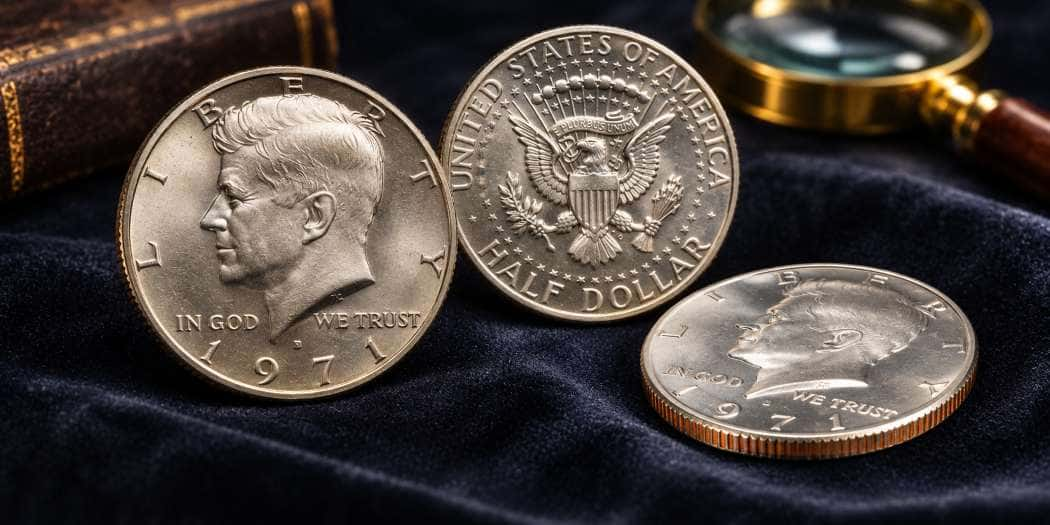
The transition became complete in 1971. New circulating Kennedy half dollars used outer layers of copper-nickel bonded to a copper core. The standard coin weighed 11.30 grams, measured 30.61 millimeters in diameter, and retained the familiar portrait by Gilroy Roberts and presidential-seal-inspired reverse by Frank Gasparro.
The change created a significant dividing line for collectors searching through mixed-date half dollars. Coins dated 1970 and earlier generally warrant examination for silver content, while ordinary 1971 issues do not. The NGC guide to grading Kennedy half dollars explains how the series moved from 90% silver to 40% silver before adopting the clad composition.
This history also helps explain why a seemingly old 1971 half dollar is not automatically valuable. Its date marks an important change in American coinage, but historical significance alone does not create scarcity.
Philadelphia, Denver, and San Francisco: Three Different Markets
The first step in evaluating a 1971 half dollar is identifying where it was struck. Philadelphia and Denver produced coins for circulation, while San Francisco manufactured proof coins intended for collectors.
|
Issue |
Mintage |
Original purpose |
Typical collector significance |
|
1971, no mint mark |
155,164,000 |
Circulation |
Exceptional mint-state condition |
|
1971-D |
302,097,424 |
Circulation |
High grades and recognized varieties |
|
1971-S |
3,220,733 |
Proof sets |
Cameo contrast, condition, varieties |
The mint mark, when present, appears on the obverse near Kennedy's neck, above the date. Philadelphia coins carry no mint mark, Denver coins show a D, and San Francisco proofs display an S.
Despite its lower production total, the 1971-S proof is not necessarily more valuable than a Philadelphia or Denver circulation strike. Proof coins were specially manufactured and generally preserved by collectors, so their survival in attractive condition is much more common.
By contrast, circulation strikes experienced handling, transportation, storage, and wear. Finding one with exceptionally clean surfaces and strong original luster can be difficult even when the date itself is abundant.
That difference between original mintage and surviving quality is central to understanding 1971 Kennedy half dollar values.
Why Condition Changes the Value So Dramatically
A circulated 1971 half dollar typically has little collector premium unless it displays an unusual feature. Lightly worn pieces may appeal to date collectors, but millions of examples remain available. Even attractive uncirculated coins are not automatically rare.
The market changes at exceptional grades.
According to PCGS CoinFacts for the 1971 Philadelphia half dollar, ordinary examples remain common through much of the mint-state grading range. The highest certified grades, however, are significantly more difficult to obtain. PCGS records an auction result of $2,900 for an MS67 example sold in March 2023.
Denver presents a similar pattern. PCGS describes the 1971-D Kennedy half dollar as extremely common in ordinary condition, with substantially greater scarcity emerging at the highest mint-state levels.
These exceptional sales require careful interpretation. A certified coin commanding thousands of dollars represents a highly selective segment of the market, not the value of an average half dollar found in circulation. Auction records also reflect particular coins, dates, grading opinions, and bidding conditions; they should never be treated as guaranteed resale prices.
Surface preservation matters enormously. Contact marks on Kennedy's cheek, scratches in open fields, impaired luster, and other imperfections can prevent a coin from receiving the grades that attract advanced collectors.
Doubled Dies and Proof Varieties Worth Investigating
Condition is not the only route to a premium. Certain 1971 Kennedy half dollars feature recognized die varieties, including doubled-die designs.
On the 1971-D issue, PCGS identifies two doubled-die obverse varieties, FS-101 and FS-102. The FS-101 variety shows its most noticeable doubling in portions of the word TRUST, particularly the U, S, and T. FS-102 displays prominent doubling on the I in IN.
These varieties result from differences incorporated into the working die, meaning the same characteristics can appear on multiple coins struck from that die. They should not be confused with ordinary mechanical doubling, which can create flattened or shelf-like secondary images without representing a collectible doubled-die variety.
Proof collectors have additional distinctions to consider. The 1971-S Kennedy half dollar exists with ordinary proof surfaces, Cameo contrast, and Deep Cameo contrast. The strongest contrast between frosted devices and reflective fields can command greater attention, particularly when combined with exceptional certified condition.
PCGS records a $12,000 auction result for a 1971-S Deep Cameo proof, graded PR69DCAM, sold by Heritage Auctions in June 2019. That extraordinary result illustrates the specialized nature of the market, not the typical value of a 1971-S proof.
Collectors should also distinguish genuine varieties from damage, polishing, environmental effects, and post-mint alterations. An unusual appearance is a reason to investigate, not sufficient evidence of rarity.
How to Evaluate a 1971 Half Dollar Before Selling
A practical examination begins with the date, mint mark, and overall condition. Check the obverse for a D or S, then examine both sides under consistent lighting. Look for obvious wear on Kennedy's hair and cheek, distracting contact marks, and whether the coin retains original mint luster.
For potential doubled dies, compare the lettering with photographs of attributed varieties. A magnifier can help reveal details, but confirmation requires matching the recognized diagnostics rather than relying on a single unusual letter.
The coin's edge provides another useful clue. Standard 1971 half dollars generally show the exposed copper core between their outer clad layers. An apparently silver-colored edge is not enough to establish a rare off-metal strike, since lighting, plating, and surface conditions can be misleading. Suspected wrong-planchet or unusual-composition errors require professional examination and, where appropriate, compositional testing.
Before paying for certification, consider whether the likely market value justifies grading and shipping expenses. Certification is most useful when a coin has credible prospects for an exceptional grade, a recognized variety, or a significant mint error.
The broader Kennedy half dollar reference guide provides additional context on the series, including its changing silver composition. Collectors comparing other half dollar varieties can also consult the half dollar coin information directory.
What Makes a 1971 Kennedy Half Dollar Worth Keeping?
The strongest candidates are coins with exceptional original surfaces, confirmed die varieties, or unusual minting characteristics that can be independently authenticated. An ordinary circulated example has a very different market from a carefully preserved, high-grade specimen.
That distinction also makes 1971 a useful date for learning how modern coin values develop. Large mintages do not prevent condition rarities from emerging, but isolated auction records do not make an entire issue scarce.
For anyone sorting through a collection, the sensible approach is selective: preserve unusually attractive examples, investigate genuine diagnostic features, and compare actual sales of equivalent certified coins. The most valuable 1971 half dollars are exceptions that must be demonstrated, not assumed.