
 View Charts
Eisenhower Dollar
Clad Eisenhower Dollars
The Eisenhower Dollar, widely known as the Ike Dollar, brought the traditional large-format dollar coin back to American circulation after a decades-long absence. Minted from 1971 through 1978, it was the first large U.S. dollar issued for circulation since the Peace Dollar series ended in 1935. Its designs connect several major chapters of 20th-century American history, including President Dwight D. Eisenhower, the Apollo 11 moon landing, and the nation's Bicentennial.
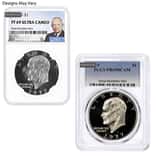
At Bullion Exchanges, collectors can explore Clad Eisenhower Dollars across different dates, mint marks, conditions, and finishes, including circulation strikes, uncirculated coins, proofs, Bicentennial issues, and collectible varieties. Common-date clad Ikes provide an accessible entry into large U.S. dollar coinage, while higher-grade coins and recognized varieties offer additional opportunities for more advanced collectors.
What Makes an Eisenhower Dollar Clad?
Standard clad Eisenhower Dollars feature outer layers composed of 75% copper and 25% nickel bonded to a pure copper core, resulting in an overall composition of approximately 91.67% copper and 8.33% nickel. Each clad coin weighs 22.68 grams and measures 38.1 mm in diameter, giving the Ike the substantial dimensions associated with earlier American silver dollars despite containing no precious metal. The copper core can often be seen as a contrasting band along the edge.
Philadelphia and Denver produced regular clad circulation strikes, while San Francisco struck collector issues, including clad proofs in certain years and separate 40% silver coins. Philadelphia circulation strikes carry no mint mark, Denver coins display a D, and San Francisco issues carry an S. Importantly, an S mint mark alone does not establish that an Eisenhower Dollar contains silver.
Eisenhower, Apollo 11, and the Ike Dollar Design
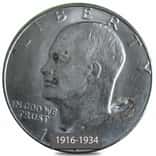
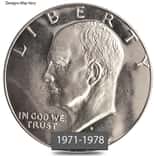
Introduced in 1971, the Eisenhower Dollar honored Dwight D. Eisenhower, the 34th President of the United States and Supreme Commander of Allied forces in Europe during World War II. Former U.S. Mint Chief Engraver Frank Gasparro designed the regular obverse and reverse. His obverse presents Eisenhower's portrait alongside LIBERTY, IN GOD WE TRUST, and the date.
The reverse connects the coin with the Apollo 11 lunar landing of 1969. Gasparro adapted its imagery from the Apollo 11 mission insignia designed by astronaut Michael Collins, depicting an eagle descending toward the lunar surface with an olive branch in its claws and Earth visible in the distance. This eagle-and-moon reverse appears on Eisenhower Dollars dated 1971–1974 and returned for the 1977 and 1978 issues.
Eisenhower Dollar Dates and Varieties to Know
Despite its short run, the Eisenhower Dollar series contains several varieties that give collectors more to pursue than a basic date-and-mint set. Among the best known are the 1972 Philadelphia reverse varieties, commonly identified as Types 1, 2, and 3. Differences in the appearance of Earth and other reverse details distinguish these varieties and have made the 1972 issue particularly interesting to Ike specialists.
Another unusual feature of the series is that no Eisenhower Dollar bears a 1975 date. During 1975, the Mint had already begun producing special 1776–1976 Bicentennial Dollars, all of which carry the dual anniversary date regardless of whether they were struck in 1975 or 1976. Regular annual dating resumed in 1977.
1776–1976 Bicentennial Eisenhower Dollars
The 1776–1976 Bicentennial Eisenhower Dollar replaced Gasparro's regular reverse with a special design commemorating America's 200th anniversary. Created by Dennis R. Williams and selected through a national design competition, the reverse depicts the Liberty Bell superimposed over the moon. Gasparro's Eisenhower portrait remained on the obverse, but the regular date was replaced by 1776–1976.
Collectors can encounter two principal Bicentennial reverse varieties. Type 1 features thicker, bolder lettering in lower relief, while Type 2 uses revised, thinner lettering with sharper characteristics. These differences give collectors another way to expand an Eisenhower Dollar set beyond dates and mint marks.
Clad vs. 40% Silver Eisenhower Dollars
Not every Eisenhower Dollar has the same composition. Regular copper-nickel clad Eisenhower Dollars contain no silver and weigh 22.68 grams, while the Mint separately produced collector issues containing 40% silver, which weigh approximately 24.6 grams. Identifying the date, mint mark, finish, composition, and specific issue is therefore important when comparing Ike Dollars.
This is particularly relevant with San Francisco coins. Although the 40% silver collector issues were produced there, San Francisco also struck copper-nickel clad proofs during the series. An S mint mark does not automatically mean an Eisenhower Dollar is silver, making the distinction between clad and silver issues important for both coin collectors and precious metals buyers.
Why Collect Clad Eisenhower Dollars?
Clad Ike Dollars combine an unusually large 38.1 mm format with a relatively short series and several different collecting paths. A basic collection can focus on dates and mint marks, while more specialized sets may incorporate proofs, higher Mint State grades, 1972 reverse varieties, both Bicentennial types, and professionally certified examples. Their designs also connect presidential history, the Space Race, and the U.S. Bicentennial within a single series.
Common issues remain approachable for collectors entering the series, while well-preserved examples and recognized varieties can present a greater challenge. This range gives the Eisenhower Dollar enough depth for experienced numismatists without making a basic collection difficult to understand.
Shop Clad Eisenhower Dollars at Bullion Exchanges
Explore Clad Eisenhower Dollars at Bullion Exchanges to discover collectible U.S. $1 coins from the 1971–1978 series. Depending on current inventory, available coins may include regular circulation strikes, uncirculated examples, proofs, 1776–1976 Bicentennial Eisenhower Dollars, collectible varieties, and professionally certified coins.
Whether you're starting an Ike Dollar set, searching for a particular date or mint mark, comparing Bicentennial varieties, or expanding a collection of modern U.S. coinage, Clad Eisenhower Dollars offer an accessible series with plenty of historical and numismatic interest.