View Charts
THREE CENT NICKEL (1865-1889)
Struck by the United States Mint from 1865 to 1889, the copper-nickel three-cent piece was often referred to as a three-cent nickel piece or three-cent nickel. Designed by US Mint Chief Engraver James B. Longacre, this three-cent piece was composed of 75% copper and 25% nickel. While initially popular for a very short time, this coin’s place in commerce was replaced by the five-cent piece, or nickel. The US Mint also produced silver three-cent pieces from (1851-1873) but the nickel version proved much cheaper for long-term production. Interestingly, the Three Cent Nickel is among the very few US coins which do not feature an actual denomination on its surface. Instead, the Roman Numeral III is displayed on the reverse.
Three Cent Nickel History
Background:
After a 20-year period of silver price stability, the early 1860s saw a sharp spike in the price of silver. Because of this, people began melting silver coins down to use them for their intrinsic value, leaving no medium of exchange to purchase basic goods such as milk and newspapers. This loss of lower value coins actually disrupted basic commerce far more severely than the loss of more valuable coins, like gold. To rectify the situation, banks and businesses began producing “makeshift currency” including low-denomination paper currency, encased postage stamps, and federally issued fractional currency. Authorized by Congress in 1863, the federal fractional currency included paper notes worth as little as three cents. The low-value paper currency issued by either the government or businesses was referred to as “shinplasters” by the public, who greatly disliked them.
In April 1864, the Coinage Act of 1864 was passed into law, which changed the composition of the one-cent coin as well as authorized the minting of the two-cent coin.
Following the introduction of the one and two-cent bronze pieces, Pennsylvania industrialist Joseph Wharton led the charge to replace the three-cent note with a three-cent piece in copper-nickel. Wharton, who notably controlled the domestic supply of nickel ore, published a pamphlet that proposed that all non-precious metal coins consist of 75% copper and 25% nickel. On March 3, 1865, which happened to be the last legislative day of the congressional session, a bill for a three-cent piece in the copper-nickel alloy was introduced in Congress. It was met with great resistance in neither the House nor the Senate, and President Abraham Lincoln signed it into law shortly after. The surprisingly quick passage of the legislation continues to puzzle historians and numismatists to this day, with American numismatist, author, and columnist Quentin David Bowers famously stating "We can only guess what happened behind the scenes".
Production of the Three Cent Nickel:
The initial release of the three-cent piece in 1865 was met with adequate enthusiasm, as this coin was considered more convenient than the larger two-cent bronze piece. However, this three-cent copper-nickel piece caused many die breakages during production due to its hard alloy. The subsequent introduction of the five-cent copper-nickel piece in 1866 greatly decreased the popularity of the three-cent piece, as well as its usage.
Even though more than one million Three Cent Nickels were minted in 1881 another blow was dealt to its popularity in October 1883. That month, postage rates for first-class mail were decreased from three cents to two cents for the first 0.5 ounces, and the two-cent rate subsequently replaced the three-cent up to one ounce on July 1, 1885 — less than two years later. With one of the original reasons for the denomination's existence taken out of play, no three-cent pieces were struck for circulation in 1886. However, several thousand proof coins were produced that year for collectors. During the final few years of the three-cent coin’s production, fewer than 60,000 circulation strikes were minted in total.
Three Cent Nickel Design and Variations
Starting in 1849, Mint Chief Engraver James B. Longacre designed various coins with different interpretations of the goddess Liberty, based on the Venus Accroupie bust he saw in a Philadelphia museum. His design for the Three Cent Nickel shows Lady Liberty wearing a coronet (simple crown) inscribed with her name; her hair bound with ribbon. On the reverse, Longacre chose to use a simple Roman numeral III similar to the one on the silver three-cent piece. The laurel wreath used on the 1859 Indian Head cent borders the coin’s edge.
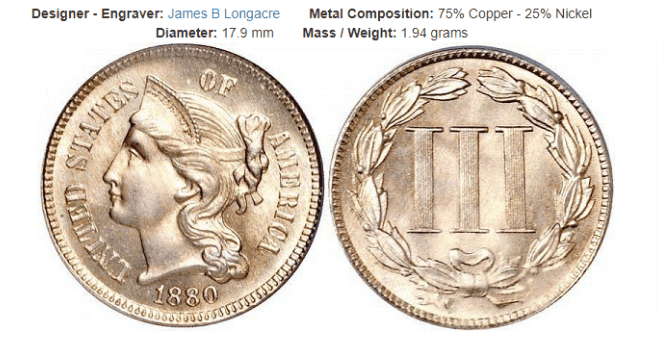
Image source: https://www.usacoinbook.com
On January 18, 1873, US Mint Director James Pollock received a complaint from Philadelphia Mint Chief Coiner A. Loudon Snowden, who observed that the digit "3" too closely resembled an "8" on that year’s new coins. Pollock consequently instructed Chief Engraver William Barber to redo the logotypes for the date, as previous designer Longacre had died in January, 1869. Because of this, most denominations of American coinage from the year 1873, have varieties, including this three-cent nickel piece. The “Close (or Closed) 3” type from early in the year, and the “Open 3” type, released post-modification from Barber.
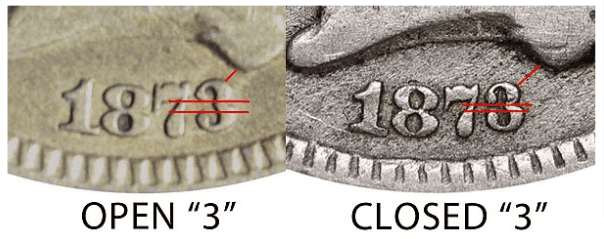
Image source: https://www.usacoinbook.com
Three Cent Nickel Value
Because the Three Cent Nickel did not last as a popular circulation coin, many of them may still be found in almost pristine or uncirculated condition, which increases their potential value. However, compared to other early US Coinage, these coins generally don’t garner a significantly high price. Only about 5 varieties of the Three Cent Nickel Pieces have reportedly sold for over $1,000 with a high grade. They are listed below:
1865 Three Cent Nickel
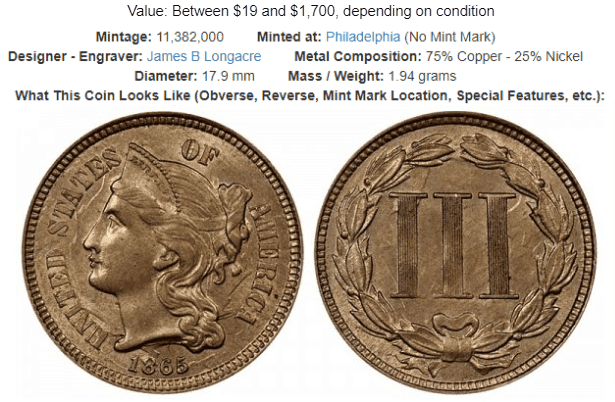
Image source: https://www.usacoinbook.com
1877 Three Cent Nickel: Proof Only
Value: Between $830 and $2,100, depending on condition

Image source: https://www.usacoinbook.com
1878 Three Cent Nickel: Proof Only
Value: Between $285 and $1,000, depending on condition
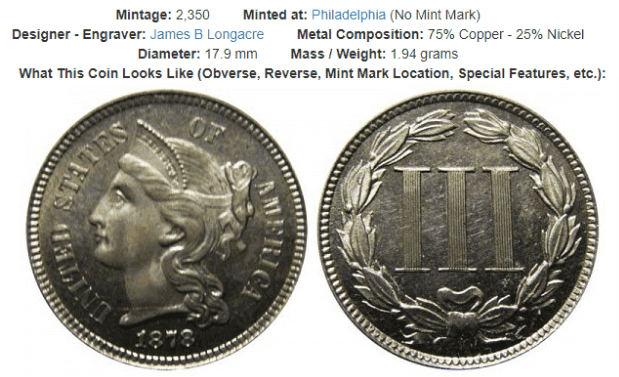
Image source: https://www.usacoinbook.com
1884 Three Cent Nickel
Value: Between $380 and $1,100, depending on condition. PR-65 valued less than EF-40
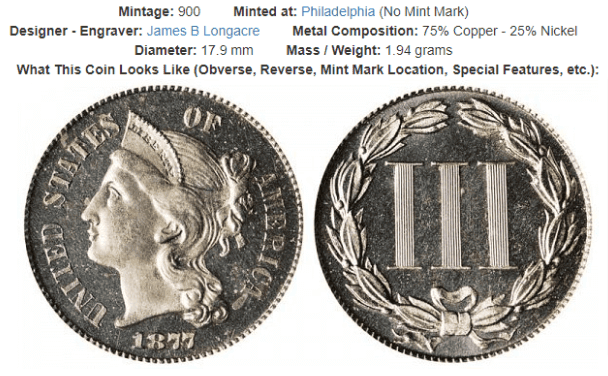
Image source: https://www.usacoinbook.com
1885 Three Cent Nickel
Value: Between $445 and $1,250, depending on condition. PR-65 valued less than VF-20

Image source: https://www.usacoinbook.com
Three Cent Nickels are a popular acquisition for many collectors, as they are relatively inexpensive, and include several mintage years that are easy to find. Values for the common dates may range from $10 in good condition up to $100 or more in uncirculated condition. In some cases, Three Cent Nickels in Extremely Fine or even Very Fine condition can earn you more than the Proof versions from the same year. As always, when determining the worth of your coin, we advise you to seek out the assistance of a numismatic professional.