View Charts
Why Silver Outperforms Gold During Early Economic Recoveries
 0
0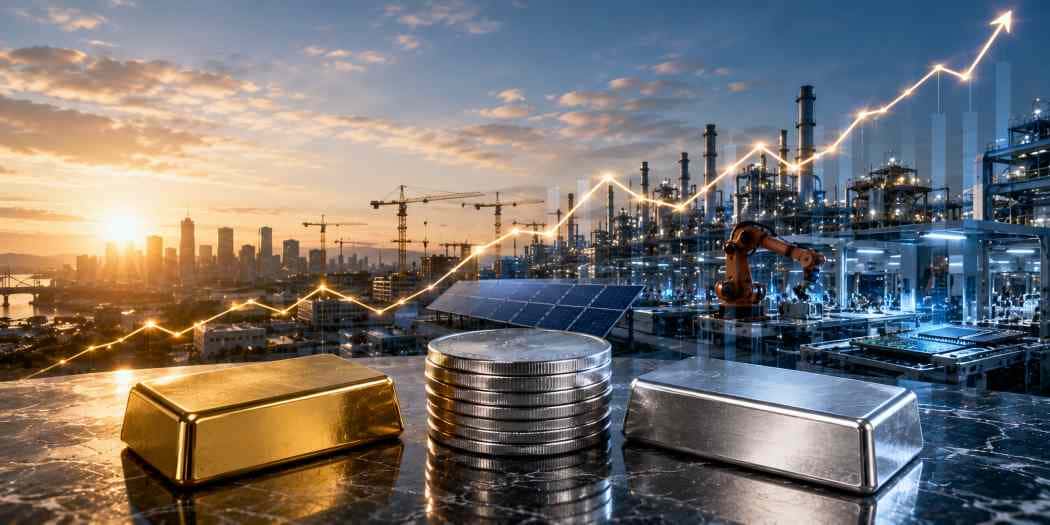
Gold Protects Wealth—Silver Often Benefits From Growth
Gold and silver are frequently grouped together as precious metals, but they rarely move through economic cycles in exactly the same way. While both can benefit from inflation, geopolitical uncertainty, and investor demand, silver has an additional characteristic that often causes it to outperform gold during the early stages of an economic recovery: it is also an essential industrial metal.
That distinction gives silver a dual identity. Investors buy it as a store of value and portfolio diversifier, much like gold, but manufacturers consume large quantities in industries ranging from electronics and solar energy to medical devices and automotive components. As economic activity accelerates, those industrial applications can become an increasingly important driver of demand, allowing silver to participate in recoveries in ways that gold often does not.
History shows that this pattern has repeated itself across multiple market cycles. While gold frequently leads during recessions and periods of financial stress, silver has often delivered stronger percentage gains once economic confidence begins to return. Understanding why requires looking beyond precious metals alone and examining where each metal fits within the broader economy.
Silver's Industrial Demand Changes the Equation
Unlike gold, which is held primarily for investment, jewelry, and central bank reserves, more than half of annual silver demand comes from industrial applications. Manufacturers use silver because it offers exceptional electrical conductivity, thermal conductivity, and corrosion resistance—properties that make it difficult to replace in many high-performance technologies.
That industrial exposure means silver demand tends to strengthen alongside economic growth. Expanding manufacturing activity increases consumption of electronic components, electrical equipment, renewable energy technologies, and other products that rely on silver. As factories increase production and businesses invest in new equipment, physical demand for the metal often rises alongside investor interest.
Gold operates differently. Industrial demand represents only a relatively small portion of the gold market, meaning its price is influenced far more by macroeconomic factors such as real interest rates, central bank policy, currency movements, and safe-haven buying. During periods of economic uncertainty, those characteristics can make gold the stronger performer. Once economic conditions begin improving, however, silver receives support from both investment demand and expanding industrial consumption, giving it an additional source of momentum.
Recoveries Shift Investor Behavior
Economic recoveries are often accompanied by a gradual change in investor psychology. During recessions or financial crises, preserving capital becomes the primary objective. Investors typically gravitate toward assets with established safe-haven characteristics, including high-quality government bonds and physical gold. The emphasis is stability rather than growth.
As confidence improves, that mindset begins to evolve. Investors become more willing to accept risk, equity markets often recover, manufacturing activity expands, and expectations for future corporate earnings improve. Silver tends to benefit from both sides of this transition. It continues attracting investors interested in precious metals while simultaneously seeing stronger demand from industrial users preparing for higher production.
This combination can produce outsized price movements. Silver's market is considerably smaller than gold's, meaning changes in investment flows or industrial demand can have a proportionally larger impact on prices. During the early stages of a recovery, when optimism is building but markets are still adjusting to improving economic conditions, those forces can reinforce one another and allow silver to outperform its larger counterpart.
History Shows the Pattern Repeating
Several major economic recoveries have demonstrated silver's tendency to gain ground after periods of recession. Following the global financial crisis of 2008–2009, precious metals initially benefited from safe-haven demand, with gold leading much of the early rally. As economic conditions stabilized and industrial activity recovered, silver accelerated sharply, significantly outperforming gold over the following stages of the recovery.
A similar dynamic emerged after the pandemic-driven recession in 2020. Gold initially attracted investors seeking stability amid unprecedented uncertainty, reaching record highs as financial markets reacted to lockdowns, monetary stimulus, and economic disruption. Once manufacturing rebounded, industrial production strengthened, and demand for renewable energy technologies accelerated, silver experienced a powerful rally fueled by both improving economic expectations and expanding industrial consumption.
These examples illustrate an important principle: silver's strongest periods often begin after the worst of an economic downturn has passed. While every recovery follows its own path, the interaction between industrial demand and investor sentiment has repeatedly helped silver outperform gold during the transition from recession to expansion.
Manufacturing Is Often the Catalyst
One of the clearest ways to understand silver's performance is by watching manufacturing activity. Economic recoveries rarely begin with consumers spending aggressively. Instead, businesses gradually rebuild inventories, factories increase production, purchasing managers place new orders, and capital investment begins to recover. Those developments create a ripple effect across industries that consume large amounts of silver.
Electronics manufacturing is one of the largest contributors. Silver is used in printed circuit boards, semiconductors, electrical contacts, switches, and connectors because of its unmatched electrical conductivity. Demand also rises in the solar industry, where silver plays an essential role in photovoltaic cells, as well as in automotive manufacturing, medical technology, and industrial equipment. As these sectors expand during the early stages of an economic recovery, physical consumption of silver often increases alongside broader industrial output.
Unlike gold, silver benefits directly from stronger factory activity. Investors therefore monitor many of the same economic indicators used to evaluate manufacturing cycles, including Purchasing Managers' Index (PMI) reports, industrial production figures, durable goods orders, and business investment. Improving data can strengthen expectations for future silver demand well before higher consumption appears in official market statistics.
Silver's Smaller Market Amplifies Price Moves
Another reason silver frequently outperforms gold is the relative size of its market. Gold is one of the largest and most liquid asset markets in the world, held by central banks, institutional investors, exchange-traded funds, and private owners across virtually every country. That depth provides stability but can also moderate silver spot price movements.
Silver is considerably smaller. As a result, incremental changes in investment demand or industrial buying can have a much larger impact on prices. During economic recoveries, the combination of renewed investor confidence and improving industrial fundamentals often produces stronger momentum than either factor could generate independently.
That same characteristic also explains why silver is generally more volatile than gold. The forces that help silver outperform during recoveries can work in reverse during economic slowdowns, when weakening industrial demand and reduced investor risk appetite place simultaneous pressure on prices. Investors considering silver should recognize that its higher upside potential typically comes with larger price fluctuations throughout the economic cycle.
Recovery Doesn't Mean Gold Stops Working
Silver's tendency to outperform during recoveries should not be interpreted as a weakness for gold. The two metals often excel during different phases of the economic cycle because they serve different purposes within diversified portfolios.
Gold generally performs best when uncertainty dominates financial markets. Periods of recession, banking stress, geopolitical instability, or falling real interest rates often increase demand for safe-haven assets, making gold an attractive store of value. Silver, by comparison, usually becomes more compelling once investors gain confidence that economic activity is beginning to accelerate again.
For many investors, this suggests that the relationship between gold and silver is complementary rather than competitive. Gold can provide portfolio stability during periods of economic stress, while silver may offer greater upside participation as manufacturing expands and growth returns. Rather than replacing one another, the metals often take turns leading as the macroeconomic environment evolves.
Understanding Where the Economy Sits in the Cycle
Predicting exactly when silver will begin outperforming gold is difficult because economic recoveries rarely follow a perfectly consistent timeline. Some expansions begin gradually, while others accelerate quickly following aggressive monetary or fiscal stimulus. Inflation, interest rates, geopolitical events, and changes in industrial production can all influence how each recovery develops.
For that reason, experienced investors often spend less time attempting to forecast individual price movements and more time identifying where the broader economy sits within the business cycle. When recession risks dominate, gold's defensive characteristics may provide greater resilience. As growth stabilizes and manufacturing activity strengthens, silver's industrial exposure has historically allowed it to capture a larger share of improving economic momentum.
Understanding that transition helps explain why silver has repeatedly outperformed gold during the early stages of economic recoveries. The metal is not simply benefiting from renewed investor optimism—it is participating in the recovery itself through expanding industrial demand. That unique combination gives silver a distinct role among precious metals and explains why its strongest advances have often coincided with the first chapters of economic expansion.