View Charts
Why Round Numbers Matter When Silver Prices Surge
 0
0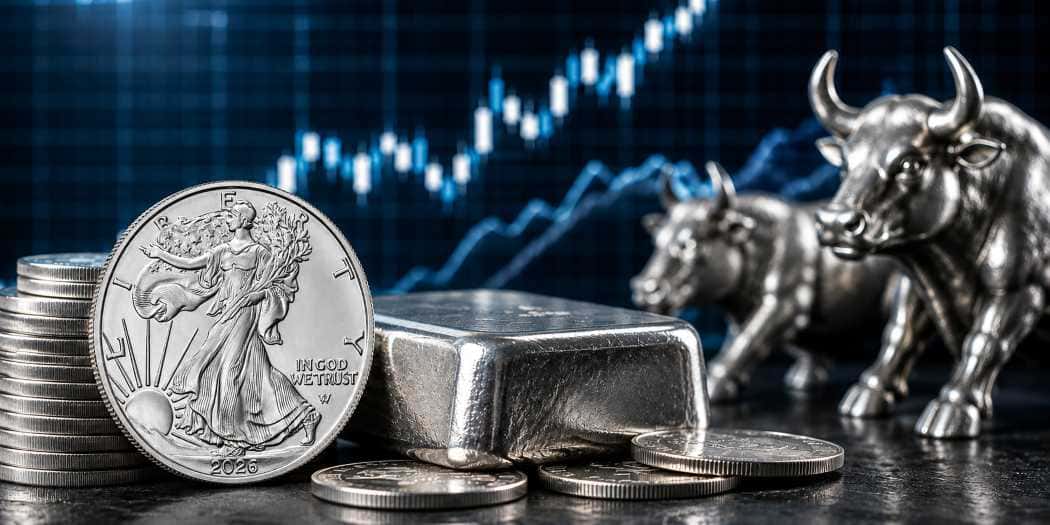
Why $70 Silver Gets So Much Attention
When silver approaches a major round-number threshold such as $70 per ounce, attention often increases even though nothing fundamental changes at that exact price. An ounce of silver has the same physical properties at $69.50 as it does at $70.50. Mine production does not suddenly shift, manufacturers do not rewrite purchasing plans, and available silver supply does not change because the market crosses a number ending in zero. What does change is investor behavior. Traders naturally gravitate toward memorable prices when deciding where to buy, sell or take profits, which can concentrate activity around an otherwise arbitrary level.
A holder who has benefited from a strong rally may decide beforehand to reduce a position near $70. Another investor might wait for silver to clear the threshold before buying, while short sellers can have stop orders positioned nearby. When enough of those decisions converge, $70 becomes an active trading zone. Its significance comes from how people react to the level, not from the number itself.
Why Do Round Numbers Become Support or Resistance?
Technical traders use support and resistance to describe areas where buying or selling has repeatedly influenced prices. Resistance develops when sellers consistently slow an advance; support forms when buyers step in during declines. These are generally better understood as zones rather than exact prices because markets frequently cross a level temporarily before establishing a clearer direction.
Round numbers can develop into these zones particularly easily because virtually everyone recognizes them. If silver repeatedly approaches $70 and retreats, the area may gain credibility as resistance. If buyers absorb the available selling and keep prices above it, the supposed ceiling can disappear quickly. Context matters as well: after a substantial rally, investors have more profits available to protect, but the same rally can attract momentum buyers looking for confirmation that the move has further to run. Their competing orders ultimately determine whether $70 becomes an obstacle or simply another price along the way.
What Happens When Silver Breaks Through $70?
A convincing breakout can generate additional momentum without a new fundamental catalyst. Traders waiting for confirmation may enter once silver moves through $70, while bearish positions can be forced to cover as stop-loss orders are triggered. Several sources of buying can therefore arrive at roughly the same time and accelerate the advance.
What happens afterward is usually more informative. If silver moves above $70, pulls back and attracts buyers around the former resistance area, traders may begin treating it as support. A quick move through the threshold followed by a sharp retreat suggests that buyers were unable to maintain control. Volume can provide additional context, while gold, Treasury yields and the U.S. dollar can help show whether silver is participating in a broader precious-metals move or developing momentum of its own. A brief trade above $70 says relatively little; sustained trading around or above the level carries more weight.
Fundamentals Still Determine Whether the Rally Lasts
Psychological levels can shape short-term trading, but they cannot sustain a silver rally indefinitely. Silver ultimately responds to the forces affecting physical supply, industrial consumption and investment demand. Investors may buy the metal because of inflation expectations, monetary policy, currency movements or broader demand for precious metals, while manufacturers consume silver in electronics, solar technology, electrical infrastructure and other applications.
Supply adds another dimension because much of the world's silver is produced as a byproduct of mining other metals, limiting how quickly output can respond to higher prices. Mine production, recycling, industrial activity and physical availability all contribute to the market balance, while interest rates and the dollar can influence investment demand. None of those forces suddenly improves or deteriorates at $70.
That distinction is particularly important during a fast rally. Momentum can carry silver through several psychological thresholds, but maintaining those gains becomes harder if the economic or physical-market backdrop weakens. Conversely, profit-taking around $70 does not necessarily mean a fundamentally supported rally has run its course.
Why Trading Around $70 Can Become Volatile
Several strategies can collide around a major threshold. Existing holders may take profits just as momentum traders enter, while short sellers cover positions and automated strategies react to changing price behavior. Silver can consequently move above and below $70 without any corresponding change in the day's economic or supply news.
Silver's historically higher volatility relative to gold can amplify those movements, making confirmation especially important. A breakout gains credibility when the metal remains above the threshold and continues attracting buyers; resistance becomes more convincing when repeated attempts to advance encounter sellers. Investors can learn more from that behavior over time than from treating the first move through $70 as confirmation of a lasting trend.
What Does $70 Silver Mean for Physical Buyers?
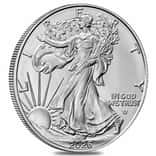
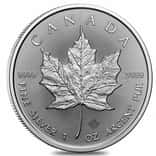
Physical bullion buyers face a somewhat different calculation because spot silver determines the underlying metal value of coins, bars and rounds but not their entire retail price. Products generally trade at a premium above spot reflecting fabrication, distribution and dealer costs, while availability and retail demand can push individual premiums higher or lower.
During a rapid rally, those premiums may behave differently across products. Some investors accelerate purchases because they fear silver will become more expensive, while others wait for volatility to ease or sell existing holdings. Two products containing the same amount of silver can therefore have noticeably different costs per ounce even when spot sits at exactly $70. Investors primarily interested in accumulating metal may favor lower-premium bars or rounds, while buyers of sovereign coins or collectible products may accept a higher premium for recognition, design or scarcity.
For physical buyers, reaching a milestone should not replace normal purchasing discipline. The total cost per ounce, premium and product type remain important, along with the reason for owning silver in the first place. A long-term buyer may ultimately find the difference between $69 and $70 less consequential than paying an unnecessarily high premium above either price.
Watch the Reaction, Not Just the Number
The attention surrounding $70 can make it a meaningful short-term reference point. Profit-taking may slow an advance, breakout buyers can add momentum, and stop orders may intensify movement as silver crosses the threshold. Repeated failures near the level would suggest sellers are successfully defending the area, while sustained trading above it indicates buyers are willing to absorb selling at higher prices. A later pullback that finds support near $70 would provide another piece of evidence that the market's perception of the threshold has changed.
That is the practical value of round numbers: they offer a window into market conviction and positioning, not a formula for determining fair value. Industrial consumption, investment demand, mine and recycling supply, monetary conditions and the broader economy remain far more important to silver's longer-term direction. $70 can influence how silver trades, but it cannot tell investors what silver is fundamentally worth.