View Charts
Why Are Some Silver Dimes Worth More Than Silver Quarters?
 0
0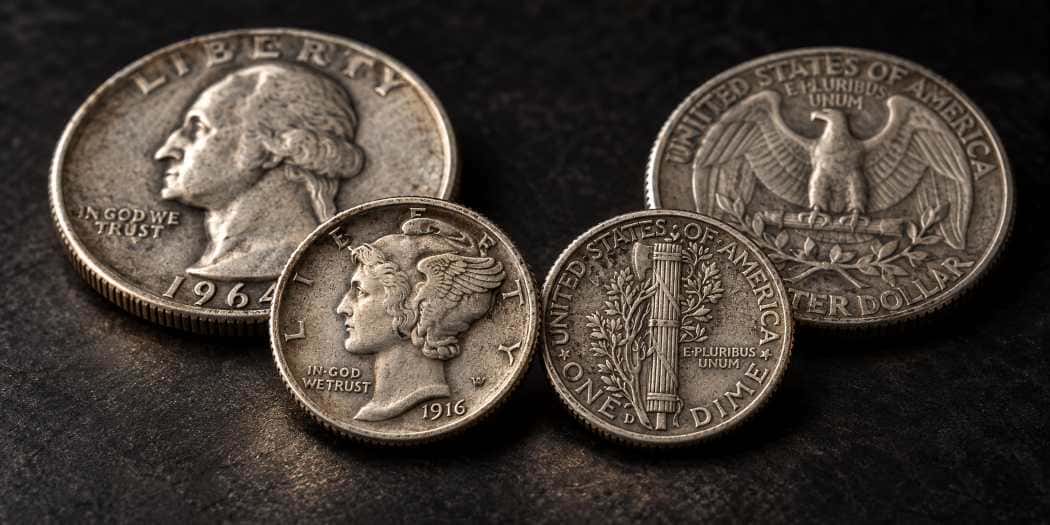
A Smaller Coin Can Carry a Bigger Premium
A pre-1965 U.S. silver quarter contains two and a half times as much silver as a dime. Measured only by precious-metal content, the quarter has the advantage. Yet certain silver dimes sell for hundreds or thousands of dollars, while a worn, common-date silver quarter may trade for little more than its bullion value. The difference is especially striking when comparing an ordinary 1964 Washington Quarter with a 1916-D Mercury Dime: the smaller coin can be far more valuable, even in heavily worn condition.
That comparison exposes the distinction between buying silver and collecting coins. Bullion buyers can substitute one common-date silver coin for another based on weight and purity. A collector trying to finish a Mercury Dime set cannot replace a missing Denver-minted 1916 dime with a heavier Washington Quarter. Specific dates, varieties, scarcity, and condition introduce a second source of value that may vastly exceed the metal inside the coin.
Silver Sets a Baseline, Not a Collector's Price
Standard U.S. silver dimes minted immediately before the 1965 composition change weigh 2.5 grams and contain approximately 0.07234 troy ounces of pure silver. Corresponding quarters weigh 6.25 grams and contain approximately 0.18084 troy ounces. Both were struck in an alloy of 90% silver and 10% copper. At the same silver price, therefore, the quarter's theoretical melt value is about two and a half times the dime's, before accounting for wear, transaction costs, or dealer spreads.
For common circulated issues, that arithmetic explains much of the market. Dealers often trade groups of 90% silver coins by face value, with each dollar of original denomination representing a broadly consistent amount of silver. A group of ten dimes and a group of four quarters each have one dollar in face value and essentially the same nominal silver content. In practice, worn coins may have lost a small amount of metal, and buying and selling prices need not match theoretical melt values.
Collectible pieces operate differently. A coin's numismatic premium reflects how difficult a particular issue is to obtain and how strongly collectors want it. Original mintage is useful evidence, but survival, grade distribution, and demand also matter. A scarce dime may command a large premium above melt value even when its surfaces are worn; an abundant quarter with more silver may offer little additional collector value. This distinction explains why key dates in coin collecting can be worth dramatically more than otherwise similar issues.
The 1916-D Mercury Dime Shows How Scarcity Changes the Equation
The Mercury Dime debuted in 1916 with Adolph A. Weinman's portrait of Liberty wearing a winged cap. That year, Philadelphia produced 22,180,080 dimes and San Francisco struck 10,450,000, but Denver minted only 264,000. The 1916-D consequently became the lowest-mintage regular issue of the Mercury Dime series and one of its defining key dates. Collectors assembling a complete date-and-mintmark set need that precise issue, regardless of how much silver an alternative coin contains.
Many surviving 1916-D dimes circulated, and collectors encounter examples across a range of grades. A genuine, heavily worn piece can still be worth substantially more than a common Washington Quarter because its date and mintmark establish its place in a constrained collector market. Uncirculated specimens are harder to obtain, creating an additional condition premium. PCGS research on the 1916-D Mercury Dime also documents the issue's vulnerability to counterfeiting, particularly through the addition of false Denver mintmarks to common Philadelphia coins.
The important lesson is not that every Mercury Dime is expensive. Many dates were struck in large quantities and remain readily available. The 1916-D illustrates how scarcity tied to a specific issue can outweigh a denomination's smaller silver weight. Its premium depends on an identifiable collecting objective and a limited supply of genuine examples, rather than on the price of silver alone.
Tiny Varieties and Exceptional Rarities Change the Comparison Again
A low-mintage date is only one route to an expensive dime. The 1942/1 Mercury Dime is sought for its overdate, a die-making variety showing remnants of an earlier date beneath the final 1942 date. An ordinary 1942 dime is comparatively common, but a genuine overdate is a distinct collector target. Identification requires more than spotting an unusual-looking numeral: die characteristics, authenticity, and condition are critical, particularly when substantial premiums are involved.
The most dramatic examples show how little a coin's silver content contributes to its numismatic price. A 1942/1 Mercury Dime graded MS66 Full Bands realized $120,000 at a Heritage auction in January 2018, according to PCGS auction records for the variety. That was an exceptional high-grade coin, not a representative price. The Full Bands designation describes sharply separated bands on the reverse fasces, a strike characteristic that specialists prize. Such premiums emerge from competition for unusually well-preserved, well-struck pieces rather than from additional precious metal.
The 1894-S Barber Dime is an even more unusual case. Mint records show just 24 were struck as proofs in San Francisco, with only a small number known to survive. Its precise origin has inspired competing stories, but the documented production figure and extraordinary rarity establish its significance. Comparing an 1894-S with a common silver quarter is not truly a bullion comparison at all: buyers are considering a celebrated historical rarity, provenance, and long-standing demand among advanced collectors.
Silver Quarters Have Their Own Key Dates
None of these examples makes dimes inherently superior collectibles. The 1932-D and 1932-S Washington Quarters are important counterexamples, with original mintages of 436,800 and 408,000, respectively. Introduced during the Great Depression, they became key dates in the Washington Quarter series as collectors pursued complete sets. A desirable example of either can command a meaningful premium beyond the value of its silver, while some high-grade pieces are particularly difficult to obtain.
Their relative value also shows why mintage alone is insufficient. Although fewer 1932-S quarters were struck, collectors often regard the 1932-D as more challenging in certain uncirculated grades. The number originally made differs from the number preserved in each condition category. PCGS research on the 1932-D Washington Quarter illustrates how collector demand and surviving condition influence the market for this Depression-era issue. A rare quarter can outperform a common dime just as readily as a rare dime can outperform a common quarter.
What to Check Before Selling Old Silver Change
An inherited collection or jar of old coins should not automatically be valued as a single pile of silver. Start by separating denominations and checking dates and mintmarks, then compare promising pieces with reputable references for their specific series. Look for recognized varieties only when their diagnostic features are documented. Condition matters, but cleaning a coin in an effort to improve its appearance can permanently damage original surfaces and reduce collector appeal.
For an apparently valuable dime or quarter, professional authentication may be worth considering before sale, especially where counterfeit mintmarks or altered dates are known risks. Price guides offer useful context, but actual prices depend on grade, eye appeal, authenticity, and market demand. Common circulated 90% silver dimes may still be most efficiently traded as bullion, while a suspected key date deserves individual evaluation. Silver weight establishes the metal's underlying worth; a particular coin's identity and preservation determine whether collectors will pay substantially more.