View Charts
The Gold Rushes That Changed History
 0
0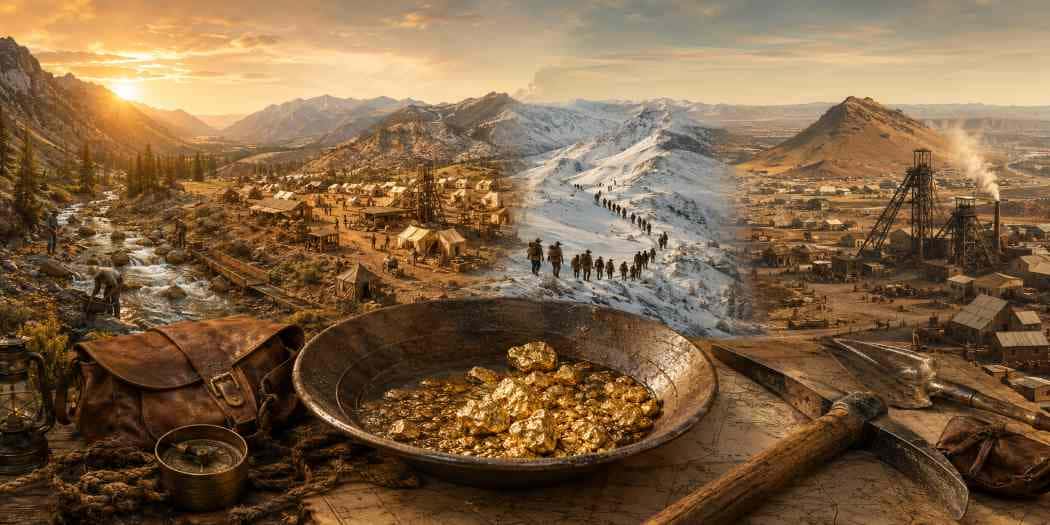
The Discoveries That Reshaped Nations
Few events have transformed economies as quickly—or captured the public imagination as completely—as a gold rush. Stories of prospectors striking fortunes with little more than a pan and determination have become part of popular folklore, but the real legacy of history's greatest gold discoveries extends far beyond individual wealth.
Major gold rushes triggered mass migrations, accelerated settlement of remote frontiers, and attracted investment that reshaped transportation, banking, and international trade. Entire cities emerged almost overnight, while governments raced to establish infrastructure and institutions to support rapidly growing populations. During the nineteenth century, when many economies operated under the gold standard, major discoveries also expanded the world's monetary gold supply, influencing commerce well beyond the mining camps themselves.
Although thousands of prospectors pursued dreams of instant riches, the greatest beneficiaries were often the regions where gold was discovered. California, Australia, Canada's Yukon, and South Africa each experienced economic transformations that continued long after the richest deposits had been exhausted.
Their stories reveal that gold rushes were never simply about finding precious metal—they were catalysts that changed the course of history.
California Ignited America's Westward Expansion
The discovery of gold at Sutter's Mill on January 24, 1848, marked the beginning of the world's most famous gold rush. When news spread the following year, hundreds of thousands of fortune seekers poured into California from across the United States, Latin America, Europe, and Asia, forever altering the American West.
The influx transformed California almost overnight. San Francisco evolved from a small settlement into one of the nation's busiest ports, while merchants, banks, shipping companies, and equipment suppliers prospered alongside the miners. In many cases, entrepreneurs who sold picks, shovels, food, and transportation earned more reliable fortunes than those searching riverbeds for gold.
The rush also accelerated California's admission as the 31st state in 1850 and strengthened calls for improved transportation across the continent. Railroads, agriculture, finance, and commerce expanded rapidly as new communities emerged to serve a growing population.
Although relatively few prospectors became wealthy, the California Gold Rush permanently shifted America's economic center of gravity westward, laying the foundation for the state's rise as one of the world's largest economies.
Australia and the Klondike Showed Two Very Different Paths to Prosperity
Only three years after California captured international attention, major discoveries in New South Wales and Victoria launched Australia's own gold rush. Beginning in 1851, hundreds of thousands of immigrants arrived from Britain, Europe, China, and North America, fueling one of the fastest periods of economic growth in the country's history.
Unlike California, Australia's goldfields remained productive for decades. Cities such as Melbourne, Ballarat, and Bendigo expanded rapidly as mining wealth financed banks, railways, public buildings, and commercial enterprises. The discoveries helped transform Australia's British colonies into prosperous economies whose influence continues today, with the country remaining one of the world's leading gold producers.
The Klondike Gold Rush, by contrast, became legendary for the extraordinary hardships prospectors endured rather than the scale of its production.
After gold was discovered along Bonanza Creek in Canada's Yukon Territory in 1896, an estimated 100,000 hopeful miners set out for the remote north. Many never reached Dawson City, forced to haul months of supplies across snow-covered mountain passes before navigating rivers into the interior. By the time thousands finally arrived, the richest claims had already been secured.
Yet the Klondike's impact extended beyond the gold recovered. The rush accelerated development across northwestern Canada and Alaska while inspiring enduring works of literature by writers such as Jack London. More importantly, it reinforced the enduring belief that a single discovery could transform an isolated wilderness into the center of global attention.
South Africa Redefined the Global Gold Industry
While California, Australia, and the Klondike captured the world's imagination, no discovery proved more influential to the global gold market than South Africa's Witwatersrand Basin.
In 1886, prospectors uncovered extraordinarily rich gold-bearing reefs beneath what would become Johannesburg. Unlike earlier rushes that focused on rivers and surface deposits, the Witwatersrand required deep underground mining, advanced engineering, and substantial financial investment. Independent prospectors quickly gave way to large mining companies capable of developing industrial-scale operations.
The impact was profound. South Africa soon became the world's leading gold producer, a position it maintained for much of the twentieth century. Johannesburg grew from a mining camp into Africa's largest financial center, while international investment poured into the region to support expanding mines, railways, and infrastructure.
The discovery also arrived at a pivotal moment in economic history. As industrial nations embraced the gold standard, the enormous output from South African mines helped meet growing demand for monetary gold, supporting international trade and financial stability. Unlike the short-lived excitement surrounding many earlier rushes, the Witwatersrand became the foundation of a modern mining industry whose influence continues today.
Not Every Gold Rush Was a Global Sensation
Several smaller gold rushes also left lasting marks on regional history, even if they never achieved the fame of California or the Klondike.
British Columbia's Fraser River Gold Rush in 1858 attracted thousands of miners and accelerated settlement along Canada's Pacific coast, helping establish what would later become the province of British Columbia. In neighboring New Zealand, discoveries in Otago and on the South Island's West Coast fueled immigration and financed roads, ports, and growing commercial centers during the 1860s.
Even earlier, Brazil's eighteenth-century gold discoveries transformed the Portuguese Empire, shifting settlement inland and sending enormous quantities of gold to Europe. While these rushes differed in scale and geography, they followed a familiar pattern: the discovery of gold drew people first, but long-term prosperity depended on the businesses, infrastructure, and institutions that developed afterward.
History repeatedly demonstrates that the greatest fortunes were often built not by finding gold, but by creating the economies that grew around it.
Gold Rushes Built More Than Fortunes
The enduring legacy of the world's great gold rushes isn't measured solely in ounces mined or fortunes won. Their true significance lies in how they accelerated the development of nations.
Gold discoveries opened frontiers that had previously seen little settlement. They encouraged governments to build roads, railways, ports, and communications networks that continued serving communities long after mining activity declined. Banks, stock exchanges, and commercial enterprises emerged to finance rapidly expanding economies, while international migration permanently reshaped the cultural identities of regions from California to Victoria and the Yukon.
Many of today's major financial and commercial centers owe part of their early growth to gold. San Francisco evolved into a gateway for Pacific trade, Melbourne became one of the British Empire's wealthiest cities, and Johannesburg developed into the economic heart of southern Africa. Even where the mines eventually closed, the infrastructure and investment they inspired continued driving economic growth for generations.
The rushes also reinforced gold's reputation as one of history's most valuable assets. During the nineteenth century, expanding gold supplies supported the global monetary system. Today, while currencies are no longer backed by gold, the metal remains a trusted store of value sought by central banks, investors, and collectors alike.
That continuity helps explain why stories of historic gold discoveries continue to resonate. They are not merely tales of adventure or speculation, but chapters in the broader history of economic development. Every major gold rush left behind more than abandoned mines and faded boomtowns—it reshaped commerce, influenced migration, and demonstrated how a single discovery can alter the trajectory of nations.
Related reading you may find interesting:
Why Gold Performs Differently in High Inflation vs. Stagflation