View Charts
Should You Ever Clean Old Coins? What Collectors Need to Know
 0
0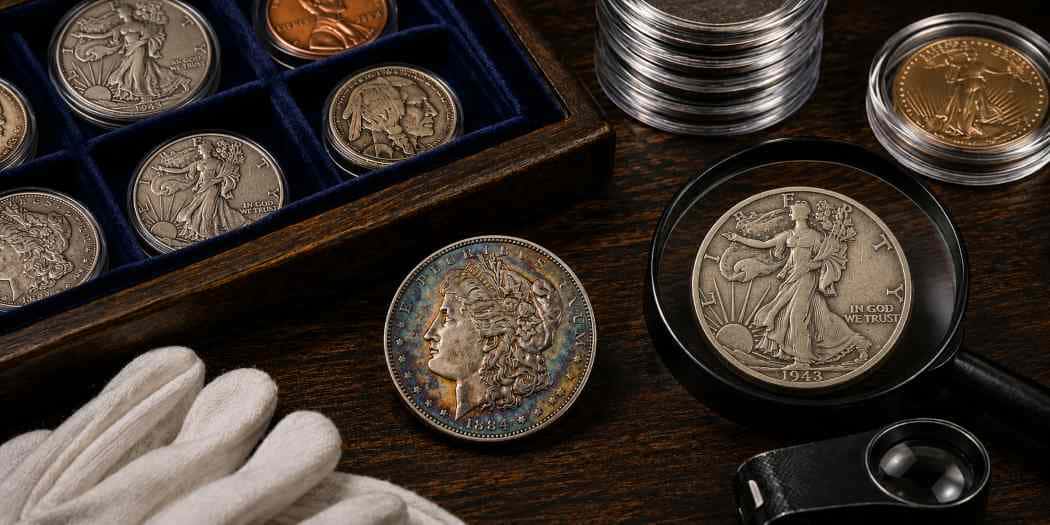
The First Thing Many New Collectors Do Is Often the Biggest Mistake
Gold and silver prices have encouraged more people to revisit old coin collections, inherited albums, and forgotten keepsakes tucked away in drawers and safe deposit boxes. Some hope they've uncovered a valuable rarity, while others simply want to know whether an old coin is worth more today than it was decades ago. Before researching mintages or checking auction prices, however, many owners make one well-intentioned decision that can permanently reduce a coin's collector value.
They clean it.
It's an understandable impulse. Nearly everything else we own benefits from a little care and polishing. Jewelry regains its shine, antique furniture can be restored, and classic automobiles often become more valuable after professional refinishing. Coins operate by a different set of rules. In numismatics, age, originality, and untouched surfaces are often far more desirable than a bright, freshly polished appearance.
This difference surprises many first-time collectors because a cleaned coin frequently looks more attractive to an untrained eye. Experienced collectors, dealers, and professional grading services, however, aren't looking for brilliance alone. They are evaluating whether the coin still reflects the condition in which it naturally survived over decades. Once those original surfaces have been altered, they cannot truly be restored.
The question, then, isn't simply whether you can clean an old coin. It's whether cleaning actually improves the coin from a collector's perspective. In most cases, the answer is no—and understanding why can help preserve both the history and the value of your collection.
Original Surfaces Tell a Story That Cleaning Erases
Collectors often describe a desirable coin as 'original.' That single word carries considerable weight because it suggests the coin has remained largely untouched since it left the mint. Rather than viewing toning or subtle signs of age as flaws, experienced numismatists frequently see them as evidence that a coin has not been polished, chemically treated, or otherwise altered.
Silver coins offer one of the clearest examples. Over time, natural exposure to air and the environment can produce delicate shades of gold, blue, violet, and gray. While someone unfamiliar with coin collecting may mistake this for tarnish, attractive natural toning is often highly prized. In some cases, beautifully toned coins command stronger premiums than examples that have been cleaned to a bright, uniform finish.
Originality extends beyond color. Professional collectors also examine a coin's mint luster, the subtle cartwheel effect created by microscopic flow lines during the striking process. These delicate surfaces are remarkably easy to disturb. Even gentle rubbing with a cloth or repeated handling can create fine hairlines or dull the original finish in ways that become obvious under magnification.
This is why two coins with identical dates, mintmarks, and numerical grades may sell for noticeably different prices. One has simply survived in a more original state. That authenticity often inspires greater confidence among buyers because it represents something increasingly difficult to find: a coin that has aged naturally without unnecessary intervention.
Why Cleaning Usually Reduces Collector Value
Cleaning changes more than a coin's appearance—it changes the evidence collectors use to evaluate authenticity and preservation. Abrasive polishing, chemical dips, household cleaners, and even seemingly harmless techniques promoted online can leave permanent traces that experienced graders recognize almost immediately.
Under magnification, cleaned coins often reveal fine parallel scratches, muted luster, unnatural brightness, or surfaces that no longer reflect the way the metal originally left the mint. Although the coin still contains the same precious metal content, part of its numismatic appeal has been lost because its history has been altered.
Professional grading services such as the Professional Coin Grading Service (PCGS) and Numismatic Guaranty Company (NGC) routinely evaluate coins for evidence of improper cleaning. When significant alteration is present, a coin may receive a details designation instead of a traditional numerical grade, signaling to future buyers that its original surfaces have been compromised. For many collectible coins, that distinction can reduce market value far more than ordinary circulation wear ever would.
The marketplace ultimately rewards preservation, not perfection. A naturally worn coin that retains its original surfaces is often considered more desirable than one that appears brighter but has been permanently changed through cleaning.
There Are Rare Situations When a Coin Should Be Cleaned—But Usually Not by the Owner
The long-standing advice to never clean coins has one important qualification. Some coins develop problems that continue to worsen if left untreated. PVC residue from older plastic flips, active bronze disease on copper coins, or corrosive contaminants introduced by improper storage can threaten a coin's long-term preservation. In those situations, the goal is not to improve appearance but to stop ongoing damage before it becomes irreversible.
This distinction separates cleaning from professional conservation. Cleaning typically attempts to make a coin look newer by removing toning, tarnish, or discoloration. Conservation, on the other hand, focuses on stabilizing a coin while preserving as much of its original surface as possible. The objective is to protect the coin's integrity, not alter its character.
For valuable or potentially rare coins, conservation is often best left to professionals. Services affiliated with major grading companies have specialized techniques for removing harmful contaminants without unnecessarily disturbing original surfaces. While no conservation method is entirely risk-free, professional treatment is generally far safer than experimenting with household cleaners, jewelry polish, baking soda, vinegar, toothpaste, or other internet remedies that can permanently damage collectible coins.
When there is uncertainty, restraint is usually the better choice. A coin can always be examined by a knowledgeable dealer or grading service before any treatment is considered. Once an original surface has been removed, there is no practical way to recreate it.
Proper Handling Preserves More Value Than Any Cleaning Method
Fortunately, preserving collectible coins is far simpler than restoring them. Most long-term damage occurs not because owners neglect their collections, but because coins are handled or stored improperly over many years.
The first rule is to handle coins only by their edges whenever possible. Fingerprints contain natural oils and acids that can leave permanent marks, particularly on silver, copper, and proof coins. Even clean hands can transfer contaminants that gradually affect a coin's surface.
Storage also plays an important role. Coins should be kept in archival-quality holders, inert capsules, or other numismatic storage materials designed specifically for long-term preservation. Stable temperatures and low humidity help slow environmental changes, while avoiding older PVC-based flips reduces the risk of chemical residue developing over time.
Perhaps the most overlooked form of preservation is simply limiting unnecessary handling. Every time a coin is removed from its holder, wiped with a cloth, or passed from hand to hand, there is an opportunity for accidental damage. Experienced collectors often follow a simple principle: examine a coin carefully, store it properly, and disturb it as little as possible thereafter.
Sometimes the Best Way to Protect a Coin Is to Leave It Alone
As interest in coin collecting continues to grow alongside higher precious metals prices, more people will rediscover collections that have been quietly preserved for decades. Some coins will derive most of their value from their gold or silver content, while others may be worth considerably more because of their rarity, condition, or historical significance. Before any of those qualities can be properly evaluated, however, the coin's originality deserves to remain intact.
For collectors, originality represents more than appearance. It reflects a coin's journey through history and provides confidence that what survives today is substantially what left the mint years—or even generations—ago. That authenticity cannot be polished back onto a coin once it has been removed.
The safest approach is also the simplest. Resist the temptation to improve an old coin before understanding what makes it valuable. In numismatics, preserving history almost always proves more rewarding than polishing it away.
Related reading you may find interesting:
Why Coin Mintage Can Have a Big Impact on Value