View Charts
Perth Mint Sets Guinness World Record With World's Largest Gold Bar
 0
0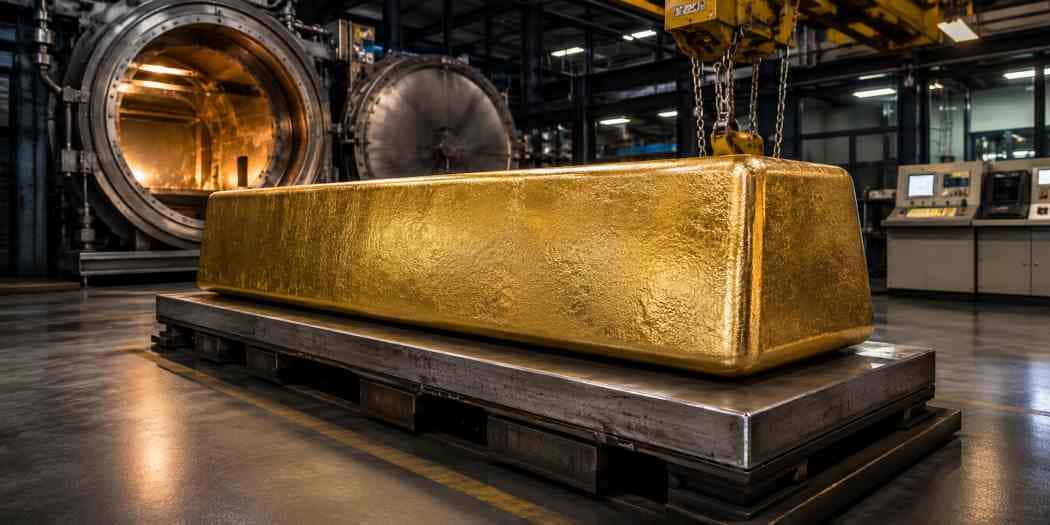
Australian Refining Expertise Takes Center Stage with a 521.2-Kilogram Masterpiece
The Perth Mint has added another outsized creation to its catalogue of precious metals achievements, earning a Guinness World Records title for the largest gold bar ever produced.
Officially weighed on July 9, 2026, the bar registered 521.2 kilograms, or about 1,149 pounds, and achieved a purity of 99.999%. It surpassed the previous record of 300.12 kilograms, set in Dubai by Emirates Minting Factory in 2024, by more than 220 kilograms.
The sheer scale is difficult to visualize. A conventional London Good Delivery gold bar—the standard used in wholesale bullion markets—weighs roughly 400 troy ounces, or about 12.4 kilograms. Perth Mint's record-setting bar therefore contains approximately the same amount of gold as 42 Good Delivery bars cast into a single piece.
At the July 31 gold price of approximately $4,050 per ounce, the record weight equates to nearly 16,757 troy ounces and about $67.8 million in metal value. That figure will naturally fluctuate with the gold market, but the significance of the project extends well beyond its price tag. Even among the industrial-sized bars that move through refineries and central-bank vaults, a half-ton casting occupies a class of its own.
Casting Gold at a Scale That Leaves Little Room for Error
Large gold bars are not created by simply enlarging the mold used for a familiar one-kilogram product. As the volume of molten metal increases, controlling temperature, cooling, internal structure and surface quality becomes considerably more difficult. A defect that might be manageable in an ordinary casting can become a major problem when hundreds of kilograms of gold are involved. Those challenges explain why the project brought together more than 35 specialists from Perth Mint's refinery and assay laboratory. Before the record attempt, approximately 1.5 tonnes of raw material were prepared and refined into a series of large bars. Six of those bars, together with several smaller pieces, were then loaded into a specially designed mold inside the Mint's enclosed Flameless Casting Chamber.
The gold was heated to about 1,400 degrees Celsius, comfortably above its melting point, and held under controlled conditions before the lengthy cooling process began. The chamber's enclosed design helped the team manage heat and limit contamination while working toward a level of purity more commonly discussed in laboratory terms than in connection with a half-ton object.
Perth Mint Chief Executive Officer Paul Graham described the project as a demonstration of the planning, technical judgment and quality control required throughout the refinery. Maintaining 99.999% purity at this size was central to the achievement; producing a heavy block of metal would not have carried the same significance without the assay result to match it.
Why the Record Weight and Finished Weight Are Different
Two weights appear in the Mint's announcement, and the distinction is worth clarifying. Guinness World Records certified the bar at 521.2 kilograms during the formal record attempt. The bar later underwent milling, polishing and engraving, processes that removed material and brought its finished exhibition weight to approximately 508 kilograms.
That difference does not affect the record itself. Guinness measured the qualifying bar at the point the title was awarded, while the lower figure reflects the finished exhibition piece visitors will eventually see. Even after machining, polishing and engraving, the bar remains more than 200 kilograms heavier than the previous record holder. Preparing surfaces of this scale presented its own engineering challenge, requiring technicians to remove imperfections and engrave the finished bar without compromising the integrity of the casting.
For comparison, the finished bar still contains roughly 16,333 troy ounces of gold. It was never intended to become a practical bullion product or circulate through the wholesale market. Instead, it stands as a demonstration of what a modern refinery can accomplish when commercial production gives way to an engineering challenge.
Nine Producers Behind One Australian Gold Bar
The record-setting bar was made from Australian Origin Gold™, with material contributed by nine producers: AngloGold Ashanti Australia, BHP, Evolution Mining, Gold Fields, Greatland, Newmont Australia, Northern Star, Norton Gold Fields and Pantoro. Bringing those companies together transformed the project from a Perth Mint technical exercise into a broader showcase of Australia's gold industry, connecting the finished bar to the mines, processing operations and refining infrastructure that underpin the country's position as one of the world's leading gold producers.
That supply chain is usually invisible to retail bullion buyers. By the time a one-ounce coin or minted bar reaches a dealer, the metal has already passed through mining, transport, refining, assaying, fabrication and distribution. The record bar shifts attention to the refining stage, illustrating how much specialized work takes place between ore leaving a mine and a finished investment product. Gold from multiple producers was ultimately refined to five-nines purity and cast under one roof in Western Australia—a straightforward story on the surface, but one supported by considerable logistical planning and metallurgical expertise.
Perth Mint Has a History of Thinking in Tonnes
A 521.2-kilogram gold bar would be the defining exhibit for most mints. At Perth Mint, however, it will eventually share space with an even larger creation. The Australian Kangaroo One Tonne Gold Coin, introduced in 2012, weighs 1,012 kilograms, measures 80 centimeters across and remains the world's largest legal-tender gold coin, carrying a face value of AUD $1 million. Although both projects earned international recognition, they showcase different disciplines. The one-tonne Kangaroo celebrates numismatic craftsmanship on an unprecedented scale, while the new Guinness World Records bar emphasizes refinery expertise, casting precision and assay control.
Together, they reinforce a distinctive part of Perth Mint's identity. The institution is not only a producer of investment bars and collector coins; it has also built a reputation for using ambitious engineering projects to demonstrate the capabilities of its refinery. The newly finished bar is expected to appear intermittently on the Perth Mint Gold Tour beginning September 21 before ultimately taking its place alongside the one-tonne coin.
From a Half-Ton Record to Investor-Sized Bullion
The practical connection between the record bar and ordinary gold ownership is not its size, but the standards behind it. Retail investors will never need a specially engineered casting chamber or equipment capable of moving more than 1,100 pounds of molten gold. They do, however, rely on refiners and mints to deliver accurate weight, dependable purity and products that can be readily authenticated and traded. Perth Mint applies that reputation to a far more accessible range of gold bars and bullion coins, including its Australian Kangaroo series, allowing investors to own precious metals produced by the same institution responsible for the record-setting casting. Bullion Exchanges carries Perth Mint bullion alongside products from other leading sovereign and private mints, giving investors access to investment-grade gold in practical sizes ranging from one gram to one kilogram.
The Guinness World Records title will attract attention because the bar is enormous. Its more lasting significance may be what that size reveals: gold refining remains a demanding combination of chemistry, engineering and precision, even in an industry whose finished products often appear deceptively simple.