View Charts
Intercontinental Exchange Launches London Precious Metals Futures
 0
0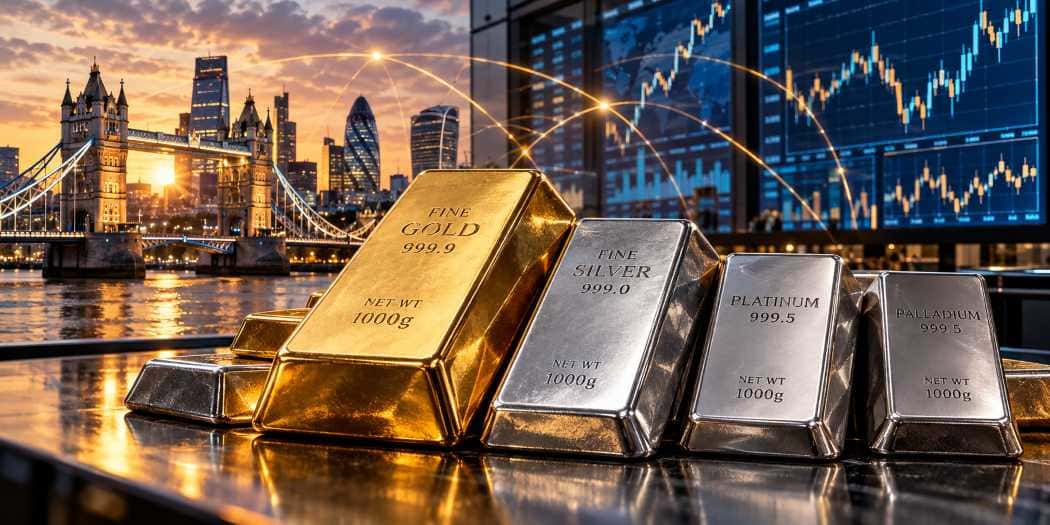
London Is Adding a New Layer to Precious-Metals Trading
London has long occupied an unusual position in precious metals. It is the center of wholesale over-the-counter bullion trading and key benchmark auctions, yet exchange-traded futures price discovery is associated far more closely with New York. Intercontinental Exchange (ICE) is now testing whether that division can be narrowed.
ICE has launched London futures tied to the benchmark prices for gold, silver, platinum and palladium. The contracts give market participants another way to trade and hedge precious metals in the same financial center where much of the underlying physical business is conducted. They arrive as volatility and renewed attention to bullion-market mechanics have made the London-New York relationship more visible. ICE currently lists daily futures for all four metals within its precious-metals futures offering.
The important question is not whether London suddenly replaces COMEX. It is whether a successful local futures market can make the connection between London’s physical ecosystem and exchange-traded derivatives more direct.
What ICE Has Actually Launched
ICE’s new offering covers all four major precious metals. Its current precious-metals product list includes daily futures for gold, silver, platinum and palladium. The London contracts can extend from one day to six months and are cleared through ICE’s UK infrastructure, according to the Financial Times.
The reference points matter. ICE Benchmark Administration operates the electronic auctions behind the LBMA Gold Price, LBMA Silver Price, LBMA Platinum Price and LBMA Palladium Price. Those benchmarks represent unallocated metal delivered in London and are used by miners, refiners, central banks, fabricators, investors and other market participants. Gold auctions take place twice each London business day, while silver has one daily auction; separate benchmark processes cover platinum and palladium.
ICE was not starting from zero before this launch. Daily gold and silver futures already play a role in centrally clearing transactions generated through the benchmark auctions. The broader initiative extends the idea into a more visible London derivatives market, allowing participants to manage exposure beyond the immediate auction settlement process.
That distinction is important. A benchmark answers the question, “What reference price emerged from this auction?” A futures market lets participants trade price exposure for a future date. Putting both mechanisms within a closely connected infrastructure could reduce some of the operational distance between benchmark-setting, hedging and clearing.
Why London and New York Have Played Different Roles
The modern bullion market does not produce one global price in one location. Instead, closely linked trading centers perform different functions. London’s institutional market is heavily associated with large wholesale transactions and “loco London” metal, while CME Group’s COMEX contracts in New York provide a highly visible exchange-traded futures market. Arbitrage and physical flows normally keep prices between the centers closely connected.
The distinction becomes easier to see when markets are stressed. During the pandemic in 2020, transportation and refinery disruptions complicated the movement and conversion of bullion between London and New York. London commonly deals in roughly 400-troy-ounce Good Delivery gold bars, while the traditional COMEX delivery system centered on 100-ounce bars. CME responded by creating its Gold (Enhanced Delivery) contract, which could accommodate 100-ounce, Kilo and approximately 400-ounce bars, a mechanism revisited recently in our examination of the apparent 125-tonne COMEX gold inventory decline.
That episode demonstrated that a price discrepancy is not necessarily evidence that one market has the “correct” gold price and another does not. Location, bar format, financing, transportation and the ability to make delivery all have economic value. When those frictions increase, the gap between markets can widen enough to make normally invisible plumbing suddenly important.
ICE’s London expansion addresses a different problem, but it operates in that same plumbing. A deeper local futures market could give institutions another mechanism for managing London-based price exposure without relying as heavily on transactions that bridge separate market structures.
A London Futures Market Has Failed Before
The launch is more significant because London has tried this before. The London Metal Exchange introduced precious-metals futures in 2017 through its LMEprecious initiative, but trading failed to achieve the scale needed to challenge established venues. Gold and silver futures were ultimately suspended in 2022.
That history makes liquidity the central test for ICE. Listing a contract is relatively easy; creating a market that participants repeatedly use is much harder. Futures markets become useful through depth: active buyers and sellers, competitive bid-ask spreads, reliable clearing, participation across maturities and enough volume that large trades can be executed without excessive price impact.
ICE does possess an advantage that earlier efforts struggled to convert into durable activity. Its Benchmark Administration business already sits inside London’s precious-metals infrastructure through the auctions underlying the LBMA benchmark prices. That places the company inside an existing reference-price ecosystem rather than forcing it to build one from scratch.
Still, incumbency elsewhere matters. COMEX has decades of liquidity, established hedging practices and a large network of traders already accustomed to its contracts. ICE does not need to displace that market for its London contracts to succeed. It needs enough recurring activity to become useful alongside it.
What Could Change for Gold, Silver, Platinum and Palladium
The immediate effect on retail bullion prices may be small. A new futures venue does not create new physical gold or silver, nor does it automatically change the supply-demand balance for platinum or palladium. Bullion products will still reflect the underlying metal price plus fabrication, wholesale, distribution and retail premiums.
The potential change lies further upstream in price discovery and risk management. If liquidity develops, London participants could gain another transparent exchange-traded reference for hedging exposures that originate in the physical market. More trading routes can also create additional arbitrage opportunities when equivalent exposures diverge across venues. Arbitrage does not guarantee identical prices at every moment, but it gives professional traders an incentive to act when differences become large enough to exceed financing, delivery and transaction costs.
The PGM contracts may be particularly worth watching. Platinum and palladium markets are smaller than gold and can experience sharper moves when liquidity thins or supply expectations change. A functioning London futures venue would not eliminate that volatility, but additional exchange-traded liquidity could alter where institutions choose to hedge it.
For bullion buyers following the live gold, silver, platinum and palladium markets, the larger lesson is that “spot price” is the visible output of a network rather than a quote generated by a single exchange. London benchmarks, OTC transactions, futures markets, physical flows and arbitrage all help keep that network connected.
The Real Test Starts After Launch Day
The launch itself establishes the contracts; trading behavior will determine their importance. Volume, open interest, bid-ask spreads, participation across maturities and the willingness of banks, refiners, miners and institutional investors to use the contracts will matter more than the first day’s headline.
There is also a broader market-structure question. London already possesses globally important physical infrastructure and benchmark prices. New York already possesses formidable futures liquidity. If ICE can build durable exchange-traded activity around London’s existing benchmark ecosystem, the result may be less a contest over which city “sets” the gold price than an additional bridge between two parts of the same global market.
That would make the launch consequential even if COMEX remains dominant. Precious-metals pricing has always depended on connections between physical metal and financial claims on metal. ICE is betting that participants now want one of those connections to be shorter, more transparent and easier to clear in London.