View Charts
How Dollar Liquidity Conditions Affect Precious Metals Pricing
 0
0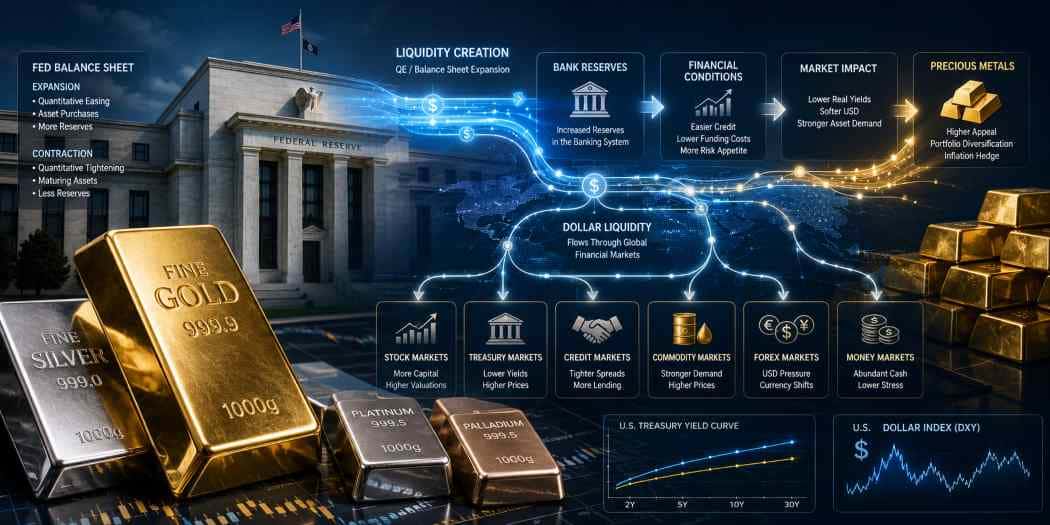
The Hidden Current Beneath the Gold Market
Gold prices are often explained through familiar headlines: inflation, Federal Reserve rate decisions, geopolitical tensions, or a weakening U.S. dollar. While each of those influences matters, they share a common thread that receives far less attention—dollar liquidity.
Liquidity describes how easily money moves through the financial system. It influences the availability of credit, the willingness of investors to take risk, and the overall flow of capital between financial assets. Unlike interest rates, which determine the price of borrowing, liquidity affects the amount of money available to circulate throughout markets.
For precious metals investors, this distinction is important. Gold does not trade in isolation. It competes with stocks, bonds, cash, and other assets for investment capital. When liquidity expands, investors generally have greater flexibility to allocate money across markets. When liquidity contracts, preserving cash often becomes a higher priority. Those shifts can alter demand for precious metals long before interest rates change or economic data dominate the headlines.
Understanding liquidity offers a broader framework for interpreting gold prices because it explains not just individual market events, but the financial environment in which those events unfold.
What Dollar Liquidity Actually Means
Dollar liquidity is often confused with money printing or low interest rates, but it represents something broader. At its core, liquidity reflects the availability of U.S. dollars and short-term funding throughout the banking system and global financial markets. It determines how easily banks can lend, businesses can borrow, institutions can finance investments, and investors can deploy capital.
Several factors influence liquidity simultaneously. Commercial bank reserves, money-market activity, Treasury issuance, and Federal Reserve operations all affect how readily dollars circulate through the economy. Markets pay close attention to these conditions because abundant liquidity generally supports lending, investment, and financial stability, while scarce liquidity can tighten credit and increase borrowing costs even if policy rates remain unchanged.
This distinction helps explain why two periods with identical federal funds rates can produce very different market outcomes. Interest rates describe the cost of money. Liquidity describes its availability. Both shape financial conditions, but they operate through separate channels.
Why the Fed's Balance Sheet Matters
The Federal Reserve influences liquidity most directly through the size and composition of its balance sheet. During quantitative easing (QE), the central bank purchases Treasury securities and mortgage-backed securities from the financial system. Those purchases increase bank reserves and inject additional liquidity into financial markets, making capital more readily available.
Quantitative tightening (QT) works in the opposite direction. As securities mature without being fully replaced—or, in some cases, are sold outright—the Federal Reserve gradually reduces the reserves circulating within the banking system. The objective is not simply to shrink the balance sheet but to remove excess liquidity created during earlier periods of monetary accommodation.
Unlike changes in the federal funds rate, balance-sheet policy operates gradually. Its effects accumulate over months rather than days, influencing credit conditions, lending activity, and investor behavior across the financial system. Because liquidity affects nearly every asset class, changes to the Fed's balance sheet often become visible well before they appear in traditional economic indicators.
Following the Flow of Money Into Precious Metals
Liquidity reaches the gold market indirectly through a chain of financial relationships rather than a single cause-and-effect mechanism.
When liquidity expands, financial conditions typically become more accommodative. Banks hold greater reserves, funding markets operate more smoothly, and investors often become more willing to deploy capital beyond cash holdings. That environment can support higher allocations to equities, commodities, and precious metals alike.
Gold benefits because expanding liquidity frequently influences other variables that matter to bullion investors. Easier financial conditions may contribute to lower real interest rates, moderate pressure on the U.S. dollar, and stronger demand for inflation hedges or portfolio diversifiers. The result is not that liquidity automatically raises gold prices, but that it creates conditions in which bullion often becomes relatively more attractive.
Periods of tightening follow the opposite path. As liquidity is withdrawn, financial conditions generally become more restrictive. Investors may shift toward cash or income-producing assets, while a firmer dollar and higher real yields can weigh on precious metals. Liquidity, therefore, acts less as a direct price driver than as the financial current influencing how capital moves throughout the broader market.
When Other Forces Take Control
Liquidity is an important macroeconomic variable, but it is never the only one shaping precious metals prices. Gold frequently demonstrates that broader market conditions can outweigh even significant changes in monetary policy.
Central-bank buying offers one example. Over the past several years, official-sector purchases have remained historically strong despite periods of quantitative tightening, providing structural demand that helped support bullion prices. Geopolitical tensions can produce similar effects by increasing safe-haven demand regardless of broader liquidity conditions.
Inflation expectations also complicate the picture. Investors who believe inflation will remain elevated may continue accumulating gold even if liquidity becomes less abundant. Likewise, financial instability can trigger defensive buying that offsets the impact of tighter monetary conditions.
Rather than searching for a single explanation, experienced investors evaluate liquidity alongside real yields, currency movements, central-bank activity, and geopolitical developments. Gold reflects the interaction of these forces rather than any one of them in isolation.
Looking Beneath the Headlines
Discussions of Federal Reserve policy often begin and end with interest rates, yet monetary policy extends well beyond the federal funds rate. The availability of dollar liquidity quietly shapes lending, investment, market confidence, and the movement of capital throughout the global financial system.
For precious metals investors, recognizing that deeper layer provides valuable perspective. Gold responds not only to what the Federal Reserve announces, but also to how money flows through the economy after those decisions are made. Changes to the Fed's balance sheet, bank reserves, and overall financial conditions may unfold gradually, but they help create the environment in which bullion ultimately trades.
Interest rates will always command attention, yet liquidity often explains why broader market trends develop in the first place. Investors who understand both are better equipped to interpret the forces shaping precious metals over the long term rather than reacting solely to the next policy headline.
Related reading you may find interesting:
Why Precious Metals Move Before Interest Rate Decisions