View Charts
How Central Bank Policies Influence Platinum and Palladium Prices
 0
0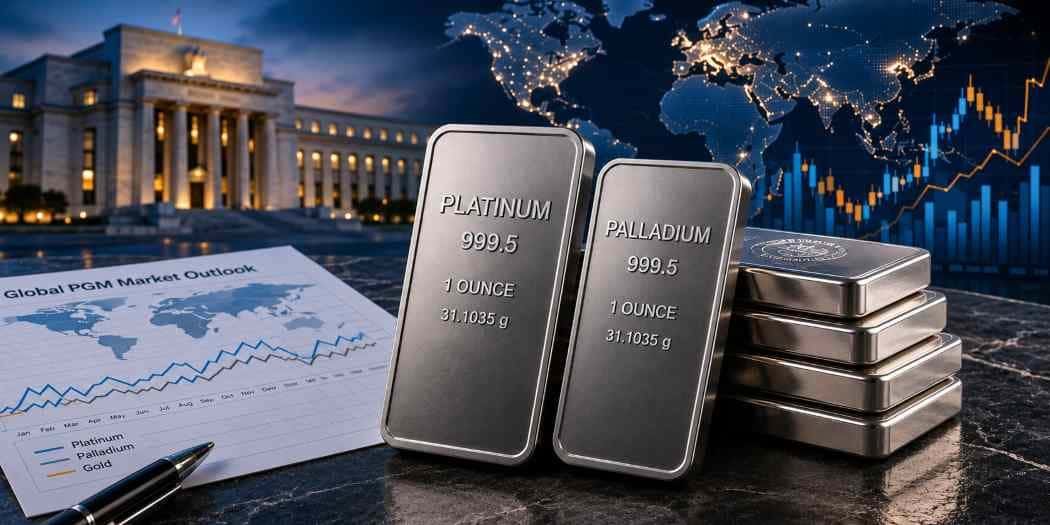
Why Monetary Policy Matters Beyond Gold
When investors think about central banks and precious metals, gold usually dominates the conversation. Federal Reserve interest rate decisions, inflation expectations, and central bank gold purchases have long been recognized as major drivers of the yellow metal's performance. Platinum and palladium, however, occupy a different place within the precious metals market. While they often move alongside gold during periods of economic uncertainty, their prices are influenced by a much broader mix of industrial demand, supply constraints, and global manufacturing trends.
That distinction doesn't mean central banks are irrelevant. Although monetary authorities rarely hold platinum or palladium as reserve assets, their policy decisions shape the economic environment in which both metals trade. Interest rates affect business investment, consumer spending, currency values, and industrial production—all of which influence demand for platinum group metals (PGMs). Understanding these indirect relationships gives investors a clearer picture of why platinum and palladium can react differently from gold during the same economic cycle.
Central Banks Don't Buy PGMs—But Their Decisions Still Matter
Unlike gold, platinum and palladium are not accumulated by central banks as part of national foreign exchange reserves. Gold's monetary history and role as a reserve asset have made it a strategic holding for governments worldwide, while platinum and palladium remain primarily industrial commodities with precious metals characteristics.
Even so, monetary policy affects nearly every sector that consumes PGMs. When central banks raise interest rates to combat inflation, borrowing becomes more expensive for businesses and consumers. Higher financing costs can slow manufacturing activity, reduce capital investment, and temper consumer demand for automobiles and other durable goods. Because automotive catalytic converters account for a significant share of global platinum and palladium consumption, changes in economic activity can eventually influence market demand.
The opposite is also true. During periods of monetary easing, lower borrowing costs can encourage business expansion and consumer spending. Increased industrial production and stronger vehicle sales often support platinum and palladium demand, although supply conditions and technological changes continue to play important roles in determining overall precious metals market prices.
Interest Rates Influence More Than Investor Sentiment
Interest rate decisions affect platinum and palladium through several interconnected channels rather than a single direct mechanism. One of the most significant is overall economic growth. Manufacturing, construction, transportation, and automotive production all respond to changes in financing conditions, making PGMs particularly sensitive to shifts in the business cycle.
Currency markets provide another important link. Higher interest rates frequently strengthen the U.S. dollar, making dollar-denominated commodities more expensive for international buyers. A stronger dollar can create headwinds for platinum and palladium prices even when underlying industrial demand remains healthy. Conversely, a weaker dollar often improves purchasing power for overseas manufacturers and investors, helping support commodity prices more broadly.
Investor positioning also evolves as monetary policy changes. During periods of tightening, market participants may favor income-producing assets over commodities. When central banks begin easing policy or signal improving liquidity conditions, investors often increase exposure to hard assets, including industrial precious metals, particularly if economic growth is expected to accelerate.
Inflation Expectations Can Support Platinum and Palladium
Although platinum and palladium are not traditional inflation hedges like gold, inflation expectations still influence their markets. Persistent inflation can raise production costs throughout global supply chains while also increasing interest in tangible assets as portfolio diversifiers. At the same time, elevated inflation often prompts central banks to maintain tighter monetary policy, creating competing forces that investors must evaluate.
This balancing act explains why platinum and palladium sometimes diverge from gold. While gold may benefit primarily from safe-haven demand during periods of financial uncertainty, platinum and palladium often depend more heavily on whether inflation is slowing economic growth enough to reduce industrial consumption. Investors who understand both sides of that equation are generally better equipped to interpret market movements without assuming every precious metal will respond identically to the same central bank announcement.
Global Central Banks Help Shape Industrial Demand
While the Federal Reserve often receives the most attention from investors, other major central banks can have an equally important influence on platinum and palladium markets. The European Central Bank (ECB), the People's Bank of China (PBOC), the Bank of Japan (BOJ), and the Bank of England all help shape economic activity in regions with significant automotive and industrial manufacturing.
China deserves particular attention because it remains one of the world's largest automobile markets and a major consumer of platinum group metals. Monetary easing or government stimulus measures that encourage manufacturing, infrastructure investment, or consumer spending can strengthen demand for vehicles and industrial equipment, supporting platinum consumption across multiple sectors. Conversely, slower economic growth or tighter financial conditions may weigh on industrial demand even if mine supply remains constrained.
Europe also plays an important role, particularly for platinum. Diesel vehicles have historically relied on platinum-rich catalytic converters, while both platinum and palladium continue to be used in emissions-control technologies as automakers work to meet increasingly stringent environmental regulations. Central bank policies that influence economic growth, business confidence, and consumer financing can therefore ripple through the automotive supply chain and affect demand for PGMs.
Supply Constraints Can Override Monetary Policy
Although central bank decisions establish the broader economic backdrop, they are only one piece of the platinum and palladium pricing puzzle. Supply disruptions have repeatedly demonstrated that mine production and refining capacity can outweigh macroeconomic influences, particularly during periods of unexpected shortages.
South Africa accounts for the majority of global platinum production and remains a leading producer of palladium, while Russia is another critical supplier of palladium to international markets. Labor disputes, electricity shortages, geopolitical tensions, mining interruptions, or transportation bottlenecks can quickly tighten supply regardless of the prevailing interest-rate environment. In these situations, prices may rise even if central banks are pursuing restrictive monetary policies.
Recycling also plays a growing role in balancing supply and demand. Higher prices often encourage increased recycling of automotive catalytic converters and industrial materials, adding secondary supply to the market. Investors evaluating platinum and palladium should therefore consider both macroeconomic conditions and developments within the global mining industry rather than relying exclusively on central bank announcements.
What Platinum and Palladium Investors Should Watch
For investors following platinum and palladium markets, monetary policy remains an important indicator—but not one that should be viewed in isolation. Interest-rate decisions from the Federal Reserve and other major central banks help shape the pace of global economic growth, manufacturing activity, and consumer demand, all of which influence the long-term outlook for platinum group metals.
At the same time, market participants should closely monitor automotive production, emissions regulations, Chinese economic stimulus measures, mining conditions in South Africa and Russia, recycling trends, and broader commodity market sentiment. These factors often work together, reinforcing or offsetting the effects of monetary policy depending on prevailing market conditions.
Understanding these interconnected drivers allows investors to develop a more balanced perspective on platinum and palladium. Rather than viewing every central bank announcement through the same lens used for gold, successful PGM investors recognize that these metals respond to a unique combination of industrial demand, constrained supply, and global economic policy. Appreciating that distinction can lead to more informed investment decisions and a clearer understanding of where opportunities—and risks—may emerge as monetary policy continues to evolve.