View Charts
Federal Reserve Holds Interest Rates Steady as Inflation Remains Elevated
 0
0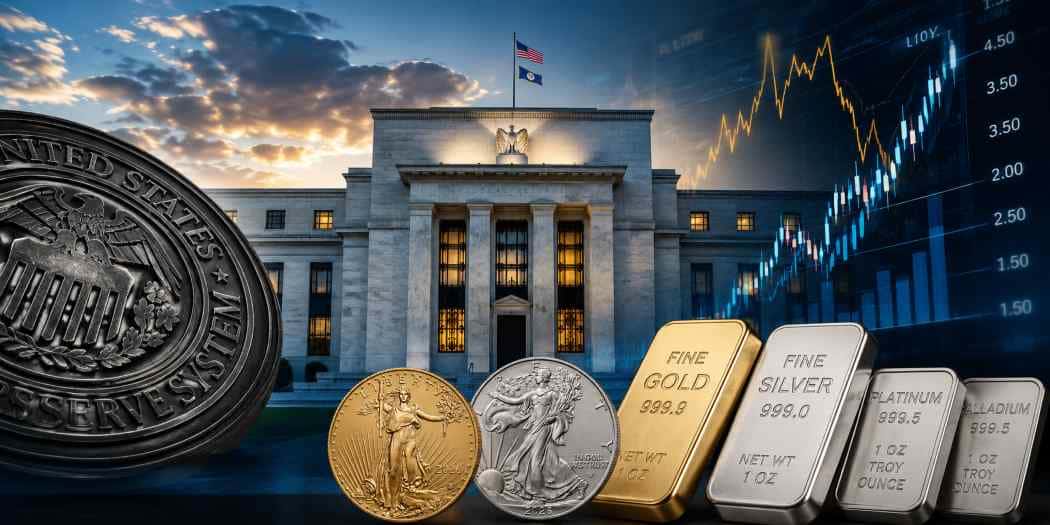
The Fed Holds Steady, but the Message Matters
The Federal Reserve left interest rates unchanged on Wednesday, July 29, 2026, opting to keep the federal funds target range at 3.50% to 3.75% while reaffirming its commitment to restoring price stability. Although the decision was widely expected by financial markets, investors closely scrutinized the accompanying policy statement for clues about how policymakers view inflation, economic growth, and the path of monetary policy during the remainder of 2026.
The outcome reflected a balancing act that has defined much of the Fed's recent approach. Economic activity continues to expand at a healthy pace, the labor market remains resilient, and business investment has stayed strong. At the same time, inflation remains above the central bank's long-term 2% target, preventing officials from signaling that interest rate cuts are imminent. For precious metals investors, the combination of steady policy and lingering inflation creates a market environment where both opportunity and volatility are likely to persist.
While the headline decision was to leave rates unchanged, the language within the statement offered a clearer picture of how policymakers are weighing competing economic forces. Rather than suggesting that inflation is nearly defeated, the Federal Open Market Committee (FOMC) emphasized that price pressures remain elevated and that external risks continue to cloud the outlook. The message was unmistakable: the Fed believes progress has been made, but its work is far from finished.
A Vote That Signals Some Division
The FOMC approved the decision by a 9-3 vote, indicating that while a clear majority favored maintaining current policy, not every policymaker agreed on the appropriate course of action. Dissents are not uncommon, but they often remind markets that opinions within the Committee can differ even when the final decision appears straightforward.
For investors, however, the more important takeaway is that the Committee chose stability over action. By leaving rates unchanged, the Fed gains additional time to evaluate incoming inflation and employment data before making further adjustments to monetary policy. Officials have consistently emphasized that future decisions will remain data dependent, and Wednesday's statement did little to change that stance.
Markets generally interpreted the decision as confirmation that policymakers are comfortable waiting for clearer evidence that inflation is moving sustainably toward their target before considering any shift in policy.
The Economy Continues to Show Resilience
One of the most notable aspects of the statement was the Fed's confidence in the underlying strength of the U.S. economy. Rather than highlighting signs of slowing growth, policymakers described economic activity as expanding at a solid pace despite ongoing uncertainty.
Several factors supported that assessment.
-
Economic growth continues to advance steadily.
-
Productivity gains remain strong.
-
Capital investment by businesses has held up well.
-
Job growth continues to keep pace with workforce expansion.
-
The unemployment rate has remained relatively stable.
Taken together, those observations paint a picture of an economy that has remained remarkably resilient despite higher borrowing costs over the past several years. Consumer spending has moderated from earlier peaks, yet businesses continue investing, employers continue hiring, and overall economic activity has avoided the sharp slowdown many economists once expected.
For financial markets, a resilient economy is generally constructive. However, stronger growth also reduces the urgency for the Federal Reserve to begin lowering interest rates. As long as economic conditions remain healthy, policymakers have greater flexibility to keep monetary policy restrictive while continuing their fight against inflation.
Inflation Remains the Fed's Primary Focus
Although economic growth received positive attention, inflation remained the central theme of Wednesday's statement.
The Committee acknowledged that inflation continues to run above its 2% objective, noting that supply disruptions have contributed to higher prices in several areas of the economy, particularly within the energy sector. That represents an important distinction from earlier inflation cycles that were driven primarily by consumer demand. Supply-side pressures, including geopolitical developments and energy markets, remain capable of influencing inflation even when overall economic growth is moderating.
Perhaps the strongest sentence in the entire statement came at its conclusion:
"The Committee will deliver price stability."
That concise declaration reinforces the Fed's determination to bring inflation under control, even if doing so requires keeping interest rates elevated for longer than some investors would prefer.
For markets, this language carries a mildly hawkish tone. While the Fed did not raise rates, it also avoided suggesting that inflation has been sufficiently contained to justify easing monetary policy in the near future. Investors hoping for a more dovish shift instead received another reminder that policymakers remain focused first and foremost on restoring stable prices.
What the Fed's Decision Means for Precious Metals
For gold, the Fed's decision reinforces a familiar but supportive backdrop. Holding rates steady removes the immediate pressure that typically accompanies higher interest rates, while the acknowledgment that inflation remains above target continues to support gold's role as a store of value. Investors seeking protection against persistent inflation or geopolitical uncertainty may continue to view physical gold as a long-term portfolio diversifier, particularly if expectations for future rate cuts remain uncertain.
Silver faces a more nuanced outlook. Like gold, it benefits from safe-haven demand during periods of uncertainty, but its significant industrial use means its performance is also tied to the broader economy. The Fed's assessment that economic activity, productivity, and capital investment remain strong could support industrial demand for silver over time, even if monetary policy stays restrictive. Platinum and palladium are even more closely linked to industrial activity, particularly the automotive sector, making the Fed's optimistic view of economic growth generally constructive for both metals. However, these markets continue to be influenced by supply constraints, manufacturing trends, and evolving global demand, factors that often outweigh monetary policy alone.
Precious metals traded modestly higher following the Fed's announcement as investors interpreted the decision and Chair Kevin Warsh's subsequent remarks as reinforcing a cautious, data-dependent approach rather than signaling an imminent shift in monetary policy. While the gains were measured, the reaction suggested that markets remain focused on incoming inflation and employment data rather than expecting near-term policy changes.
What Investors Should Watch Next
Wednesday's meeting reinforced that the Federal Reserve is in no rush to alter monetary policy or provide detailed forward guidance. Both the policy statement and Chair Kevin Warsh's remarks emphasized that future decisions will depend on incoming economic data rather than a predetermined timeline. For investors, that means each major inflation report, employment release, and economic update will continue to carry added significance ahead of the remaining FOMC meetings this year.
Among the key developments to watch are:
-
Inflation reports, particularly Core CPI and the Personal Consumption Expenditures (PCE) Price Index.
-
Monthly employment data, including job growth and changes in the unemployment rate.
-
Energy prices and geopolitical developments that could contribute to renewed inflationary pressures.
-
Future FOMC statements for any meaningful shift in language regarding the outlook for interest rates.
Each of these factors has the potential to influence both expectations for future monetary policy and the outlook for gold, silver, platinum, and palladium.
Looking Beyond the Headlines
Although the Federal Reserve left interest rates unchanged, the broader message was that inflation remains unfinished business. A resilient economy has given policymakers room to keep monetary policy restrictive while continuing their effort to restore price stability. For precious metals investors, that combination of elevated inflation, steady economic growth, and ongoing geopolitical uncertainty reinforces the importance of maintaining a long-term perspective. Rather than reacting to a single Fed meeting, investors will likely remain focused on the evolving economic data that will determine when the central bank is ultimately prepared to change course.