View Charts
Canadian Gold Maple Leaf: One of the World's Most Trusted Gold Coins
 0
0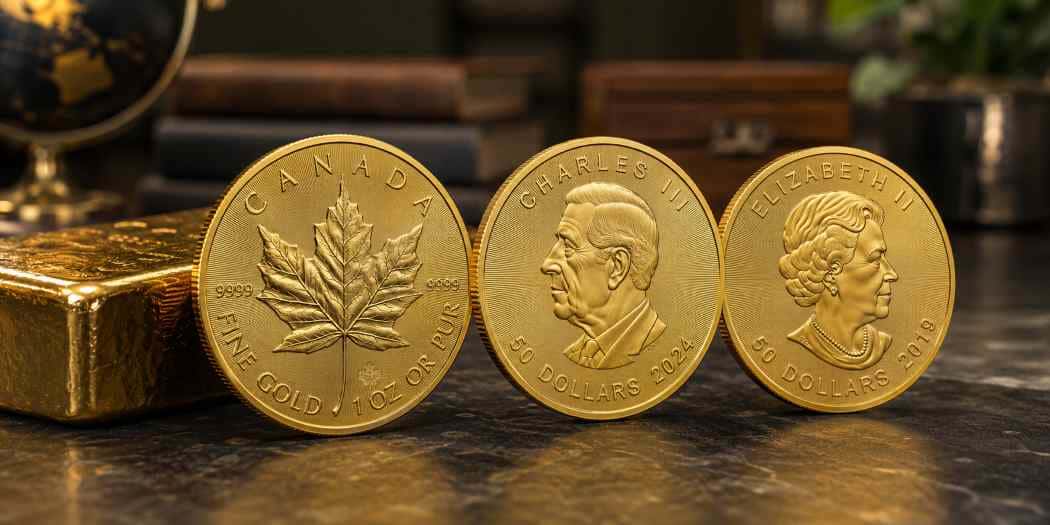
The Coin That Changed the Global Gold Market
Today, the Canadian Gold Maple Leaf is so firmly established that it's easy to forget it was once the newcomer.
For much of the 1970s, investors seeking modern gold bullion had remarkably few choices. The South African Krugerrand dominated international markets, accounting for the overwhelming majority of private bullion ownership. It was widely recognized, readily traded, and had little meaningful competition.
Then politics changed the landscape.
As international opposition to apartheid intensified, many countries restricted or banned Krugerrand imports. Investors still wanted physical gold, but suddenly the market was searching for an alternative from a stable Western nation. Canada recognized the opportunity. In 1979, the Royal Canadian Mint introduced the Gold Maple Leaf, creating what would become one of the most successful bullion coins ever produced.
The timing proved almost perfect. The Maple Leaf wasn't simply another one-ounce gold coin entering an already crowded field—it arrived when investors were actively looking for one. More than four decades later, it remains one of the most recognized investment coins in the world, valued not only for its gold content but also for its reputation for purity, innovation, and security.
A Simpler Design Became an Enduring Identity
Unlike many historic coins, the Gold Maple Leaf doesn't tell a complicated story through its artwork.
Its reverse has always centered on Canada's national symbol: the maple leaf. The design is striking in its simplicity, relying on crisp detail rather than elaborate imagery. That decision helped create a timeless appearance that has required remarkably little alteration since the series debuted.
The obverse has naturally evolved alongside Canada's monarchy. Coins issued from 1979 through 2023 feature successive portraits of Queen Elizabeth II that reflected different stages of her reign, while beginning in 2024 the Royal Canadian Mint introduced the first bullion issue bearing the effigy of King Charles III. The transition marked a historic moment for collectors, but the coin itself remained immediately recognizable.
That continuity has become one of the Maple Leaf's greatest strengths. Investors purchasing a current issue are buying a bullion coin that looks unmistakably connected to those struck more than forty years ago. In an industry where trust and recognition matter, consistency has proven just as valuable as innovation.
Raising the Standard for Gold Purity
When the Gold Maple Leaf debuted in 1979, it already distinguished itself by being struck from 99.9% pure gold, a higher standard than the 22-karat South African Krugerrand that dominated the market.
The Royal Canadian Mint didn't stop there.
Only three years later, it increased the purity to 99.99%, establishing a benchmark that many competing bullion programs would eventually follow. At a time when investors increasingly compared bullion products ounce for ounce, the additional refinement became an important selling point and reinforced Canada's growing reputation for metallurgical excellence.
The Mint later pushed the boundaries even further with limited-production 99.999% pure Gold Maple Leaf coins. Although standard bullion issues remain 99.99% fine, those special releases demonstrated the Mint's refining capabilities and helped strengthen its reputation as one of the world's leading producers of high-purity precious metals.
For investors, the difference between 99.99% and 99.999% purity has little practical impact on bullion value. The greater significance lies in what those numbers represent: decades of continual investment in refining technology and quality control, giving buyers confidence that every Gold Maple Leaf meets exceptionally high production standards.
Innovation Didn't Stop With Purity
For years, the Gold Maple Leaf's reputation rested largely on its exceptionally pure gold. Eventually, however, the Royal Canadian Mint recognized that purity alone was no longer enough. As bullion ownership expanded worldwide, counterfeiters became more sophisticated, prompting mints to think beyond the precious metal itself.
Rather than redesigning the coin, the Mint focused on making it more difficult to imitate.
Beginning in 2013, Gold Maple Leaf bullion coins received precision-machined radial lines that extend across both sides of the coin. While visually subtle, these fine lines are created using specialized equipment with exact spacing that is extremely difficult to reproduce accurately. Two years later, the Mint added another layer of protection: a laser-engraved micro maple leaf containing the coin's year of issue. Although barely visible without magnification, the mark serves as an authentication feature tied directly to the Mint's production process.
These additions were significant because they changed how modern bullion coins approached security. Rather than relying solely on packaging or certificates, the anti-counterfeiting technology became part of the coin itself. The innovations have since influenced security developments across the bullion industry, as other sovereign mints introduced their own advanced authentication features.
Why Investors Continue Choosing the Gold Maple Leaf
A bullion coin's reputation is built over decades, not individual releases.
The Gold Maple Leaf has earned broad acceptance because dealers, investors and institutions around the world know exactly what it is. Its weight, purity and specifications are instantly recognizable, making transactions straightforward whether the coin is being purchased, sold or added to a long-term portfolio. That familiarity often translates into strong liquidity, one of the qualities investors value most in physical precious metals.
Its annual production also contributes to that confidence. Unlike many collectible programs issued in strictly limited quantities, the Gold Maple Leaf is manufactured to meet investor demand rather than predetermined mintages. Most buyers are interested first in its bullion value, while collectors often appreciate the subtle changes that have occurred over the decades, including evolving royal portraits and occasional commemorative editions.
That balance between investment appeal and collectible interest has helped the series remain relevant through changing market conditions. Whether gold is experiencing record highs or prolonged periods of consolidation, the Maple Leaf continues to occupy a prominent place among the world's leading bullion coins.
More Than a Competitor to the Krugerrand
History remembers the Gold Maple Leaf as the coin that challenged the South African Krugerrand, but its lasting importance goes well beyond that rivalry.
The series helped establish many of the expectations investors now take for granted. High-purity gold became the industry standard rather than a distinguishing feature. Sophisticated security technology evolved from a novelty into a necessity. Just as importantly, the Maple Leaf demonstrated that a sovereign bullion coin could maintain a consistent identity while continuing to evolve behind the scenes through advances in refining and minting technology.
Those qualities have allowed it to remain competitive despite an increasingly crowded marketplace that now includes the American Gold Eagle, Austrian Philharmonic, Australian Kangaroo, British Britannia and numerous other government-issued bullion programs.
A Cornerstone of Modern Bullion Investing
Every successful bullion coin has a defining characteristic. The Krugerrand pioneered the modern bullion market. The American Gold Eagle became synonymous with U.S. precious metals investing. The Canadian Gold Maple Leaf built its reputation differently, combining exceptional purity with continuous technical innovation and decades of dependable production.
That combination explains why the coin remains a favorite among both first-time buyers and experienced investors. While gold spot prices fluctuate and new bullion products continue to enter the market, the characteristics that established the Maple Leaf's reputation—recognized purity, trusted minting standards, advanced security features and worldwide liquidity—have remained remarkably consistent.
More than forty-five years after its debut, the Canadian Gold Maple Leaf is no longer simply an alternative to another bullion coin. It has become one of the benchmarks by which modern investment gold is judged.