View Charts
August's Inflation Surge
 0
0
Source: Canva
The U.S. economy faced an unexpected shakeup this past month, witnessing the most substantial inflation spike of the year.
The repercussions of such an upsurge are multifaceted, touching various sectors and prompting considerable speculation about the nation's economic trajectory.
Understanding the Numbers:
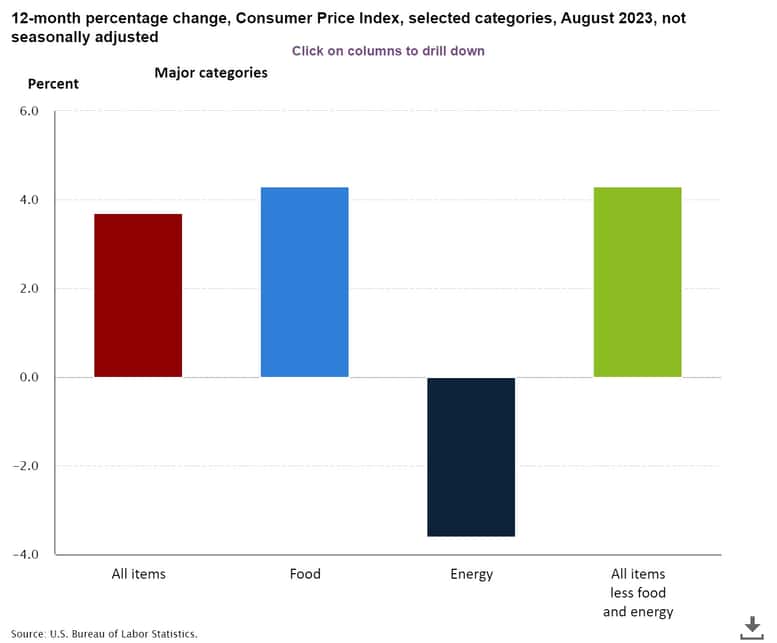
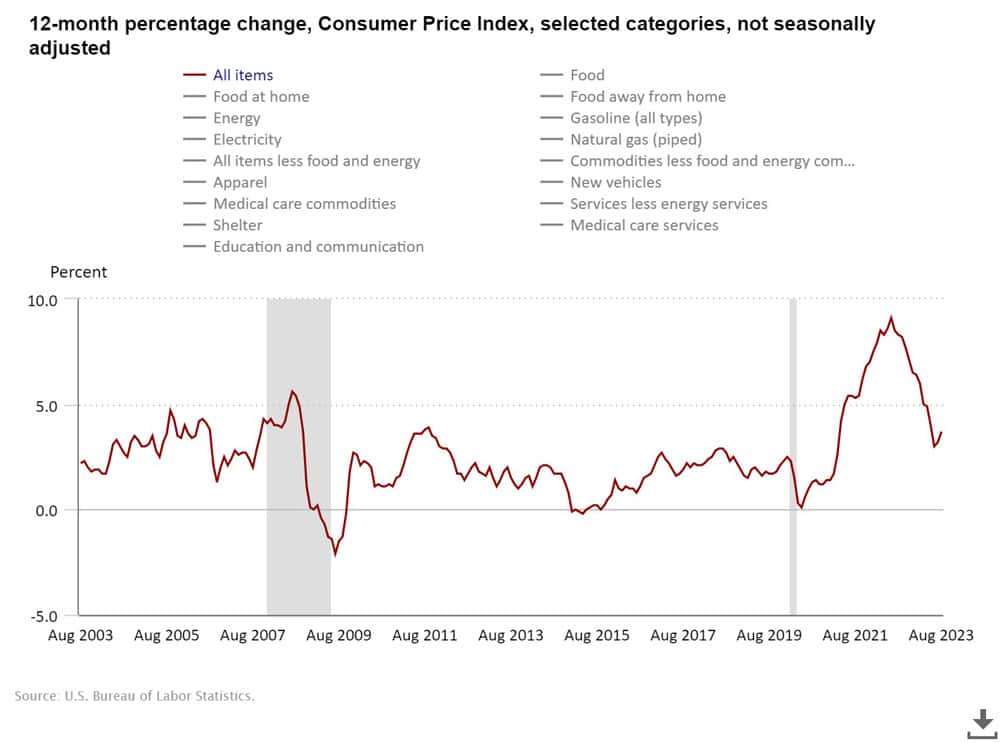
In August, the Consumer Price Index (CPI), a barometer that evaluates the costs of a plethora of goods and services, witnessed a seasonally adjusted increase of 0.6%. This percentage points towards a 3.7% ascent compared to last year's figures, as detailed by the U.S. Department of Labor.
Contrary to prevailing economic forecasts, the core CPI, which excludes volatile commodities like food and energy, grew by 0.3% monthly and 4.3% annually.
For analysts and policymakers, the core CPI often serves as a more reliable metric for gauging long-term inflation patterns.
Its unexpected rise has reignited extensive discussions about the underlying factors and potential remedial actions.
Sector-specific Breakdown:
- Energy: This sector was particularly hard hit. Energy prices ballooned by 5.6% within just a month. Notably, gasoline prices, an essential component of the energy category, experienced a dramatic 10.6% surge. Such price hikes have direct implications for consumers, affecting daily commutes, travel, and even the cost of goods, given the intertwined nature of energy costs with transportation and production.
- Shelter: Shelter costs, which command a significant chunk (about a third) of the CPI, rose by 0.3%. To understand the gravity of this rise, consider the fact that without factoring in shelter costs, the annual CPI rise would merely be 1%. It underscores the outsized impact the housing market currently has on inflationary metrics.
- Transportation: Travel and transportation also felt the ripples of inflation. Even though airfares rose 4.9% over the month, they remain 13.3% lower than the previous year—offering a silver lining for avid travelers. On the flip side, used vehicle costs, previously a dominant catalyst in the inflation surges of 2021 and 2022, decreased by 1.2%. This reduction translates to a 6.6% drop year over year.
The Housing Conundrum:
Lisa Sturtevant, Chief Economist at Bright MLS, shed light on the prominent role housing plays in these inflation figures.
Sturtevant noted the recent deceleration in rent growth, which seemingly contrasts with the inflation narrative. But there's a caveat: the broader impacts of this rent slowdown might take a while to trickle down into the CPI metrics.
These delayed effects are crucial data points that the Federal Reserve should account for when shaping interest rate policies.
Financial Markets React:
The inflation report undeniably sent shockwaves through the financial markets. In the immediate aftermath, stock futures faced a downturn. However, they made a swift recovery, highlighting the markets' adaptive capabilities.
In the realm of Treasury yields, there was a noticeable uptick, which can influence borrowing costs and saving rates for consumers and businesses.
Long-term Perspective and Predictions:
These inflationary trends emerge at a pivotal juncture. The Federal Reserve, the nation's central banking system, is grappling with formulating long-term countermeasures to address inflation.
Since its proactive move in March 2022, the institution raised its cornerstone borrowing rate by a significant 5.25 percentage points. This move was a response to combat the sky-high inflation noted in the summer of 2022.
Recent insights from officials hint at a shift towards a more tempered approach. They emphasize a balanced view of risks and display increased prudence regarding forthcoming rate hikes.
Andrew Hunter, Deputy Chief U.S. Economist at Capital Economics, conveyed the sentiment succinctly. He highlighted the absence of any compelling reason for the Federal Reserve to drastically modify its stance on interest rates in the upcoming Federal Open Market Committee session.
The market's anticipations are a mirror reflection of this sentiment. A significant chunk of experts projects the Federal Reserve to bypass a rate hike in their next convening. Yet, predictions for the ensuing months carry a tinge of uncertainty.
The traders’ arena is rife with speculation, and the pendulum swings between diverse outcomes, with some projecting a 40% chance of a subsequent hike come November.
In conclusion, the inflationary spike of August has not just presented a snapshot of the current economic climate but has also ignited a plethora of discussions on future financial pathways. The coming months will be pivotal in deciphering whether these inflationary trends are short-lived or indicative of a more prolonged economic challenge.
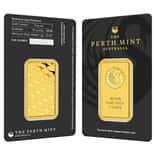
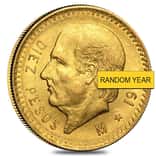
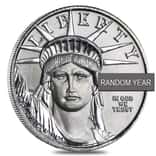
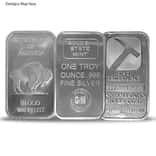
Today in precious metals, gold prices fell 0.05% to $1,910.45 per ounce. Silver dipped 0.67% to $22.89 per ounce. Platinum decreased by 1.21% to $897.50 per ounce, while Palladium spiked by 1.45% to $1,261.50 per ounce. Bitcoin jumped 1.63% to $26,264.00.
FAQs: August's Inflation Surge and its Implications
-
What was significant about August's inflation rates?
- August saw the most substantial inflation spike of the year in the U.S., with the Consumer Price Index (CPI) witnessing a seasonally adjusted increase of 0.6%.
-
How does the August inflation compare to last year?
- The August inflation pointed to a 3.7% increase compared to the previous year's figures.
-
What's the difference between the CPI and core CPI?
- The core CPI excludes volatile commodities such as food and energy, making it a more reliable metric for understanding long-term inflation patterns. In August, it grew by 0.3% monthly and 4.3% annually.
-
Which sectors were most affected by the inflation?
- Energy was notably impacted, with prices rising by 5.6%. Gasoline prices, a crucial part of this sector, surged by 10.6%. Shelter costs also increased by 0.3%, while airfares went up by 4.9%.
-
How did used vehicle costs fare in this inflation report?
- Used vehicle costs decreased by 1.2%, translating to a 6.6% drop year over year.
-
How does the housing market influence the current inflation rates?
- Shelter costs, which make up about a third of the CPI, have a significant impact on inflationary metrics. Without including shelter costs, the annual CPI rise would only be 1%.
-
How did the financial markets react to the inflation report?
- Stock futures faced a downturn immediately after the report but quickly recovered. Treasury yields also saw an uptick, affecting borrowing and saving rates.
-
What countermeasures has the Federal Reserve taken regarding inflation?
- The Federal Reserve raised its cornerstone borrowing rate by 5.25 percentage points in March 2022 to address the high inflation observed in the summer of that year.
-
Are there any predictions on the Federal Reserve's stance for the upcoming months?
- While many experts anticipate the Federal Reserve to bypass a rate hike in their next meeting, predictions for subsequent months carry some uncertainty. Some speculate about a 40% chance of a rate hike by November.