View Charts
From $29 to $74 in 2025: Can Silver Prices Reach $135–$309 in 2026?
 0
0
https://bullionexchanges.com/buy-silver/coins/us-silver-coins/american-silver-eagles
Silver’s Historic Breakout Has Rewritten Expectations
Silver’s rapid ascent in 2025 from roughly $29 per ounce to more than $74 in just one year has forced investors to rethink what is possible in the next phase of this precious metals cycle. Once viewed as a slower-moving counterpart to gold, silver has reasserted itself as one of the most volatile and potentially explosive assets in global markets. With supply deficits persisting, industrial demand accelerating, and major financial institutions revising their forecasts higher, the question is no longer whether silver can move further—but how far it could realistically go in 2026.
Bank of America’s Silver Outlook Shifts the Narrative
Much of the renewed attention around silver’s upside potential stems directly from Bank of America’s (BofA) research, which has outlined scenarios where silver prices could reach $135 to as high as $309 per ounce in 2026 under specific macroeconomic and market conditions. These projections are not short-term price calls, but cycle-based models that examine silver’s historical performance during periods of monetary stress, inflationary pressure, and extreme gold-to-silver ratio compression.
Bank of America’s analysis focuses on two key drivers. First, silver has consistently outperformed gold during the late stages of precious metals bull markets, particularly when investor participation broadens beyond early adopters. Second, when the gold-to-silver ratio compresses sharply—as it did in both 1980 and 2011—silver prices have historically accelerated at a multiple of gold’s gains. BofA’s upper-range scenarios assume a continuation of current supply deficits, sustained industrial demand growth, and a ratio compression toward historic extremes rather than averages.
The higher-end projections near $300 are tied to stress-case environments, including prolonged inflation, currency debasement, and elevated monetary intervention—conditions under which silver’s dual role as both a monetary metal and an industrial input becomes increasingly powerful. While not presented as base-case forecasts, these figures illustrate how quickly silver prices can escalate when structural constraints collide with rising investment demand.
By framing silver’s potential through historical ratios and structural supply dynamics, Bank of America’s outlook has helped legitimize discussions that once seemed overly aggressive. Rather than signaling speculation, these projections reflect how silver has behaved when similar forces aligned in past cycles—often faster and farther than most investors expected.
The Gold-to-Silver Ratio Signals More Room to Run
The gold-to-silver ratio remains one of the most important indicators for assessing silver’s long-term potential. While the ratio has recently moved closer to historical norms, previous bull markets show that silver’s strongest gains tend to occur when the ratio compresses well below average. In both 1980 and 2011, silver surged rapidly as the ratio fell dramatically, reflecting silver’s tendency to play catch-up once investor momentum shifts. If the gold price continues to strengthen while silver accelerates at a faster pace, the ratio could again compress—supporting significantly higher silver prices relative to gold.
Supply Deficits Enter a Sixth Consecutive Year
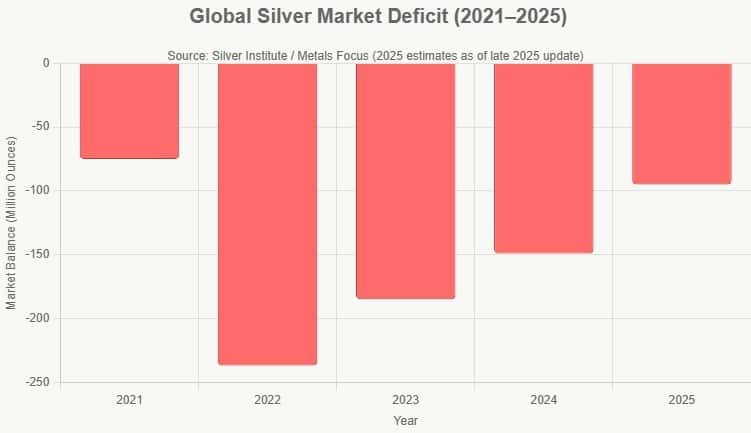
Perhaps the most compelling fundamental driver behind silver’s outlook is the ongoing global supply deficit. According to data from the Silver Institute, silver demand has exceeded mine supply for multiple consecutive years, with 2026 projected to mark the sixth straight annual deficit. Unlike gold, silver is consumed in industrial processes and is far less likely to be recycled efficiently at scale. This persistent imbalance between supply and demand tightens the physical market and reduces available above-ground inventories, amplifying price sensitivity during periods of rising demand.
Industrial Demand Is Reshaping Silver’s Market Role
Silver’s industrial importance has grown substantially over the past decade. The metal plays a critical role in solar panel production, electric vehicles, advanced electronics, and emerging AI infrastructure. As governments and corporations accelerate investments in energy transition and digitalization, silver demand continues to rise independently of investment flows. This dual role—as both a monetary metal and an industrial input—gives silver a unique advantage during periods of economic transformation, where demand drivers reinforce one another rather than compete.
Historical Parallels: Lessons From 1980 and 2011
History does not repeat perfectly, but it often rhymes. In 1980, silver experienced a parabolic rise driven by inflation fears and monetary instability. In 2011, silver surged again amid post-financial-crisis uncertainty and aggressive monetary easing. In both cases, silver’s move was swift and exceeded expectations once momentum took hold. While today’s market structure is different, the underlying themes—currency debasement, supply constraints, and investor demand for hard assets—remain strikingly familiar.
What Would $135–$309 Silver Require?
Reaching silver prices between $135 and $309 would not require unprecedented conditions—only a continuation and intensification of existing trends. Sustained inflation pressure, further monetary easing, expanding industrial demand, and continued physical shortages could all contribute. Historically, silver has demonstrated the ability to overshoot fair value during late-cycle rallies, particularly when investor participation broadens beyond early adopters.
What Investors Should Watch Next
Investors evaluating silver’s trajectory should monitor physical inventory levels, mining output trends, and updates from the Silver Institute regarding annual deficits. Movements in the gold-to-silver ratio, central bank policy shifts, and broader commodity market strength will also provide important signals. As the price of silver responds to both financial and industrial forces, volatility is likely to remain elevated—but so is opportunity.
Is Triple-Digit Silver a Stretch—or a Scenario?
Silver’s move from $29 to $74 in 2025 has already challenged long-held assumptions about its upside potential. While projections of $135–$309 may seem ambitious, they are rooted in historical precedent and current market fundamentals rather than speculation alone. In a world grappling with supply constraints, industrial transformation, and monetary uncertainty, silver’s next chapter may prove even more dramatic than its last. For investors willing to understand the dynamics at play, silver remains one of the most compelling stories in the precious metals market heading into 2026.